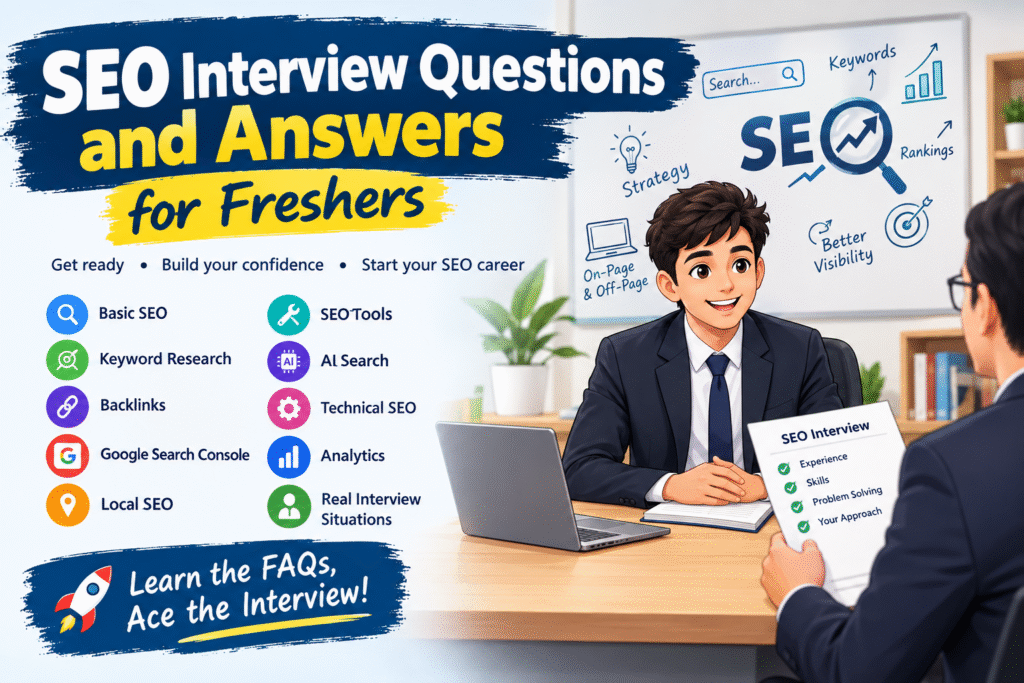
SEO Interview Questions and Answers for Freshers
Preparing for SEO interview may become a challenging task, especially when you are a Fresher and applying for your first SEO executive/ intern position. While conducting seo interview, the interviewer does not only test your understanding of SEO definitions but whether you understand working mechanism of the search engine, optimizing the website, analyzing the SEO problem, and measuring the success.
This guide presents you the most important seo interview questions and answers for freshers in 2026 from basic SEO to keywords research, backlinks, Google Search Console, local SEO, SEO tools, AI search, and practical SEO interview situations.
1. What is SEO?
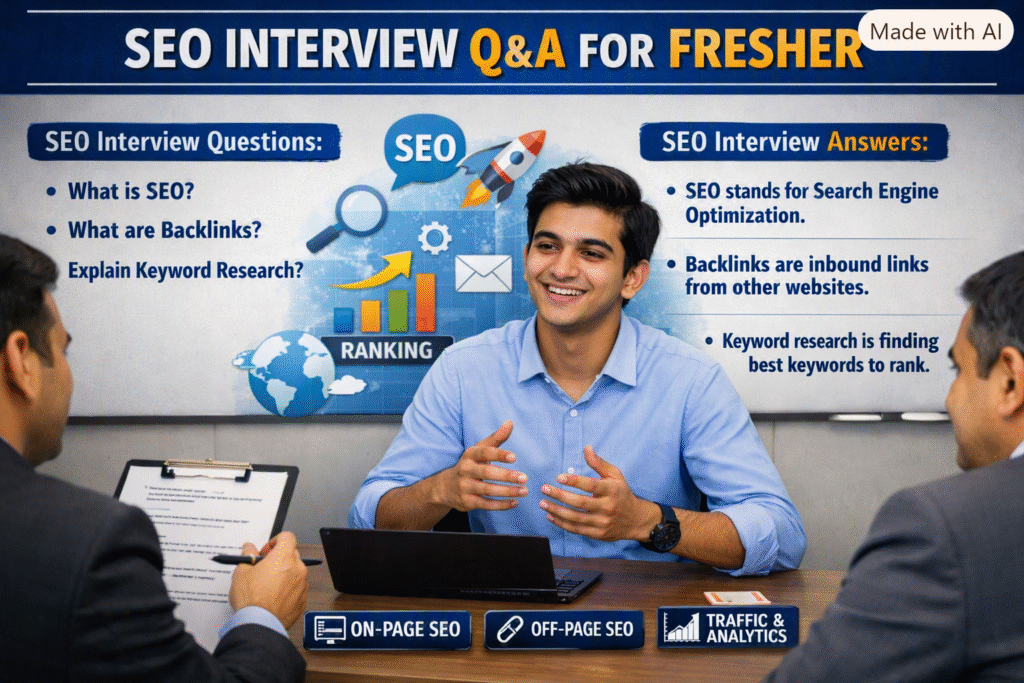
Search engine optimization refers to SEO. It involves the improvement of the website and the content so that it becomes more readable and understood by the search engines, and so that it is found by the users organically. SEO involves the following things: content optimization, technical optimization, internal linking, and site structure, and earning authority.
Interview tip: Never give the interviewee the impression that SEO means ranking a website.
2. How does SEO work?
Search engines operate in three broad ways:
Crawling, that is, searching and fetching web pages.
Indexing, where the information on the web pages is processed and stored.
Ranking, identifying the relevant web pages to be displayed for search queries.
SEO assists in this process of search engines knowing a website and improving the usability of its web pages.
3. Why is SEO important?
Search Engine Optimization can help organizations improve their organic visibility, acquire relevant visitors, get leads, establish credibility, and grow.The key difference between Search Engine Optimization and paid advertising is that organic search visibility doesn’t have to be paid for at all times.
4. What are the main types of SEO?
On page SEO
Technical SEOOff page SEOLocal SEOE commerce SEOInternational SEOWhat the actual SEO strategy will be, of course, depends on the site.
5. What is organic traffic?
Organic traffic can be defined as traffic coming from searches on search engines without having to pay for anything.
For example, in case one does a search on “SEO interview questions” on Google and he/she clicks on an unpaid link; that will be organic traffic.
6. Explain what is SERP?
SERP refers to the Search Engine Results Page. It refers to the search engine results page returned after the user makes an inquiry. It may have organic results, ads, featured snippets, local results, images, videos and other types of search features.
7. What is a keyword?
- A keyword is a term used to describe the search term used by the user.
- Example:
- SEO interview questions
- SEO course in Delhi
- Technical SEO checklist
- The SEO expert studies these queries in order to
- know what the user needs.
8. What is keyword research?
Keyword research is a process whereby you find and analyze the search queries related to your website or business.
Keyword research should consider:
Search intent
Relevance
Competition
Search demand
Business value
Keyword variations
9. What is meant by long tail keywords?
Long-tail keywords are specific keywords having several words.
Examples are
SEO interview questions for freshers in India”
which is more specific than:
SEO interview questions.”
These can prove useful since the purpose of the user’s search becomes clear
10. What is search intent?
Search intent is the motive behind a user’s search. The types of search intent are:
.Informational
Navigational
Commercial
11. What is on-page SEO?
On-page SEO is optimization of different elements of the page in such a way that it becomes relevant to both user and the search engine itself.
It can include:
- Content
- Title tag
- Headings
- URLs
- Images
- Internal links
- Structured content
12. What is a Title tag?
A title tag is an HTML tag that contains the title of the web page. The search engine utilizes the title tag to display it on the search result page.
13. Define the meta description?
Meta description is the HTML code that should describe the web page. It can be utilized by the search engines in order to depict a description of the web page. It should be understood that the meta description will feature accurate information about the web page and capture the interest of those who are concerned.
14. What is H1 Tag?
The H1 tag is used for identifying the heading of the web page representing its theme.
15. What is internal linking?
The term internal linking is understood as establishing links between pages on the same website.
This helps users navigate through other pages and search engines to establish relations between pages.
16. Define keyword cannibalization?
Keyword Cannibalization happens when the two or more pages compete against each other within the website because of same search intent.
This problem can be solved by SEO expert who will either optimize or separate the pages.
17. What is image SEO?
Image SEO means optimizing images for search understanding, accessibility, performance and user experience.
- Descriptive filenames
- Useful alt text
- Proper image dimensions
- Compression
- Modern image formats
- Relevant placement
18. What is alt text?
Alt text is the description of an image using text. This text can explain the image if the image fails to load.
19. What is technical SEO?
involves technical SEO elements of the website that impact crawling, indexing, and rendering of the website.
It can include:
- Crawlability
- Indexability
- Robots.txt
- XML sitemap
- Canonicalization
- Redirects
- Mobile usability
- Page performance
- Structured data
20. What is crawling?
Crawling is a process through which the search engines’ crawlers identify and then have access to web pages.
The location of the URL is done through links, sitemaps, etc.
21. What is indexing?
Indexing is the process through which the search engines index the data regarding web pages they discover.
22. Explain robot.txt?
This is a file that tells the crawler about which web page it can crawl and which it should not crawl.
Note: Robot.txt is not a Noindex command.
23. What is XML sitemap?
XML sitemap refers to a list of all the URLs of the website used for crawling the website.
This is particularly useful for bigger websites.
.24. What is the canonical tag?
It is employed to identify the preferred URL in case there are multiple URLs with almost identical or duplicate content.
It enables the search engines to determine which URL must be regarded as the main one.
25. What does 301 redirect mean?
301 redirect is the process of redirecting one URL to another URL.
Example:can be redirected permanently to:
This will allow users and search engine to access the new URL.
26. Define 404 Error?
A 404 Error simply indicates that the page is not available.
In the event of 404 error on an important page the decision about removal or redesigning of the page by the SEO professional will have to be taken.
27. What are Core Web Vitals?
Core Web Vitals are Google’s metrics for important aspects of webpage experience.
They currently include:
- LCP – loading performance
- INP – responsiveness
- CLS – visual stability
A useful interview answer should mention INP, because it replaced FID as the responsiveness metric in Core Web Vitals. Current competitor content also highlights this 2026-specific point.
28. Explain mobile-first indexing?
Mobile-First Indexing is one type of indexing that allows Google to index the mobile content on the website. It simply implies that the content which is to be indexed should be present in the mobile version of the website.
29. What is off-page SEO?
The Off-Page SEO comprises all activities done outside of your website to increase visibility and reputation of the website.
These are:
Gathering backlinks
Digital PR
Brand Mentions
Logical citations
Networking
30. Define backlink?
Backlink is the link which comes from other websites pointing to your website. In other words, if the website dealing with marketing puts a link to your SEO guide, you get a backlink from their website. But, SEO is not only about links and links; it is about quality here.
31. What does link building mean?
Link building is the technique of obtaining or generating backlinks to your site from other web pages. Link building should always involve quality content, relationship management, and relevant websites.
32. Define anchor text?
Anchor Text is the clickable text within the hyperlink.
33. Explain the difference between a do follow and a no follow link.
They are descriptions of link attributes which indicate the way in which search engines may treat certain links.A do follow link indicates that the website owner wishes that link to be treated normally as an endorsement link in the ranking process.
34. What is Local SEO?
Local SEO is the process of optimizing the visibility of a company in search results related to that geographic area.
Example:
Digital marketing institute in Delhi”
is an example of a local search query.
35. What is Google Business Profile?
Google Business Profile is the name of Google’s service to manage the listing of the eligible businesses in Google Search and Maps.
Businesses can enter their:
Business Name
Address
Phone number
Business Hours
Website
Services
PhotosReviews
36. How can you improve Local SEO?
A business can improve Local SEO by:
- Optimizing its Google Business Profile.
- Keeping business information accurate.
- Creating useful local content.
- Earning relevant local links and mentions.
- Getting genuine customer reviews.
- Creating useful location/service pages.
- Maintaining consistent business information.
37. Which SEO tools should a fresher learn?
A fresher should become familiar with:
- Google Search Console
- Google Analytics
- Google Keyword Planner
- Google Trends
- PageSpeed Insights
- Ahrefs
- Semrush
- Screaming Frog
However, just knowing the names of tools isn’t sufficient. You need to know what problems each tool solves for you.
38. What is Google Search Console?
Google Search Console is a product by Google that provides information to the webmaster regarding their website performance and ranking on Google Search.
It can help you get data on:
- Queries
- Clicks
- Impressions
- CTR
- Search position
- Indexing
- Search-related issues
39. Define Google Analytics.
Google Analytics is an analytics tool which aids in getting to know about user behavior on a certain website or application. The SEO professionals can make use of the analytics tool for getting to know about organic traffic, engagement, conversions, etc.

40. How do you measure SEO success?
I would not measure SEO success using rankings alone.
I would monitor:
- Organic clicks
- Impressions
- CTR
- Keyword visibility
- Organic traffic
- Leads
- Conversions
- Revenue
- Engagement
- Indexed pages
41. Your website traffic suddenly drops. What will you check first?
I would investigate systematically:
- Check Google Search Console.
- Compare the date of the traffic decline.
- Identify which pages and queries lost clicks.
- Check whether impressions also declined.
- Check indexing issues.
- Review technical changes.
- Review recent content changes.
- Investigate possible algorithm-related changes.
I would avoid making random changes before identifying the cause.
42. A page is indexed but not ranking. What would you do?
I would analyze:
- Search intent
- Content quality
- Top-ranking competitors
- Keyword targeting
- Internal links
- Page structure
- Topical coverage
- Backlinks/authority
- Technical issues
- User experience
Then I would improve the page based on the actual search intent rather than simply adding more keywords.
43. How do you carry out your SEO technical audit?
This is how I conduct my SEO technical audit:Crawling indexing site architecture URL canonical redirect sitemap robot txt mobile usability performance internal linking structured data broken pages
44. How would you conduct keyword research?
The process that I will follow is:
Understanding of the business.
Defining the target audience.
Creating the seed keywords.
Generating more keywords using SEO tools.
Analyzing the search intent.
Analysis of the competition and SERP.
Classification of the related keywords.
Assigning of the keywords to appropriate pages.
45. What does E-E-A-T stand for?
E-E-A-T means:
Experience
Expertise
Authoritativeness
Trustworthiness
It is a model for evaluating certain characteristics of content and authors/sites in Google Search Quality Rater Guidelines. It is essential to note that E-E-A-T is not a score in itself.
46. What is AEO?
AEO means Answer Engine Optimization. The main point of AEO is optimizing content in order to make it more answer-friendly.
For example, providing clear answers, good headings, definition, FAQ, etc., could be helpful.
47. What does GEO mean in SEO?
GEO may mean Generative Engine Optimization. The point of it is making sure that good and trustworthy information from your content would be included in answer-oriented search experience created by AI. Considering fast development of AI search engines, it is better for SEO specialists to concentrate on good content, structure of information, accuracy and other factors.
48. What are AI Overviews?
AI Overviews are summaries generated by AI that may show up on Google Search for some searches. To SEO practitioners, this indicates that the SEO ecosystem is widening its scope from conventional blue links. Consequently, the content needs to be both valuable, factual, and organized enough to fulfill the user’s real intention. The current SEO interview resources in 2026 now feature AI Overviews among other SEO concepts.
49. Your competitor ranks above you. What would you analyze?
I would compare:
- Search intent
- Content depth
- Content quality
- Page structure
- Topical coverage
- Internal linking
- Backlink profile
- Website authority
- Technical performance
- SERP features
I would identify content gaps and user needs that my page can satisfy more effectively.
50. The website has many backlinks, but it ranks poorly. Why?
Just because the number of backlinks is more does not imply that the rankings will be improved.Some of the possible reasons are:Backlinks of low qualityRelevance issuesBacklink manipulation techniquesBad content Mistaken search intent
Technical issues
Internal linking issues
Poor website authority
Bad user experience
51. How can you enhance the ranking of the page in position 8?
I would first analyze the SERP and competing pages.
Then I would look for opportunities to improve:
- Search intent alignment
- Title and snippet appeal
- Content completeness
- Original insights
- Internal links
- Relevant entities/topics
- Page experience
- Supporting backlinks
The goal would be to make the page more useful and relevant, not simply increase keyword density.
52. How would you recover a page after losing rankings?
I would compare the page before and after the decline and investigate:
- Search Console data
- Search intent
- Competitor changes
- Content changes
- Technical issues
- Indexing
- Internal links
- Backlinks
- Major Google changes
Then I would create a recovery plan based on the diagnosed problem.
53. Why would you like to be in SEO?
“I am keen on SEO as this field is based on content, data, technology and problem solving. It allows me to analyze what people are searching for and how to make the content and website suitable to reach out to the desired audience organically.”
54. Which SEO tools have you used?
In my work, I have utilized SEO tools including Google Search Console, Google Analytics, Google Keyword Planner, Google Trends and SEO platforms to conduct keyword and competitive research. I am furthering my practical experience tools.”
55. How do you react if your SEO strategy is not working?
Initially, I will look into all the data before concluding that the SEO strategy isn’t working. I will review all the ranking positions, impressions, clicks, traffic, indexing, technical aspects, and search intents.” SEO Interview Questions That Can Impress an Interviewer These should be added to your article since they make it more practical than an ordinary listicle.
56. Do all web pages need keywords?
No. The first thing that matters about a page is that it should be able to satisfy the unique needs of the visitor. Keywords matter in understanding the need, but not in building web pages.
57. Is ranking first the most important KPI for SEO?
This need not always be the case. Rankings are quite good but it’s also important to measure success in SEO in terms of clicks, traffic, leads, conversions and sales.
58. Is keyword density important?
The concept of keyword density is dead. You need to use relevant terminologies within the copy while addressing the intent of the searchers.
59. Can SEO guarantee ranking number one?
Not at all. No SEO expert in his right mind can claim to get you a number one ranking position permanently on Google search.

60.What is the most important SEO skill for a fresher?
Problem-solving skills and good fundamentals. A fresher with good problem-solving ability and understanding of SEO concepts will perform better than a fresher who knows only the SEO terminologies by rote learning.
- SEO Interview Preparation Checklist
- When getting ready for the interview, be prepared to provide answers on:
- SEO basics
- SEO
- SERP
- Organic traffic
- Search intent
- Keywords
- Crawling
- Indexing
- On-Page SEO
- Title tag
- Meta description
- H1
- URLs
- Internal links
- Image SEO
- Robots.txt
- Sitemap
- Canonical
- 301
- 404
- Mobile-first indexing
- Off-Page SEO
- Backlinks
- Link building
- Anchor text
- Link attributes
- Digital PR
- Tools
- Search Console
- Analytics
- Keyword Planner
- Trends
- Semrush
- Ahrefs
- Screaming Frog
- Modern SEO
- E-E-A-T
- AI Overviews
- AEO
- GEO
- Practical SEO
- Traffic drop
- Ranking drop
- Competitor analysis
- Keyword research
- Technical audit
- Measuring SEO performance