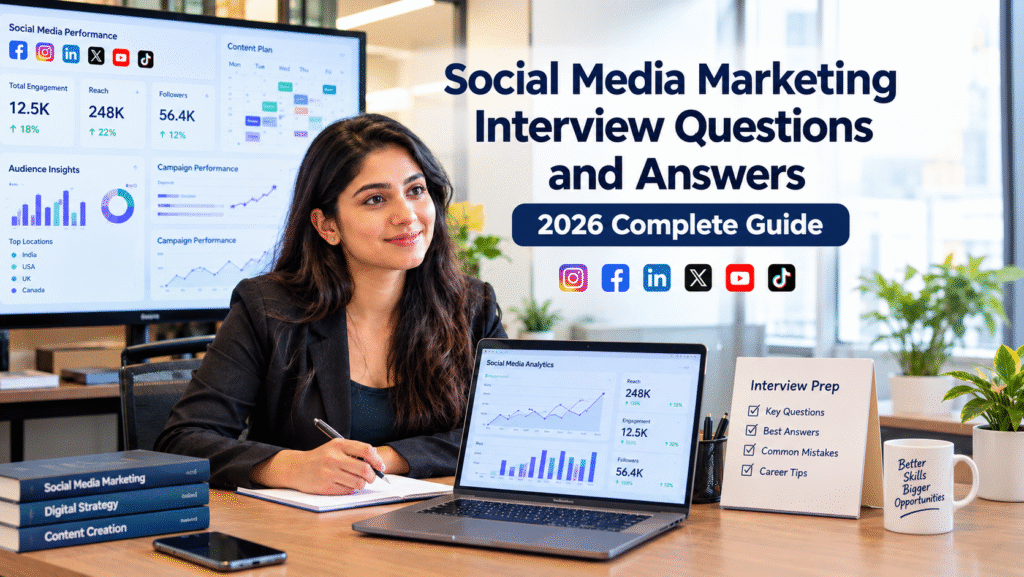
Landing a job in social media marketing is no cakewalk. As more and more brands establish their web presence, interviewers are now expecting answers from candidates on these social media marketing interview questions Strengths in Strategy Analytics Content Paid campaigns AI-enabled toolsWhether you are a fresher or someone with experience aiming for the position of senior social media manager, this guide includes all the important Social Media Marketing Interview Questions and Answers that you can expect. Every question comes with a sample answer and breakdown of what the interviewer is looking for.
What this guide will help you with:
✅Interview Questions and Answers
✅Platform knowledge and strategy questions
✅Content creation and community-building questions
✅Analytics, ROI, and performance questions
✅Crisis management and reputation questions
✅Advanced and situation based queries for experienced candidates
✅Questions to ask your interviewer
✅Red flag avoids and honor tips sprinkled throughout
What Are Interviewers Seeking in Candidates for Social Media Marketing:
It is helpful to know the four pillars that every interviewer mentally assesses before we get into the questions:
➡️Strategic Thinking — Can you weave social media targets into larger business plans? Aren’t you, for instance, confused between tactic (posting 3x a week) and strategy (develop brand authority in a niche)?
➡️Platform Know–Do — Do you understand how the Instagram algorithm is different from LinkedIn? Do you know which platform goes well with which audience and business type?
➡️Analytical Ability — Can you quantify success ahead of a campaign, measure it in context and use the data to make decisions (not just report numbers)?
➡️Adaptability — Social media is a dynamic landscape. Through various interviews, you will see that interviewers are looking for the ability to get ahead of the changing landscape of algorithms, platforms and consumer behavior.
➡️As you work your way through each section below, have these four pillars in mind – and make sure that your answers reference one or more of them whenever possible.
1. General Social Media Marketing Interview Questions
Q1. How do you keep up with the latest social media trends?
I follow a combination of publications every day Sprout Social’s blog for insights driven by the data they collect, Social Media Examiner for tactical advice from industry experts, and LinkedIn thought leaders like Matt Navarra who shares platform news as it happens. I reserve time every week to test new features on my profiles outside of the work-related analysis for instance, on launch day for Threads I tried it out personally as well so that I can write informed opinions rather than simply repeating what others say.
Q2. Which brands in your opinion have great social media strategies and why?
They knew that Gen Z has an expectation for self-aware brands with a flair for self-deprecation. They developed a brand personality (rather, made their corporate face somewhat more human) based on absurdist humour and what they believed to be the trends of conversation in societies at that point. The genius of it is that it’s low-budget, high-creativity genuine over shiny, right? as ever authentically consumer-focused usually outperforms. You’d use that same principle of meeting the audience where they are emotionally not just literally scrolling.
Q3. Describe the most demanding social media campaign you have managed. What did you learn?
I managed a campaign with a stressed deadline and short budget. I learned the importance of careful planning, audience targeting, regular performance tracking, and quickly adjusting content based on results.
Q4.differentiate between B2B vs B2C Companies?
B2B social media marketing focuses on building professional relationships, generating leads, and sharing industry insights, while B2C marketing focuses more on engaging consumers, building brand awareness, and driving quick purchases through entertaining and emotional content.
2. Platform-Specific Social Media Marketing Interview Questions
Q5. What social media sites would you choose to invest your time in for a new biz and why?
The best visual discovery potential on younger demographics for a consumer lifestyle brand is in Instagram. LinkedIn for a professional services firm, this is non-negotiable.
Q6. How does the Instagram algorithm work and how does that affect your strategy?
Instagram currently giving preference to saves and shares versus passive engagement likes, because saves and shares show strong potential content. He said it impacts pro-accounts that leverage platform-native features particularly Reels and prioritizes content from accounts users have engaged with recently.
Q7. When you go to LinkedIn marketing, how do be different than Instagram?
LinkedIn’s audience is in a business frame of mind career progression, industry challenges, how to improve business results. The context calls for an entirely different tone and content type.for long-form content that shares actual insights related to the professional, meaning real case studies with quantifiable numbers and other behind-the scenes elements which humanise the knowledge of what the brand represents.
Q8. How do you build an organic social media following from scratch?
Exit for play-to-earn games due to its human controlled modes and fully user generated, You need a niche, real value consistently fed into the community, be present in it. The way I work is with what I call the 80/20/80 rule: 80% of your content should actually serve the needs of the audience 20% can be promotional and finally, you spend an extra 80% of your time beyond posting to engage comment on others’ content, reply to everyone who leaves a comment and join popular conversations.
3. Social Media Content Questions
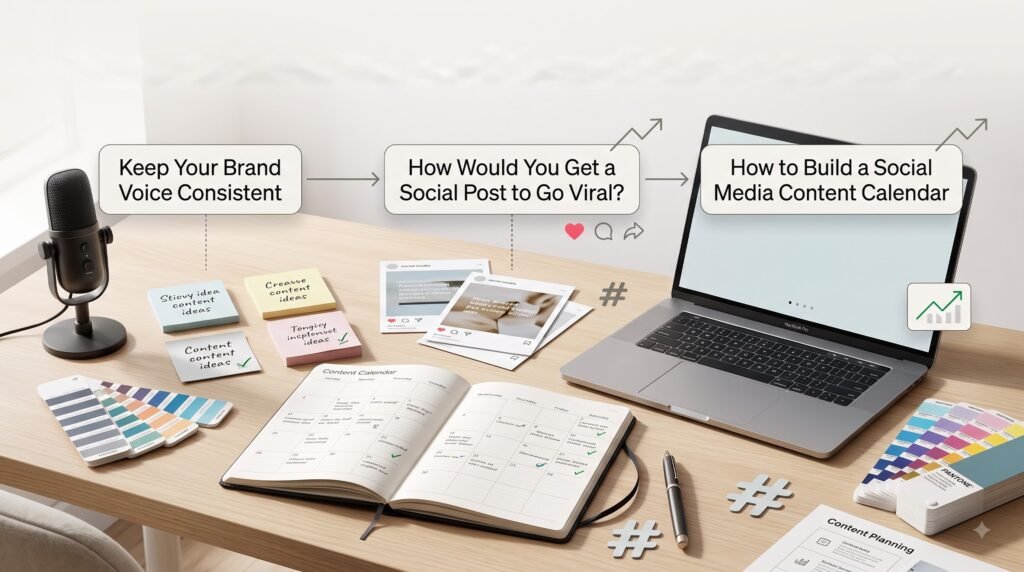
Q9. How To Keep Your Brand Voice Consistent Across Social Media Channels
I would begin creating a Brand Voice Guide that is, a living document that outlines three to five key personality traits, on-brand and off-brand examples of language use, and platform-based tone guidelines. One example of this could include the brand is our ‘confident, but never arrogant’ across touch points with that confidence being communicated through punchy one-liners on Twitter/X and expert analysis on LinkedIn.
Q10. Walk us through how you build a social media content calendar.
I back into business goals and key milestones. Every month that I work, I begin by mapping the month: PRODUCT LAUNCHES? Third, I find content pillars typically 4–6 themes that are repeated in a way that keep it imbalanced across educational, entertaining, inspirational and promoting. My spreadsheet with Platform, Format, Caption draft, Visual brief, Post time and KPI target in columns. I plan minimum two weeks ahead, giving myself time to design it, send for review and approval but still keep 20% of the calendar open for content trending in real-time. I perform a monthly audit to kill weak formats and double up on what is working.
Q11. How would you get a social post to go viral?
When content generates emotion, feels relevant in the moment and is digestible text that gives people enough reasons to tag someone or share it on their story. In reality, I think about this: Starting with an incredibly interesting hook in the first two seconds for video or the first line of text; linking it to some trending conversation or cultural moment; both resonate across a broad audience but rooted within one niche; and sowing in some early engagements from employees, partners, community members to give the algorithm signals right away.
4. Analytics, Metrics, and ROI Questions
Q12. How would you measure the ROI for your social media campaign?
ROI evaluation begins early in the campaign. Firstly, I determine what will constitute success with my stakeholders whether that be awareness, leads, sales, or retention and set the appropriate metrics to measure. If my objective is lead generation, my metrics include CPL, conversion rate, and lead quality, while if my objective is brand awareness, the metrics become reach, share of voice, search volume, and sentiment. In terms of tracking campaigns, I make use of UTM parameters within GA4 to calculate ROAS.
Q13. What Social Media Metrics Do You Monitor Regularly, and Which Are the Most Important?
Metrics are tied to campaign objectives, reach and impressions for distribution, engagement for resonance, click-through rate for intent, and conversions for results. I care about real results, not metrics such as impressions or numbers of followers.
Q14. What tool are you using for social media analysis and reporting?
For organic analytics, I employ native analytics such as Meta, LinkedIn Reporting is done using Sprout Social or Hootsuite, whereas Semrush and Brandwatch are used to track competitors. The paid campaigns will be created with the aid of Meta Ads Manager, GA4 and UTM tracking, and Canva.
5. Questions on Community Management and Engagement
Q15. How to Build and Engage an Online Community?
All this falls into community building it is about posting great content for conversations, not just posts. I notify people on commentary, create dialogues with questions and polls and showcase user-generated material. Specifically, it’s a way to facilitate connections between followers (not just with the brand, of course).
Q16. How will you respond to undesirable publicity or reviews on social media?
Act fast, keep your cool, and handle it out of the line of fire.respond as necessary and provide a promise via customer support. I also search for complaints that have continuity in time, since they can indicate a larger problem with the product or service.
6. Crisis Management and Reputation Questions

Q17. Have you ever been at the helm of a social media crisis? How did you handle it?
I have never personally sat at the head of a table during an executive crisis, but I have studied real case studies. My first step would be to move fast, be open and communicate with empathy. I would notify the appropriate teams, publicly admit to the problem, provide updates as needed and concentrate on a more straightforward solution.
Q18. What will you do if a team member posts something inappropriate from the business account?
I would delete the post immediately, screenshot it then evaluate. Then I would communicate talk with the team member. finally , I would audit approval and access policies to ensure it does not occur again.
7. Advanced Interview Questions for Experienced Professionals
Q19. How to Build from Scratch a Social Media Strategy for a New Brand
I would research about the target audience and competitors, and decide what goals and key performance indicators to go after. Then I will select the platforms to define the main content and brand tone, and develop a 90-day action plan.
Q20. How do you achieve buy in from stakeholders for your social media strategy?
To ensure stakeholder approval of your social media strategy, it’s important to focus on business results, not just social media metrics, to connect social activities to such goals as generating leads, sales, and customer retention.
Q21. What is Your Strategy to Integrate Social Media with SEO and Content Marketing?
Social media, SEO, and content are integrated by me in my strategy, instead of being separate from each other. The social side is useful to figure out the topics that people are interested in, while SEO articles can also serve as social posts.
8. Essential Social Media Marketing Interview Questions for Freshers and Students
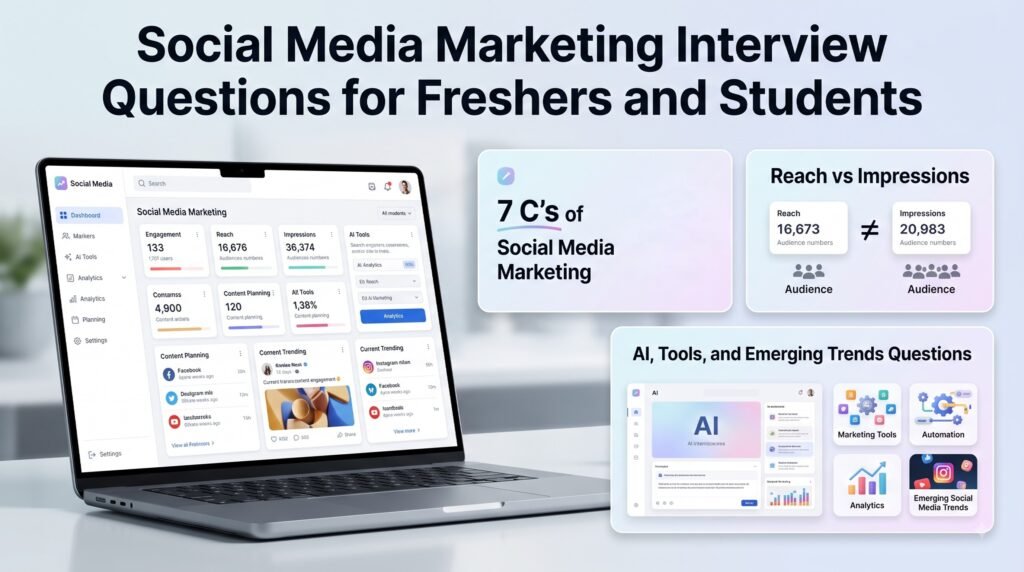
Q22. You have no experience outside of october 2023 you don’t know what professional is. Why should we hire you?
I have dedicated the last year to grow my ego and social media presence I expanded my own personal @instagram account from 0-2400 followers in eight months by experimenting with various content types, analyzing my analytics on a weekly basis as well as researching what works. Also, I know well the tools that your team uses and have completed [where you did some certification example: HubSpot’s Social Media Marketing course or Google Digital Garage]. I simply bring passion, data-driven thought and the willingness to learn at a quicker rate than someone who may be comfortable in their habits. I’m also aware of platform updates such as [specific recent update] because I monitor this daily.
Q23. List out the 7 C’s of social media marketing.
Content, Community, Conversation, Channels, Context, Connection, and Conversion. The 7 C’s altogether signify a holistic approach towards social media marketing which means you must have the correct content, delivered through correct channels, delivered in a context which is relevant to your audience, and which will actually help you create conversations, connections, community and eventually conversions. Most brands today only concentrate on the first and last aspects i.e., content and conversion and ignore everything in between.
9. AI, Tools, and Emerging Trends Questions
Q24. How will you be using AI to help with the work that you do for social media marketing?
AI has entered my daily workflow, but only with specific reasons. I leverage AI tools (Claude or ChatGPT) to speed up the first pass of captions, content angles, and repurposes longer form content into platform-native formats but always edit until it reads like us as human beings. For the making of images, I take advantage of either Midjourney or Canva’s AI tools for concept visuals. On analytics, I use AI features in tools like Sprout Social to find content trends and the best times to post. The number one difference I always make is that while AI augments the labor it does not replace the strategy, the judgment, or creativity that makes social media marketing work.
Q25. Which social media trends are emerging in 2026 that brands need to keep an eye out for?
There are a number of trends taking place right now. The first is social search TikTok and Instagram have begun to operate like search engines in their own right, particularly amongst young people, which has made SEO applicable to social content. Another trend is that the creator economy is beginning to mature and that collaborations between brands and creators are getting to be more performance-driven. The third trend is that the rise of AI-generated content has created a big opportunity for brands that focus on authentic storytelling. The fourth trend is that social commerce is gaining momentum.
10. Technical Social Media Marketing Questions

Q26. What is the difference between reach and impressions?
Reach refers to the number of different users who are exposed to your content, while impressions refer to the number of times that your content is viewed by those users.
Q27. How would you compute for engagement rate?
Engagement Rate = (Number of Engagements ÷ Number of Reach) x 100
Engagements refer to likes, comments, shares, saves, among others.
Q28. What is a social media content calendar?
The social media content calendar is an overview of all the content to be published and when. It normally has information about the type of content to post, the format, caption, hashtags, creatives, campaigns, among others.
Q29. How does SEO complement social media?
Social media may be used to distribute the content, raise its visibility, bring referral traffic, and engage the audience. SEO keyword research may also be helpful in coming up with social media content. Although social signals do not rank on Google, social media may promote the content’s visibility.
Q30. Organic social media vs paid social media
Organic social media is content without any spending behind it (non-paid advertisement) such as posts, Reels, Stories and Community. Paid social media is paid advertising budget targeted towards specific goals and target audiences to generate traffic, leads or sales.
Conclusion
Becoming a social media marketing pro takes creativity, strategy, analytics and communication and practice. Good news is that grappling with platforms, content planning and creation, audience engagement strategies, paid promotion visibility tactics and performance measurement can turn you into a confident digital marketer as this guide demonstrates! Even for students and prospective professionals to get practical exposure also matters as much as theoretical. NSIM is a digital marketing company that enables you to develop actionable skills, work on real projects, learn industry tools and the execution process of digital campaigns. Those who all are interested to make their career in Social Media Marketing can join at NSIM and know the internal industry working.