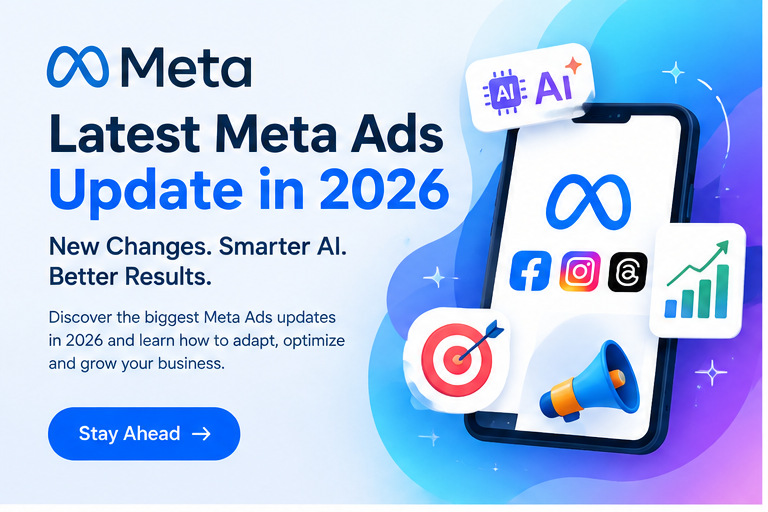
Advertising has changed a lot in 2026. Facebook advertising and Instagram advertising are getting more automated. Artificial intelligence is playing a part in how advertising campaigns are optimized how audiences are found how creative is delivered and how advertising performance is predicted.
For advertisers the old way of making small ad sets controlling every audience by hand and changing things often is no longer as important. Instead advertisers should put focus on creative ideas, reliable conversion signals, wider testing and simpler campaign structures.
Meta has also. Expanded changes around attribution AI-powered advertising tools, reporting, placements, APIs, billing and other parts of its advertising ecosystem.
This guide explains the Meta Ads update in 2026, in simple language and shows what businesses and Digital Marketers should actually do about these changes.
What Is the Latest Meta Ads Update in 2026?
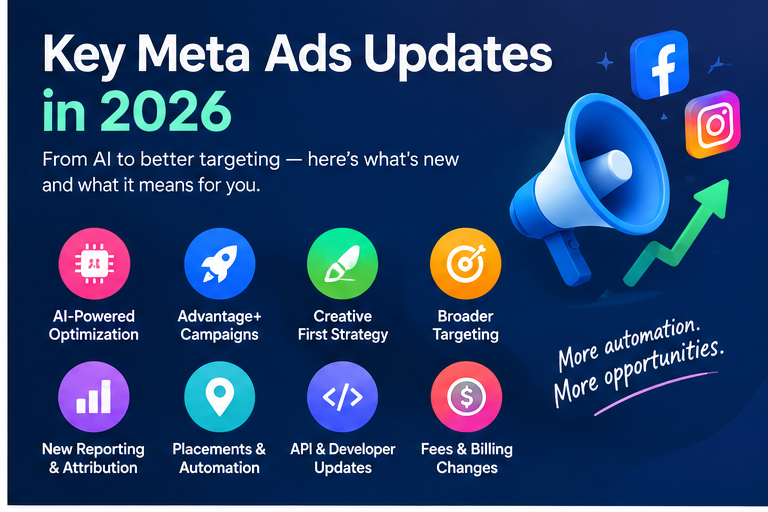
The biggest Meta Ads changes in 2026 can be grouped into areas:
1. AI helps run campaigns better.
2. Advantage+ automation lets Meta do automatically.
3. Creative-first advertising means the ad design comes first.
4. Attribution and measurement are changing.
5. Audience discovery is getting broader.
6. Placement optimization is now automated.
7. Ai creative tools appear.
8. Reporting and Ads Manager get updates.
9. Meta API changes come.
10. New advertising chances spread across Metas ecosystem.
11. Conversion signals become more important.
12. Some markets see changes.
The important point is that Meta Ads in 2026 are becoming more automated.
Of advertisers manually controlling every part of a campaign Meta increasingly uses machine learning to decide which users, placements and creative variations are most likely to produce the desired result.
Meta has publicly described AI as a driver of value for businesses and advertisers, in 2026.
Major Meta Ads Changes in 2026:
1. AI Is Playing a Bigger Role in Meta Advertising:
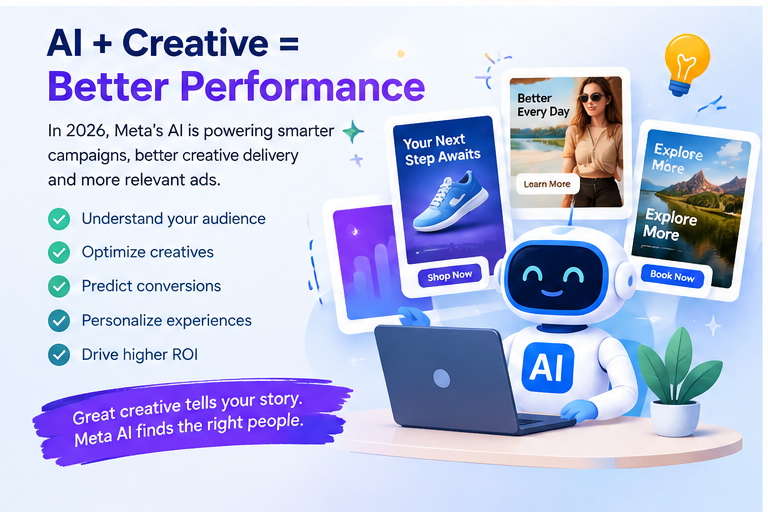
One of the trends, in Meta advertising this year is the growing use of artificial intelligence.
Artificial intelligence is becoming important across parts of the advertising process including:
1. Audience discovery
2. Creative optimization
3. Campaign optimization
4. Conversion prediction
5. Personalisation
6. Content generation
7. Performance analysis
This changes the job of a marketer.
Of spending most of the time manually adjusting targeting marketers should spend more time understanding customers, offers, creative concepts and conversion data.
What should advertisers do?
Use intelligence as a tool to make things better instead of thinking of it as a substitute, for marketing plans.
A great mix is:
strategy + strong creativity + good data + Meta AI optimizatio
2. Advantage+ Campaigns Are Becoming More Important:
Advantage+ automation is one of the important changes in Meta advertising. Meta is pushing advertisers to let its system handle more of the campaign delivery of building very complex manual setups. This can involve automation for:
1. Audience selection
2. Placements
3. Budget allocation
4. Creative delivery
5. Campaign optimization
News about the 2026 algorithm change also shows a move, toward targeting and simpler campaign setups.
Why does this matter?
Suppose you create 10 ad sets, for interests.
The old method might require you to decide which audience receives which creative.
With automated Meta campaigns the system can use its own signals to find people the system believes are most likely to complete the objective you have chosen.
Practical recommendation:
Do not automatically create dozens of ad sets.
Instead:
1. Start with a campaign objective.
2. Use creative variety so the audience stays interested.
3. Give the system conversion data.
4. Avoid fragmentation that splits the audience too finely.
5. Monitor performance closely, before making changes.
3. Creative Is Becoming More Important Than Micro-Targeting:
This is one of the biggest strategic lessons from the 2026 Meta Ads environment.
Nice Digitals’ analysis describes the shift toward creative-driven delivery and highlights Meta’s Project Andromeda as a major development in how the system evaluates creative and audiences.
In simple terms:
Your creative can help Meta understand who may respond to your advertisement.
That means two advertisers targeting broadly can still achieve very different results because their creatives communicate different messages.
What Makes a Strong Meta Ad Creative?
I believe this is one of the strategic lessons that emerged from the 2026 Meta Ads environment.
Nice Digitals analysis talks about the shift toward creative‑driven delivery. Points out Metas Project Andromeda as a major development, in how the system evaluates creative and audiences.
In terms:
Your creative can help Meta understand who may respond to your advertisement.
That means two advertisers who target broadly can still achieve different results because their creatives communicate different messages.
What Makes a Strong Meta Ad Creative?
Your creative should quickly communicate:
1. What are you offering?
2. Who is it for?
3. Why should someone care?
4. What problem does it solve?
5. What should the user do next?
For example of creating five almost identical ads with different headlines test genuinely different concepts:
A: Problem-Focused – Highlight a common customer problem and show how your solution can address it.
B: Customer Testimonial – Share genuine customer feedback, experiences, and results to build trust.
C: Before-and-After – Show the difference between the situation before using the product or service and the results afterward.
D: Educational – Teach users something useful related to your product, service, or industry.
E: Offer-Focused – Clearly communicate discounts, special offers, benefits, or limited-time deals.
F: Product Demonstration – Show how the product or service works through a simple, engaging demonstration.
This gives the system more meaningful creative signals to work with.
4. Creative Diversity Matters More in 2026:
Creative testing is not about changing one word in the headline.
True creative diversity is, about changing the idea changing the message changing the presentation or changing the angle.
Examples of Creative Variations:
For a marketing course you could test:
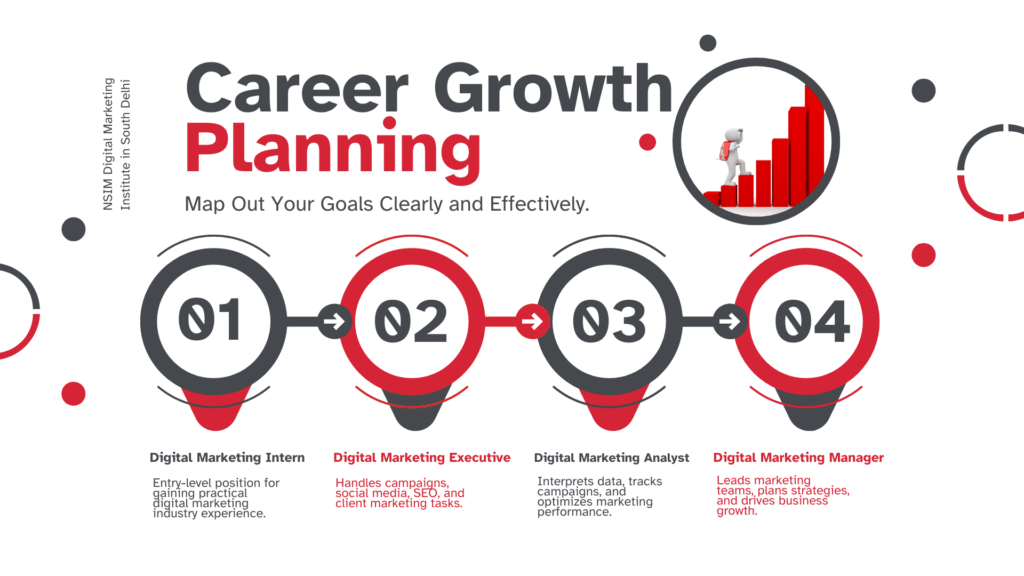
- Career Growth – Show how digital marketing skills can help learners build and develop their careers.
- Job Placement – Highlight placement support, interview preparation, and opportunities available after completing the course.
- Learn Google Ads – Focus on practical Google Ads skills, campaign creation, keyword research, bidding, and performance tracking.
- Learn SEO – Explain how students can learn keyword research, on-page SEO, technical SEO, link building, and SEO analytics.
- Student Success Story – Share a student’s learning journey, skills gained, projects completed, and career progress.
- Course Benefits – Highlight practical training, live projects, certifications, expert guidance, and industry-focused learning.
- Beginner-Friendly Learning – Emphasize simple lessons, step-by-step training, practical examples, and support for students with no prior experience.
The visuals can also change:
1. Talking-head video
2. Classroom video
3. Student testimonial
4. Screen recording
5. Animated explainer
6. Carousel
7. Short-form video
The objective is to discover which idea resonates with which users, not to produce more advertisements.
5. Meta Attribution and Measurement Have Changed:
One of the important changes in operations that AdManage covers is Metas 2026 attribution reclassification.
This change impacts how advertisers understand conversion data, including the difference, between click-based actions and engagement-based actions.
This is important because your Ads Manager numbers might not always match with reports.
Why Attribution Matters?
Imagine your campaign generated:
1. 100 Conversions month
2. 90 Conversions this month
You might think performance went down.
If Metas way of measuring or how they categorize conversions has changed, comparing the two numbers without knowing about the reporting change can lead to the wrong idea.
What should advertisers do?
When looking at performance:
1. Compare the reporting definitions.
2. Check attribution settings.
3. Look at conversion trends over time.
4. Use your website analytics along with Meta reporting.
5. Focus, on business outcomes, not platform metrics.
6. Conversion Tracking Is More Important Than Ever:
As the system, from Meta becomes more automated good data becomes more important.
If Meta gets conversion signals its optimization system has less trustworthy information to use.
Important Tracking Components?
Advertisers should regularly check:
1. Make sure to check Meta Pixel.
2. Make sure to check Conversions API.
3. Make sure to check events.
4. Make sure to check Custom conversions.
5. Make sure to check Event matching.
6. Make sure to check Domain configuration.
7. Make sure to check Deduplication.
8. Make sure to check Purchase/lead values.
Why Clean Data Matters?
Imagine Meta is focused on getting leads.
If your system sends:
1. Duplicate leads,
2. Incorrect events,
3. Missing values,
4. Poor-quality conversions
Meta might use that flawed data to learn.
That can lead to bad decisions.
The outcome? Inefficient delivery.
Clean data → signals → smarter choices.
Better data means results.
7. Broad Targeting Is Becoming More Useful:
One of the changes in Meta advertising is moving away from too many audience limits. Advertisers used to create audiences such, as:
1. Facebook interest A
2. Facebook interest B
3. Facebook interest C
4. Lookalike audience A
5. Lookalike audience B
But automation lets Meta use behavioral signals to find potential customers. This does not mean that targeting is useless. Meta advertising means that marketers should think about whether many restrictions are stopping the system from finding valuable users.
When Should You Use Broad Targeting?
Broad targeting can be useful when:
1. You have conversion data to rely on.
2. Your product can appeal to a group of people.
3. Your ad makes the offer very clear.
4. You can track conversions without errors.
For products that’re very specific or when location matters or when the customer needs are very particular tighter targeting may still be a better choice.
8. Advantage+ Placements and Automated Delivery:
I notice that Meta keeps urging advertisers to use automated delivery throughout its ecosystem. Depending on the campaign and objective this can involve placements in areas such, as:
1. Facebook Feed
2. Instagram Feed
3. Instagram Stories
4. Instagram Reels
5. Facebook Reels
6. Audience Network
7. Other eligible Meta placements
Metas Audience Network has also added full‑screen ad formats that aim to boost engagement and simplify in‑ad browsing.
Should You Manually Select Placements?
Not always.
Before you start limiting placements ask yourself:
Is this placement really delivering business results?. Am I just not fond of it and want to switch to something else?
Test how it performs before you take it away.
9. Meta Is Expanding AI-Powered Advertising Tools:
AI is not just for delivering campaigns.
Meta is also growing AI features across its system.
Metas 2026 product announcements show an effort, toward AI-powered creation, personalization and business interactions.
This opens up chances for advertisers to:
1. Make creative versions quicker
2. Customize marketing experiences
3. Make customer communication better
4. Come up with content ideas
5. Handle jobs
6. Make campaign processes better
The key thing is that AI should make testing faster without making creative quality worse.
10. Meta Ads Are Becoming More Important for Commerce in India:
For advertisers the shift toward AI‑powered commerce is especially important.
Meta’s 2026 India research shows a shopping journey that can start with content, creators and messaging and can end with a purchase. Meta has also shared results from AI‑powered omnichannel optimization among retailers. (About Facebook)
Meta is particularly relevant, for :
1. E‑commerce brands
2. D2C businesses
3. Local businesses
4. Education companies
5. Service businesses
6. Beauty brands
7. Fashion brands
8. Restaurants (Retailers)
What Indian Advertisers Should Focus On?
Indian campaigns should consider:
1. Mobile‑first creative
2. Reels
3. Regional‑language content
4. WhatsApp conversations
5. Lead‑generation campaigns
6. Local offers
7. Creator content
8. Strong landing pages
9. Follow‑up
A lead is not valuable simply because Meta reports it.
The real goal is leads and revenue.
11. Threads and the Wider Meta Advertising Ecosystem:
Metas advertising ecosystem is no longer about thinking about Facebook and Instagram.
Threads is becoming part of the Meta advertising conversation as Meta keeps growing its business and developer ecosystem.
AdManages 2026 update specifically points to the growth of the Threads Marketing API along, with advertising infrastructure changes
For marketers this means the Meta ecosystem should be seen as a larger network instead of just one advertising placement.
12. Meta Ads Manager Is Becoming More Automated:
The Ads Manager experience is also changing.
Advertisers may notice updates in:
1. Campaign creation
2. Recommendations
3. Reporting
4. Creative tools
5. Conversion reporting
6. Optimization options
The direction is clear :
Meta wants advertisers to spend time adjusting every technical detail and more time giving the system solid input.
That means the advertiser’s role is shifting toward:
Strategy → Creative → Data → Testing → Analysis
of:
Manual targeting → Manual placement, → Constant editing
13. Meta Ads Billing and Regional Fees:
Another important development for 2026 is that some advertisers may have to pay location-based fees.
AdManage reports that a surcharge of 2% to 5% will be added based on the delivery country for markets, such, as the UK, France, Italy, Spain, Austria and Türkiye starting July 1, 2026.
This matters a lot for agencies that manage campaigns.
What Advertisers Should Do?
Review:
1. Billing settings
2. Delivery countries
3. Campaign budgets
4. Client invoices
5. Account–level charges
Do not assume that advertisers’ media budget is the cost, for international Meta campaigns.
14. Meta Ads API Changes Matter for Agencies:
If you are handling Meta Ads on your own inside Ads Manager the API changes might not impact you away.
However agencies and companies that make software should take notice.
AdManages 2026 changelog lists a number of API related changes and deadlines including changes to old Advantage+ API paths and the way webhooks work.
Who Needs to Care?
API updates are especially important, for:
1. Advertising agencies
2. SaaS platforms
3. Marketing automation tools
4. Reporting platforms
5. Developers
6. Large advertisers
7. Businesses using custom integrations
The best approach is to maintain an API-change checklist. Don’t wait until an integration breaks to take action. Keeping a checklist helps you stay ahead of changes. It makes tracking updates much easier. You can spot issues before they cause problems. This way your system stays stable and reliable.
15. What the 2026 Meta Algorithm Means for Advertisers:
The biggest lesson from the 2026 changes is simple:
Stop trying to control everything. Start giving Meta inputs.
Better inputs include:
Better Creative:
Create different concepts.
Better Data:
Make sure Pixel and conversion signals are reliable.
Better Offers:
A weak offer cannot be fixed by algorithm optimization.
Better Landing Pages:
Your ad may generate clicks. Your website needs to convert them.
Better Testing:
Test meaningful differences, than making tiny changes every day.
16.Meta Ads Strategy for 2026:
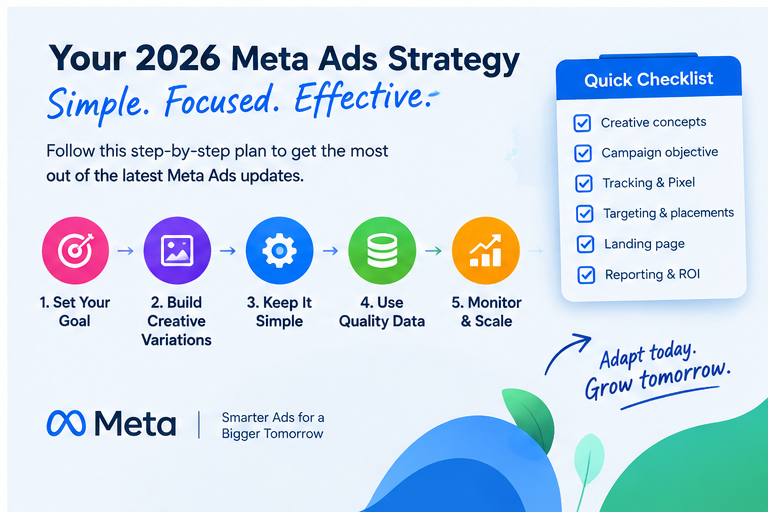
A clear 2026 campaign framework, for Meta Ads Strategy may appear like this:
Step 1 — Define One Clear Business Goal;
Choose the outcome:
1. Sales
2. Leads
3. App installs
4. Messages
5. Website conversions
Step 2 — Build Multiple Creative Concepts:
Start with a few different creative ideas.
Step 3 — Keep Campaign Structure Simple:
Stay away from many different parts.
Step 4 — Give Meta Enough Data:
Do not make changes after only a few hours of results.
Step 5 — Monitor Business Metrics:
Track:
1. CPA
2. ROAS
3. Conversion rate
4. Revenue
5. Lead quality
6. Customer acquisition cost
Step 6 — Scale Winners Carefully:
When a campaign is working grow it based on steady results instead of getting excited, about what happened in just one day.
17.Meta Ads Mistakes to Avoid in 2026:
Creating Many Ad Sets:
Too much fragmentation can make testing and optimization harder.
Testing Headlines:
Changing one sentence is not creative testing.
Ignoring Conversion Tracking:
Poor tracking can damage optimization.
Editing Campaigns Constantly:
Frequent major changes can make it harder to understand what actually caused performance changes.
Using AI Without Strategy:
AI can create variations. It does not automatically understand your brand, customer psychology or business economics.
Optimising for CTR:
A high CTR does not necessarily mean high revenue.
Always connect advertising metrics to business results.
18.Meta Ads 2026 Checklist:
Before launching or optimizing a campaign use this checklist:
1. Multiple creative concepts
2. Strong first few seconds
3. Clear value proposition
4. Friendly format
5. Strong CTA
Campaign:
1. Clear campaign objective
2. Appropriate optimization event
3. Simple structure
4. Suitable audience
5. Automated placements tested
Tracking:
1. Pixel installed
2. Conversions API checked
3. Events firing
4. Duplicate events controlled
5. Conversion values accurate
Landing Page:
1. Fast loading is a must. Fast loading keeps visitors happy.
2. Mobile friendly is essential. Mobile friendly lets people use phones.
3. Clear CTA is key. Clear CTA tells people what to do.
4. Consistent message matters. Consistent message builds trust.
5. Simple conversion process is vital. Simple conversion process makes signing up
Reporting:
1. I have monitored CPA.
2. I have monitored ROAS.
3. I have checked conversion quality.
4. I have understood attribution.
5. I have compared business revenue, with platform reporting.
19.Frequently Asked Questions About the Latest Meta Ads Update in 2026:
What is the biggest Meta Ads update in 2026?
The biggest strategic change is the shift toward using artificial intelligence to improve campaign performance, automate tasks and deliver creative content more effectively. Meta’s communications in 2026 highlight that AI will play a role, in its advertising systems and overall business operations.
Is Meta Ads still effective in 2026?
Yes. Meta Ads are still an advertising channel but advertisers must change their approach because Meta Ads are becoming more automated.
H3: Is broad targeting better in 2026?
Broad targeting can work well when the campaign has conversion data, strong creative and reliable tracking. However broad targeting is not automatically the choice, for every business.
Is creative more important than targeting?
Creative has become more important lately. Meta’s systems look at creative. Behavior signals to find people who are likely to respond. Because of this testing content is now a big part of running Meta Ads. It helps you see what works best with your audience. You can’t ignore it if you want results. Many people are focusing on this part of the process now. It’s not about the message anymore. How it. Feels matters too. Testing images, videos and text helps you learn what gets attention. That’s why creative testing is key, in today’s Meta Ads strategy.
Should I use Advantage+ campaigns?
For advertisers trying Advantage+ can make sense. This is especially true when the campaign has data and a clear goal, for conversions. Don’t assume automation will always perform better. Instead compare results to see what works best.
What should I track in Meta Ads in 2026?
Focus on metrics that directly impact business results including:
1. Cost, per acquisition
2. Conversion rate
3. Revenue
4. ROAS
5. Lead quality
6. Customer acquisition cost
7. Purchase value
These numbers tell you how well your efforts are driving real business success. Keep an eye on them regularly to see what’s working and what needs adjustment.
20.Final Thoughts on the Latest Meta Ads Update in 2026:
The newest Meta Ads update in 2026 is not one thing or one change to an algorithm.
It is a move toward artificial intelligence, automation more different types of creativity, wider optimization and stronger signals for better results.
Advertisers who keep using ways—too many ad sets, too many limits, on the audience the same pictures or videos over and over and always making changes by hand—might have a hard time getting the same success.
The newest Meta Ads update in 2026 is not one change or a single tweak to an algorithm.
It’s a shift toward artificial intelligence more automation, new kinds of creative options, broader optimization and stronger signals that help deliver better results.
Advertisers who still rely on methods—like using too many ad sets setting too many restrictions reusing the same images or videos over and over and manually adjusting everything—might find it harder, than before to get the same level of success.