Interviewing Questions of Digital Marketing: An Introduction
The significance of digital marketing has increased over time due to its role in customer acquisition, brand awareness, lead generation, and sales. With the increasing use of digital marketing by companies, there is a growing need for people with real-life digital marketing skills. For this reason, digital marketing interviews go beyond theory and focus on skills as well.
Interviewers might ask about SEO, Google Ads, social media marketing, content marketing, Meta Ads, analytics terms, digital marketing software, campaigns, and their performance in an interview. In addition, they may give you a scenario and ask how you will deal with it.
While interviewing freshers, the interviewer will mostly concentrate on the basic concepts, learning capability, communication skills, and understanding of digital marketing. Experienced digital marketers can have tough questions in the areas like campaign effectiveness, budget, digital marketing strategies, optimization of campaigns, management of clients, and return on investment.
This article provides information about the most important digital marketing interview questions and answers for freshers and experienced professionals. Along with theoretical and conceptual digital marketing interview questions and answers, there are scenario based questions as well that will help you in solving problems at the time of interview.
If you are preparing yourself for digital marketing interview from any institute in Delhi with placement, you can use these digital marketing interview questions and answers along with your digital marketing projects and practical experience.
In addition to memorizing the answers to these digital marketing interview questions and answers, you can improve your practical knowledge of concepts and thinking process of solving problems.
Digital Marketing Interview Preparation Tips
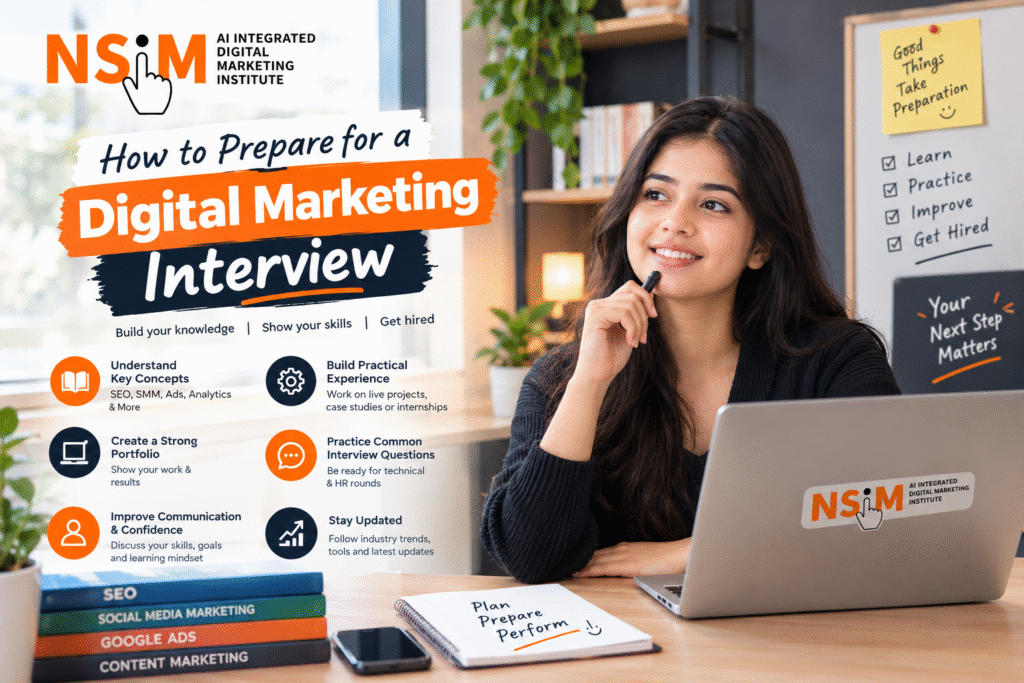
The preparation process for a digital marketing interview entails not only rote learning of terms but also the ability to demonstrate an understanding of marketing goals, selection of appropriate channels, analysis of outcomes, and proposing solutions. A proper preparation method should therefore be based on both theory and practice.
1. Review the Basics of Digital Marketing
It is always best to start with the basic concepts. Know how to explain SEO, PPC, social media marketing, content marketing, affiliate marketing, conversion, keywords, target audience, marketing funnel, and paid advertisements. Interviewers usually begin with easy questions then proceed to more complicated ones.
2. Get Familiar With The Mechanics of Each Channel
Be able to explain the purposes of each important digital marketing channel. For instance, SEO may assist with increasing organic visibility, whereas Google Ads may generate paid search traffic. Social media marketing can help businesses raise their awareness and engagement, while content marketing attracts and informs potential clients.
The ability to tell when and why a company would select a particular channel instead of another is crucial too.
3. Get to Know The Key Digital Marketing Metrics
A digital marketer must be knowledgeable about campaign performance metrics. Refresh your understanding of such metrics as CTR, CPC, CPM, CPA, CPL, conversion rate, ROI, ROAS, engagement rate, and customer acquisition cost.
Do not just learn what these terms mean. Learn what it means for these metrics to go up and down.
4. Practicing by Solving Real-World Examples
Examples of scenario-based questions include:
What action would you take in case of sudden drop in web traffic?
How would you decrease a high cost per lead?
How would you market a new venture with low budget?
What action would you take in case of clicks but no conversion on an advertisement campaign?
In your response, you should outline your thinking process, your actions, and their outcome.
5. Get Your Projects and Portfolio Ready
If you have taken any digital marketing course, internship, freelance assignment or a personal one, get ready to talk about that project. Elaborate on your goal, role, tools used, strategy, challenges, and achievements in the project.
Freshers, in particular, would benefit from talking about any project done at a digital marketing institute in Delhi with placement facility, provided they are able to present their work in the interview.
6. Research the Company
Before going for the interview, research the company’s website, social media accounts, products/services offered, their target customers, and their competition. Find out any one or two places where their digital presence can be improved.
In this way, you will be able to give relevant answers rather than vague ones.
7. Always Tell the Truth About Your Skills
Never lie about having skills on tools or platforms that you haven’t used much. Even if you have some basic knowledge about them, tell it straight away and add that you are ready to learn. Honesty, curiosity, practicality, and a learning attitude are usually appreciated by employers.
Lastly, always practice giving your answers in simple terms. A good digital marketer must be able to convey his/her marketing concepts in a very simple way.
Digital Marketing Interview SEO Questions – Basic Level
When preparing for a digital marketing interview, SEO is considered one of the most important topics that should be focused on since SEO questions in an interview are often used by interviewers to find out if the candidate understands the working process of search engines, website optimization and ways to measure the performance of SEO.
7. What is technical SEO?
Answer: Technical SEO refers to technical elements of a website that affect crawling, indexing, and overall user experience. Some of the technical elements that could be improved include site architecture, broken links, internal linking, mobile performance, redirect management, page loading speed, and ensuring discoverability and indexation of key pages.
8. What is a backlink?
Answer: Backlink is a link from another website leading to your website. Relevant and credible backlinks may influence the authority of your site and demonstrate search engines that other sites consider content of your site useful. However, the importance of quality and relevancy of links is higher than the number of backlinks itself.
9. What is the difference between white hat and black hat SEO?
Answer: White hat SEO involves following search engines’ rules and concentrating on content creation, improvement of websites, and gaining visibility naturally. Black hat SEO utilizes manipulative approaches that are aimed at affecting page rankings, for example, redirects, keyword stuffing, or link schemes that are not legitimate.
10. How would you rank up a new website?
Answer: First, I would analyze the website’s purpose, its audience, competitors, and the keywords used. Next, I would carry out the keyword research, build the structure of the website, optimize critical pages, produce valuable content, do technical optimization, generate internal links, and acquire backlinks.
11. How do you measure SEO performance?
Answer: SEO performance is best measured through metrics that are tied up with business goals. Examples of these can be organic traffic, ranking, keyword visibility, impressions, clicks, conversions, leads, backlinks, and engagement signals. Rather than measuring only rankings, I would also find out if the visitors generated organically are doing something valuable, like completing a form, buying something from the website, or contacting the business.
12. How will you act in case you notice a sudden loss of organic traffic?
Answer: I would identify when exactly this drop began, the pages and keywords involved, as well as the sources of traffic. I would then conduct research about technical issues, indexing, any changes that occurred on the site, content issues, algorithm changes, losses in terms of rankings, and unusual activities on the side of backlinks.
13. What are the differences between SEO and SEM?
Answer: SEO mostly deals with acquiring organic visibility from search engines’ results pages, but SEM is usually referred to as a type of search engine marketing that involves paid search advertising. SEO can offer long-term organic visibility, while paid search can help drive traffic once the campaign starts. Companies may use them together.
14. Explain keyword stuffing.
Answer: Keyword stuffing refers to the excessive use of keywords in an effort to manipulate the ranking in search engines. This can make the text hard to read for users, resulting in bad user experience. A better strategy would be using natural language and concentrating on answering the user’s query fully.
15. What is the way to do SEO for a local business?
Answer: I would tailor my SEO efforts according to the intent of location-specific searchers, write helpful local content, manage business information effectively on appropriate platforms, get SEO optimized in Google, acquire authority locally and motivate genuine reviews from the customers.
SEO Interview Tip
Don’t limit your answers about SEO to only its definitions. In most cases, the interviewer is more concerned about how you think while solving an SEO issue. Whenever possible, try to share the actions you would take, the tools or data sources you would look into and how you can tie the SEO efforts to a concrete business goal.
If an SEO candidate can clearly articulate the reason behind taking a certain SEO step, then he/she would make a better impression than just listing SEO terms.
Google Ads and PPC Interview Questions
Google Ads and PPC are key competencies for digital marketers since businesses rely on paid marketing campaigns to drive traffic, leads, downloads, and conversions. Interviewers frequently test interviewees’ understanding of the subject by asking about campaign setup, bidding, targeting, ad performance, and optimization. They can also give a scenario of a problem that occurs in a campaign and require a solution.
1. What is PPC?
Answer:
PPC stands for Pay-Per-Click and is a form of online advertising where the advertiser typically pays when somebody clicks on an advertisement. Search marketing is a typical example. PPC enables the advertiser to target audiences depending on parameters like search terms, geographic location, interests, demographics, and so forth.
2. What is Google Ads?
Google Ads is the online advertising system offered by Google where companies get to market their goods and services via the Google ads network. Depending on the kind of campaign being created, businesses can market their products via search, display networks, YouTube, apps, and many other places.
3. What is the difference between SEO and Google Ads?
SEO is about achieving visibility via unpaid or organic searches, while Google Ads is all about paid advertising. SEO takes time to achieve visibility in organic searches while paid searches achieve visibility instantly. Companies can use both methods for capturing visibility in short and long term searches.
4. What is CPC?
Answer: CPC is the abbreviation for Cost Per Click. This refers to the cost of the advertiser when a person clicks on the ad.
Formula:
CPC = Advertising Cost ÷ Number of Clicks
If there is an advertising expenditure of ₹5,000 and 1,000 clicks, then the CPC will be ₹5.
5. What is CTR?
Answer: CTR is the abbreviation for Click Through Rate. It determines the percentage of clicks from the ad.
Formula:
CTR = (Number of Clicks ÷ Number of Impressions) × 100
A low CTR shows that the ad message or keyword may not be relevant to the target audience.
6. Define the concept of Quality Score?
Answer: The Quality Score is an analytical metric that is linked with Google Ad keywords. This metric takes into consideration the expected CTR, ad relevance, and landing page experience. Higher relevance of the keyword, ad, and landing page can contribute to higher effectiveness of your campaigns.
7. Define the concept of negative keywords?
Answer: Negative keywords are keywords that prevent the advertisement from triggering for an inappropriate search. These help in making the advertising more relevant to the users by filtering out the unwanted searches. For instance, if the organization offers paid high-quality courses, then it will use appropriate negative keywords to filter out searches that are looking for something free.
8. What is CPA?
Ans: CPA is the abbreviation of Cost Per Acquisition / Cost Per Action. This is used to measure the cost incurred in making one desired conversion.
Formula:
CPA = Total Advertising Cost / Number of Conversions
In a lead-generating campaign, CPA may help marketers measure the cost of acquiring each lead.
9. What is ROAS?
Ans: ROAS stands for Return On Ad Spend. It measures the revenue in terms of advertising cost.
Formula:
ROAS = Revenue Generated by Ads / Advertising Cost
For example, ₹20,000 worth of ads generate ₹80,000 worth of attributed revenue; ROAS = 4.
10. What are the ways to improve your low-performing Google Ads Campaign?
Answer: First of all, I will find out what exactly is the issue through such metrics as impressions, CTR, CPC, conversion rate, CPA, search terms, targeting, and budget split. Then, I will look into keywords relevancy, negative keywords, ad copy, landing page, bidding strategy, and conversion tracking. After making the changes, I will observe the results without changing everything at once.
11. What will you do if the campaign receives too many clicks and too few conversions?
Answer: I will conduct thorough research on the whole path from search to conversion. First, I will check out if conversion tracking is properly done, and I will look into search terms that bring traffic. Also, I will see if keywords and ads correspond with landing page and user’s intentions.
12. How can you lower your cost per lead?
Answer: By finding out what campaigns, keywords, audiences, geos, device types, and ads are generating high cost per lead. Depending on the results, you can decrease wasted money, do more targeting, use negative keywords, check ad messages, make them more relevant and re-allocate budget to better lead-generating segments. Not forgetting that you should take into account the quality of leads and not just a lower numerical CPL.
13. What is conversion tracking?
Answer: It enables advertisers to track valuable conversions made by their campaigns. This could be purchases, subscriptions, phone calls or any other action. Without conversion tracking information, it becomes very hard to find out what campaigns and targets work towards advertiser’s goals.
14. How do Search and Display advertising differ from each other?
Answer: Search advertising reaches the users at their time of actively searching, making it very helpful in targeting the existing demands. Display advertising can reach users on websites, applications, and many more. Depending on the campaign objective and the target user group, display or search advertising may be used.
15. How will you set up a Google Ads campaign for a new business?
Answer: First, I will have a clear understanding of the business goal, target audience, product/service details, budget, geographical focus and conversion objective. After that, I will research the keywords, group similar themes together, create appropriate advertisements, develop good landing pages, configure the conversions and other settings of the campaign. Post setting up the campaign, I will review the search terms and analyze the data and optimize the campaign accordingly.
PPC Interview Tip
An ideal PPC candidate must have a commercial mindset rather than just being knowledgeable in advertising terminologies. If an interviewer asks about improvements to make in the campaign, you should talk about the data analysis first and then the problem identification and solution and the measurement of its effectiveness.
Questions on Social Media Marketing for Interviews
Social Media Marketing is an essential component of digital marketing since companies make use of Instagram, Facebook, LinkedIn, YouTube, or other social media platforms to reach out to people, build communities, market their products, and create leads. Here are some common questions asked in interviews regarding social media marketing.
1. What is social media marketing?
Answer: Social media marketing involves the use of social media platforms for the purpose of promoting a brand, a product, a service, or an idea. This can range from organic promotion in the form of posts, videos, stories, and community interaction to paid promotions. The aim of social media marketing can be anything from brand awareness, engagement, lead creation, traffic, or sales.
2. What steps would you take to make your social media marketing strategy?
Answer: First of all, I will clarify what business goal and target audience I will have. Then I will choose suitable platforms, conduct competitors’ research, identify content pillars, develop content calendar, set KPIs, and check if there is a need to promote content through paid means. After that I will publish the content and analyze its performance.
3. What is the way to choose the right social media platform for your business?
Answer: It depends on many things like target audience, type of business, content format, goal of the campaign, and behavior of the platform. For example, LinkedIn can be useful for B2B communication, and Instagram may be appropriate for visually oriented companies. The key here is the presence of target customers on that platform, not the popularity of the platform itself.
4. What is organic social media marketing?
Answer: Organic social media marketing entails practices that do not depend on paid advertising directly. They encompass regular posts, videos, stories, community interaction, responses, and other kinds of content that are published via social profiles of the brand. The purpose of this practice may include raising awareness, building trust, creating engagement, and forming a relationship with the audience.
5. What is engagement rate?
Answer: The engagement rate shows how actively the audience interacts with social media content. Depending on the platform used and the way statistics are gathered, engagement may consist of likes, comments, shares, saves, and clicks. A marketer needs to view engagement from the perspective of the goal of the campaign rather than seeing it as the only metric for success.
6. How could you boost your engagement on social media?
Answer: I would create relevant content according to interests of the audience, use relevant format, publish regularly, engage in discussions, respond to comments, explore various creative ways, and track which content and formats work better.
7. How would you track the success of social media campaign?
Answer: It depends on the goal of the campaign. If it is about awareness, then reach and impressions could be measured. In case of engagement campaign, interactions and engagement rate could be relevant. Traffic campaigns will require tracking of clicks and click through rate. Lead/sales campaign could consider conversions, cost per result and overall quality of results.
8. What is a social media content calendar?
Answer: The content calendar is a planned schedule that indicates what kind of content will be posted on which platform, at what time, and sometimes why it should be posted, in what format it will be posted, and who the responsible team member is.
9. How would you respond to negative comments against the brand?
Answer: I would first try to understand the nature of the complaint rather than reacting emotionally. If it is a valid complaint, I will accept the complaint and give an informative answer. Any issue of a sensitive nature can be dealt with via a private mode of communication.
10. What is influencer marketing?
Answer: Influencer marketing consists of working with people who already have followers and some sort of influence in a certain niche or group. An appropriate influencer could help you reach the right audience and add credibility to your brand. It is important to take into account the factors such as audience relevance, quality of engagement, content style, brand match, and goals of a particular campaign rather than simply number of followers.
11. How would you promote a new brand on social media?
Answer: I would start with figuring out who the target audience is and positioning the brand. After that, I would establish visual and message guidelines, come up with valuable content that solves some issues of the audience or caters to its interests, make an initial content calendar and conduct some paid social media ads.
12. What would you do if there is high number of followers but low engagement in a social media page?
Answer: I would check the relevance of followers for the business and study the content format and topics which have been doing well in the past. Posting frequency, content quality, audience expectation and call-to-action will be analyzed. Content strategy may need refreshing and testing of new formats instead of increasing the number of followers.
Tip for Social Media Interview
Avoid saying that the social media success is all about gaining more followers or likes. Your answer should make the link between social media actions and the business objective. You should explain how you would discover the audience, choose the right platform, develop the content, monitor the results and improve them with the help of analytics.
In case you have an actual experience in social media gained during an internship or a project or from the digital marketing institute in Delhi with placement, prepare an example of the social media campaign that you could share with the interviewer.
Meta Ads / Facebook & Instagram Ads Interview Questions
Meta Ads is a key competency for digital marketers as companies rely on Facebook and Instagram ads to target certain people, get leads, boost traffic on websites, advertise products and drive sales. At an interview, the employer can ask questions concerning the objectives of a campaign, targeting audience, bidding, creatives, retargeting, metrics and how to optimize the campaign.
Interviewers will also present a scenario to see how you can resolve issues such as a campaign that has high cost-per-lead. It means you have to understand the reasons for using a particular setting in Meta Ads and not only know the vocabulary.
1. What are Meta Ads?
Answer: Meta Ads are ads distributed through Meta’s ad network and mainly consist of ads placed on Facebook and Instagram. Advertisers have the option to leverage different types of
campaign goals, audience, placement, budget, and ad format to meet their campaign goal like awareness, traffic, engagement, leads, app install, or purchase.
2. How does organic social media differ from Meta Ads?
Answer: Organic social media entails the creation of content without paying for any advertising placement. In contrast, Meta Ads entail paid advertising where advertisers can set the goals of the campaign, audience, budget, placement, and optimizations.
Organic social media marketing helps create communities and presence in the long run, whereas Meta Ads may enable you to reach out to the right audience with scalability.
3. What are campaign objectives in Meta Ads?
Answer: Campaign objective is an instruction that informs the advertising system about the kind of outcome an advertiser wishes to generate. Based on the existing setting of the Meta Ads, objectives can be grouped according to wider goals such as Awareness, Traffic, Engagement, Leads, App Promotion, and Sales.
The objective needs to be aligned with the actual goal of the advertiser. For instance, if the advertiser would like to have its users fill in the contact form, lead-oriented setting may make more sense than the engagement one.
4. What is audience targeting in Meta Ads?
Answer: Audience targeting is the technique through which an advertiser identifies the people whom it wishes to target. This depends on how the campaign is set up, but some of the factors that the target can be based on include location, demographics, interests, behavior, customer data, web behavior, and brand engagement.
5. What is Custom Audience?
Answer: The Custom Audience is an audience generated based on the company’s own eligible data or interactions with its digital property and Meta platform. It may include interactions with websites, apps, customer list, and some type of Facebook or Instagram posts, depending on the set up.
The Custom Audience may be used for remarketing because it allows reaching people who already showed some interest.
6. What is a Lookalike Audience?
Answer: The Lookalike Audience allows advertisers to reach people who are similar to the source audience. For example, a company can use a suitable customer audience as a source and asks Meta to find people with specific characteristics.
The Lookalike target can be used for prospecting, although the quality and performance of the audience must be evaluated anyway.
7. What is retargeting?
Solution: Retargeting is an approach used to connect with customers who are familiar with the brand but haven’t taken the necessary steps. For instance, an e-commerce company could use retargeting to advertise products that were seen by the customer but not purchased.
This marketing tactic can be useful due to the fact that the users are familiar with the brand. But one has to take into account the frequency, scale of the audience, creative fatigue, and the place of the user in the buyer’s journey.
8. What is Meta Pixel?
Solution: Meta Pixel is a piece of code that can be installed on a website to measure actions and track interactions with respect to Meta advertising. Meta Pixel may work for measurement, audience generation, and campaign optimization if used appropriately.
The interviewer expects from you the understanding of the importance of the tracking setup because incomplete data makes it hard to optimize campaigns and evaluate their performance.
9. What does CPM in Meta Ads refer to?
Answer: CPM refers to Cost Per Thousand Impressions. It refers to the average cost incurred to obtain 1,000 ad impressions.
Formula:
CPM = (Cost of Advertising ÷ Number of Impressions) × 1,000
For instance, a campaign that incurs ₹1,000 to deliver 20,000 impressions has a CPM of ₹50.
CPM helps marketers determine how costly it is to reach their audience; however, low CPM does not always imply success of the campaign. This is because the campaign objectives and the subsequent business outcomes should be taken into account.
10. What does frequency refer to in Meta Ads?
Answer: Frequency refers to the average number of times an individual within the audience reached has seen the advertisement. Fast-rising frequency could mean that the same audience is seeing the same creatives again and again.
In case the performance begins to drop while the frequency is rising, a marketer may investigate the size of the audience, creative fatigue, structure of the campaign, and whether new creatives or audiences need to be tested.
11. How is reach different from impressions?
Answer: Reach stands for the number of people who viewed the ad, whereas impressions stand for the number of times the ad was displayed.
For instance, in case 1,000 people view an ad twice on average, the campaign can have about 1,000 reaches and 2,000 impressions.
12. How would you address a high CPL in Meta Ads?
Answer: In order to reduce a high CPL, I would first try to understand why CPL is high and not rush to reduce the budget right away. I would analyze the performance of audience, performance of creatives, placements, CTR, landing/lead form experience, conversion rate, frequency, and lead quality.
Then, I would pinpoint which segments underperform and run tests related to creative concepts, messaging, audience targeting, landing pages/forms, and other parameters of campaigns.
13. What would you do if Meta Ads have a high CTR but low conversions?
Answer: A high CTR means that people click on the advertisement, however, it doesn’t mean that they are going to do what we want. I would evaluate if there is congruence between ad promise and landing page or lead form, relevancy of the offer, purchase intention of the target audience and any potential technical problems.
Also, I would analyze conversion tracking and test the effectiveness of the ad campaign among different audiences, placements, devices and creatives in order to find where exactly the people drop off after clicking.
14. How would you test different Meta Ads creatives?
Answer: I would use differences that matter for testing rather than making random changes to the ad. For instance, I would try to test hooks, visuals, offers, formats, headlines, etc.
Test should have a well-formulated hypothesis and a metric. If the goal is generating leads, I wouldn’t evaluate ads only based on the likes and comments. I would focus on metrics like CTR, cost per result, conversion rate and lead quality.
15. What makes for a great Meta Ad Creative?
Answer: A great creative is one that grabs attention, clearly communicates the value proposition, is appropriate for the platform and target audience, and provides a next step. It is important that the visual, headline, offer, and call-to-action be in harmony with each other and not send conflicting messages.
It is also necessary that the creative fit in with the stage of purchase funnel of the person who will view it. An educational or problem-solution focused creative might be more appropriate for someone unfamiliar with the brand while product focused ones for returning visitors.
16. How would you design a Meta Ads strategy for a new business?
Answer: First of all, I will consider its business model, target client, products/services, competition, budget, geography, and conversion goal. After that, I will define its audiences, create multiple concepts of creatives, set up the tracking system, choose the right campaign structure, and run controlled experiments.
After gathering enough data, I will analyze the audiences, creatives, placements, and conversions. The best combination will get my money while weaker will get tested again, reworked, or cut out.
17. What is ad fatigue?
Answer: Ad fatigue is a situation in which audiences are bombarded by the same or similar ads, leading to a decrease in response levels. It leads to poor performance and increases cost.
Ad fatigue can be avoided by testing new creative ideas, changing the message, reviewing the audience size and overlap, as well as avoiding repetition of advertisements on unnecessary campaigns.
18. What would you check if a Meta Ads campaign suddenly stops working?
Answer: I will compare the recent performance with the past performance and find out the exact metric that is performing poorly. I would then check for delivery, budget, audience size, frequency, creative performance, placements, conversion tracking, website or form performance, as well as the recent changes made to the campaign.
I would be careful not to make several changes at once before identifying the reason. After finding the problem, I will make a small change to the campaign and observe the results.
Meta Ads Interview Tips
Never use the phrase “Increase the Budget for success” or “Change the Audience for failure” during an interview. Always give an explanation behind your choice.
Here is how a typical response to Meta Ads questions looks like:
Objective -> Audience -> Creative -> Delivery -> Conversion -> Cost -> Business Effect
Having done practical training in digital marketing from an institute in Delhi with placement, you should be ready to talk about at least one campaign/project in this pattern. Include your objective, your role, the way you targeted the audience, the way you created an ad, key metrics, challenges and lessons learned.
The best applicants prove their deep understanding of Meta Ads as a business tool and not just a feature-list application.
Content Marketing Interview Questions
One of the key components of digital marketing is content marketing, which allows businesses to attract their targeted audience, provide answers to customer inquiries, build trust, and generate conversions. An interviewer can inquire about the following aspects of the concept:
It is crucial for candidates to comprehend that the essence of content marketing does not lie in blog publishing. Good content should be developed based on its purpose, audience, search intent, message, distribution channels, and measurable goal.
1. What is content marketing?
Answer: Content marketing is a type of marketing which implies creating and sharing valuable, relevant, and consistent content for targeting a particular audience. The content can be presented in different forms such as blog posts, video presentations, infographics, posts for Social Networks, case studies, guides, etc. The ultimate goal is to help companies achieve their goals in terms of awareness, lead generation, sales, or customer retention.
2. What role does content marketing play in digital marketing?
Answer: Content is an effective way of attracting prospective clients, answering their questions, showcasing knowledge and experience, building trust. In addition, it can be useful for SEO, since search engines use information provided in the content to rank relevant pages. Quality content can remain valuable even after its publication in case of its relevance and visibility.
3. How would you develop a content marketing strategy?
Answer: I would start with an analysis of business goals and target audience. After that, I would investigate their needs, analyze the competitive environment, find relevant keywords and search intent. Depending on the results obtained, I would choose content topics and formats, develop content calendar, determine how and where it will be distributed and KPIs.
Upon publishing of the content, I would measure its performance and see which topics, formats and distribution channels produce the most significant results.
4. What is a content calendar?
Answer: A content calendar is an organized schedule of future content. This can include the topic to be covered, target audience, content type, platform, date of publication, primary keyword, goal of content, and individual who will be writing/publishing the content.
A content calendar assists a team to stay consistent and also helps to avoid topics that are similar.
5. How do you choose topics for your content?
Answer: Some of the things that I would consider are target audience’s question, search intent, keyword research, business goals, competitor’s content, industry trends, and gap in current content. Content topics that are user-centric and business-relevant would be considered.
For instance, a digital marketing training company can write on interview preparation, SEO techniques, advertising platform, career options, and marketing techniques.
6. What is the function of SEO in content marketing?
Answer: SEO ensures that the content is easily searchable through search engines. The content marketer can perform keyword and search intent analysis to know the needs of the users and then create content around those requirements.
Nevertheless, SEO content should not just repeat the keywords but rather should give unique value to the user, provide the solution to their problem, have a good structure, and also be readable.
7. What is search intent in content marketing?
Answer: The search intent is the intention of the user behind the search query. The user could want to know something, land on a particular website, compare the products, or make a transaction.
Knowing the intent enables the determination of the right format of the content to be created. For instance, informational intent requires the creation of a guide while comparative intent requires writing a comparison.
8. What is evergreen content?
Answer: Evergreen content is any type of content which stays valuable and relevant over a long period of time. It can be represented by educational articles, how-to instructions, explanations, lists, and FAQ.
While evergreen content can help get organic traffic consistently, it needs to be periodically checked whether all the information, examples, statistics, and recommendations provided there are up to date.
9. How would you make a blog post SEO-friendly?
Answer: First of all, it is important to find out the target keyword and its search intent. After that, I would build a rational structure including the helpful title, headings, content, proper use of keywords, internal links, image descriptions if necessary, and clear introduction for users.
Then I would take a look at the competitive pages to see what people expect when searching for some information and how to bring in something additional.
10. How would you measure the performance of content marketing efforts?
Answer: It depends on what the goal of content was. If the goal was SEO-related, then organic visibility, clicks, rankings, traffic, and conversions could serve as metrics. For social media efforts – engagement and reach. For lead generation-related content – looking at the number of leads and conversion rate.
The key aspect here is aligning the content metrics with the desired business result and not just counting pageviews as success.
11. What would you do in case your blog got traffic but didn’t get any leads?
Answer: First of all, I would check if the traffic is relevant for the business. Lots of visits from those who had no intention of buying anything or making an inquiry might not generate any leads. Then I would review search intent, relevance of the content to the offer, calls to actions, page layout, user experience, and conversion opportunities.
Also, I would check how users interact with the site and try out more relevant CTAs or supporting materials.
12. How would you promote your new content piece?
Answer: Distribution channels would vary according to the audience. Promotion would depend upon the content type and could be through social media, communities, internal linking from the site, outreach, emails to an appropriate audience, partnerships, paid promotion or any other channel that suits.
Not all pieces of content would be promoted in the same manner. This would depend upon the audience, format, topic and business goal.
13. What do you understand by content repurposing?
Answer: Content repurposing would be taking a good piece of existing content and using it in other forms or channels. For instance, an elaborate blog could be used to make a series for social media, infographic, video script, presentation, or checklist.
14. How would you manage obsolete content?
Answer: I would find the pages where the relevance, ranking, traffic, and utility of the content has become poor. Then I would analyze if that particular piece of content requires updating, extension, merging with another page, redirection, or deletion.
In the case of updating, I would analyze obsolete data, examples, links, search intent, competition, and FAQs. The goal should be to increase the utility of the page, not just by changing the publishing date.
15. What is the criterion of high-quality content?
Answer: High-quality content must be accurate, relevant, unique, clear, properly structured, and written to fulfill the requirements of the user. It should also reflect adequate knowledge and should not include any redundancy or keyword stuffing.
Also, high-quality content provides a clear call to action for the users when required, such as visiting other resources, contacting an organization, downloading some material, or evaluating a service.
Interview Question On Content Marketing
While replying to the content marketing question, it is always better not to give an answer in the form of “blogs writing and posting on social media.” Give the entire process which includes:
Audience Research -> Search Intent -> Planning -> Creating -> Promotion -> Measuring -> Optimization
If you have made any blogs, social media content, presentations, videos, and other kinds of marketing material in your internships or while learning about digital marketing from any institute of Delhi having placements, make sure to take one example and explain everything related to it.

Affiliate, Influencer & E-commerce Marketing Interview Questions
These types of digital marketing play a key role in contemporary marketing. The interviewer can use some questions related to this sphere to find out if you know how companies make their sales, get clients and measure marketing results.
1. What Is Affiliate Marketing?
Affiliate marketing is a performance-based marketing strategy where a person or a company promotes the product or the service of another company and gets a commission for making a specific action by the customer.
For instance, a blogger can promote a digital marketing tool via an affiliate link, and then he gets a commission for the purchase made via this link.
Tip for interview:
Do not just define affiliate marketing. Rather, mention that it is performance-oriented and generally works on the basis of actions like clicks, leads, or sales.
2. How Does Affiliate Marketing Work?
Affiliate marketing basically works on the basis of four main elements:
- The merchant or advertiser – The seller of the product/service.
- The affiliate – The one promoting the product/service.
- The customer – The one taking the required action.
- Affiliate network or platform – Sometimes a platform that manages the referral program.
The affiliate gets a tracking link that when clicked by the customer to take the required action credits the affiliate with the conversion.
Example:
Affiliate sells a product worth ₹2,000 with 10% commission. The affiliate earns ₹200.
3. What is CPA in Affiliate Marketing?
CPA stands for Cost per Acquisition or Cost per Action.
It refers to the cost incurred to get a customer or generate certain actions.
Formula used:
CPA = Total Cost of the Campaign ÷ Total No. of Conversion
For example:
If the total campaign cost incurred is ₹10,000 and we get 100 conversions
CPA = ₹10,000 ÷ 100
= ₹100
Having a lower CPA is a sign of efficient acquisition, assuming the quality and value of these conversions are good.
4. What is Influencer Marketing?
Influencer marketing is the process of working with people who already have an audience and some influence in a certain niche.
Companies collaborate with influencers to promote their product, service, campaign, or brand message.
For instance, a fitness brand will work with a fitness influencer to showcase its products on Instagram or YouTube.
But remember, you cannot judge the effectiveness of influencer marketing based on the number of followers alone.
Other aspects such as engagement rate, relevance of the audience, content quality, reach, conversion rate, and compatibility with the brand must also be considered.
Interview tip:
You must know that the best influencer doesn’t necessarily have the most followers.
5. How Would You Choose an Influencer for a Brand?
Several criteria would be used in the selection of the influencer for a brand:
- Target audience
- Relevant niche
- Engagement rate
- Content quality
- Authenticity of audience
- Previous work with brands
- Reach and impressions
- Objectives of the campaign
- Budget
- Business outcome expected
If a company were trying to launch a premium skincare product aimed at young city dwellers, one would look for creators with a relevant audience and creating content relevant to their campaign.
6. What is the Difference Between Micro and Macro Influencers?
The most important difference is in audience size and usually in the type of relationship with it.
- Micro-influencers tend to have niche-focused and smaller audiences, which makes it possible for them to achieve high engagement rates.
- Macro-influencers have larger audiences and offer wider reach and awareness.
The best decision depends on the objective of the campaign.
If it is about achieving targeted engagement, micro-influencers are more useful. If it is about achieving wide awareness, then a macro-influencer is preferable.
7. How Do You Measure the Success of an Influencer Campaign?
First, I would define the goal of the influencer campaign and choose the metrics depending on it.
An awareness campaign can be measured using metrics such as:
- Reach
- Impressions
- Video views
- Audience growth
- Brand mentions
Key metrics for an engagement campaign may include:
- Likes
- Comments
- Shares
- Saves
- Engagement rate
A sales-driven campaign can be evaluated using metrics such as:
- Link clicks
- Leads
- Sales
- Conversion rate
- CPA
- Revenue
- ROAS
Interview tip:
Remember always to tie a metric with a business goal to demonstrate knowledge of marketing beyond vanity metrics.
E-commerce Marketing Interview Questions
8. What is E-commerce Marketing?
E-commerce marketing is a set of marketing efforts directed at bringing customers into an online store and driving them to buy products from this store.
There might be different channels used to achieve this goal such as:
- SEO
- Google Ads
- Meta Ads
- Social media marketing
- Content marketing
- Influencer marketing
- Affiliate marketing
- Marketplace marketing
- Retargeting
Successful e-commerce marketing is usually about creating a full funnel from discovery of the product till purchase and return.
9. How Would You Promote a New E-commerce Product?
Firstly, it would involve researching the product, target audience, competition, pricing, and unique selling point.
My approach would be:
Research → Audience Definition → Positioning → Channel Selection → Content/ Creatives → Campaign Launch → Measuring → Optimizing
For instance, for a fashion product, I could use Instagram and Meta Ads for visual discovery, Google Ads for high intent search traffic, influencer marketing for brand awareness and re-targeting to reach visitors who do not buy.
It all depends on the product and target audience rather than the utilization of all marketing channels.
10. What is Product Feed in E-commerce Advertising?
A product feed is a structured document comprising details on the products such as:
- Product name
- Product description
- Price
- Product image
- Availability
- Product category
- Brand
- Product link
This data can help advertising platforms display products in their shopping or catalog-based campaigns.
An incorrectly configured product feed may cause issues like wrong prices, availability or product rejection.
Interview tip:
Demonstrate your knowledge of how product data feeds into advertising performance.
11. What Is Cart Abandonment?
Cart abandonment takes place when the customer adds a product into the cart but exits the website without making the purchase.
For instance, a customer adds shoes of ₹3,000 in his/her cart but exits without making the purchase.
Reasons could be:
- Unexpected shipping charges
- Difficult checkout process
- Unavailability of desired payment methods
- Lack of trust
- Slowing down of the website
- Price comparison
- Technical issues
- Just delaying the purchase
Some methods used by marketers to encourage customers to make the purchase are retargeting, good checkout experience, price transparency, trust and suitable offers.
12. How Would You Increase the Sales of an E-commerce Website?
Instead of increasing the budget for advertisements right away, I will first identify at which point customers are leaving the sales cycle.
This could be analyzed on the basis of:
- Traffic source
- Product page performance
- Cart addition behavior
- Checkout performance
- Purchase conversion ratio
- Average order value
- Customer acquisition cost
- Repeat purchase behavior
Then, I will improve those aspects. For instance, if there are many visitors on the product page of an e-commerce website but only few adding products into the cart, then I will see what needs to be improved.
13. What is Retargeting in E-commerce?
Retargeting is the strategy of displaying advertisements to those who have interacted with the business before but have not yet done what is expected of them.
For instance, a person visits an online shop and views shoes but does not buy them. The brand may target this customer in the future through relevant ads.
The process can be applied to:
- Product Viewers
- Abandoned cart visitors
- Former Customers
- Website Visitors
Those who have engaged with ads
The objective is to reach out to those who already have an interest in something.
14. What is AOV?
AOV refers to Average Order Value. It is basically the average price of an order.
The formula is:
AOV = Total revenue / Number of orders
For example, if the total revenue for an e-commerce store is ₹1,00,000 based on 500 orders:
AOV = ₹1,00,000 / 500 = ₹200
There are several ways in which companies can aim to improve AOV.
15. How Do You Promote a Product When Working on a Small Budget?
Given my limited budget, I will have to concentrate my efforts on the channels that can help me reach my target market and ensure some kind of success.
My plan is to:
- Target a specific audience.
- Determine what sells the product.
- Conduct research on the competition.
- Concentrate on high intent keywords.
- Write good content around the product.
- Develop several creatives for advertisements.
- Use organic social media where applicable.
- Retarget people showing interest.
- Monitor the conversions and costs.
- Only then spend more.
For instance, a small business can start with a budget advertising campaign, test out different creatives and target groups, choose the winning combination, and keep increasing the budget.
Interview Tip For Affiliate, Influencer & E-commerce Questions
While answering these questions, try to approach from a marketing perspective rather than just defining things.
A good answer will link:
Audience → Objective → Channel → Campaign → Metric → Business Outcome
For instance, rather than replying, “Influencer marketing enhances brand awareness,” talk about who would be the influencer, why his audience suits the brand, the kind of content he would create, and how you will track the performance of the campaign.
This shows that you have practical sense of things and can help you score higher marks in interviews after the completion of your course from digital marketing institute in Delhi with placement program or digital marketing training.
The Bottom Line :
Affiliate, influencer, and e-commerce marketing are highly measurable aspects of digital marketing. The interviewer may want to test whether you can correctly choose the right audience, channel, and campaign strategy in light of business objective and profitability.
AI in Digital Marketing Interview Questions
AI is increasingly being applied in digital marketing for such purposes as content creation, audience analysis, automation, personalization, and optimization of campaigns. Interviewers may ask about AI-related topics to learn whether you are able to apply the technology effectively and responsibly.
1. How Is AI Used in Digital Marketing?
AI may be used by marketers to:
- Analyze data about customers and their campaigns
- Determine patterns of the audience
- Create ideas and even texts of content
- Personalize marketing messages
- Automate routine processes
- Predict behavior of customers
- Optimize advertising
- Create chatbots
The good marketer should be able to use AI as a productivity and decision-making tool, but not rely completely on it.
2. How Can AI Be Used In Content Marketing?
AI can help with keyword ideas, outlines, research on topics, headlines, variations of the content, and personalization.
Yet, marketers must check the AI-generated content to ensure its accuracy, uniqueness, brand voice, and value.
Interview hint:
Highlight that AI can serve as an aid to the human’s creativity and knowledge instead of being used just to generate the content without human intervention.
3. Can AI Replace Digital Marketers?
AI can automate a number of marketing activities, however, it does not replace the necessity for digital marketers.
Marketing activities still require human abilities, such as:
- Strategic thinking
- Creativity
- Psychology of customers
- Brand communication
- Decision making
- Problem solving
It is better to use both AI and human knowledge in combination to increase productivity.
4. How Would You Use AI in an Advertising Campaign?
AI could be used to help with aspects like audience research, creation variations, campaign optimization, and finding out performance patterns.
For instance, when several ad creatives are being run, it is possible to use AI-supported tools to determine the patterns of which messages or types of content work better. In any case, I would compare the findings to the actual business goals.
5. What Are the Risks of Applying AI for Marketing Purposes?
Some main risks are as follows:
- False or inaccurate information
- Bland or repetitive content
- Privacy concerns
- Bias within automated decisions
- Overreliance on automation
- Brand voice loss
Thus, it is important to use AI alongside human review, right data management, and brand voice guidance.
Interview tip:
When answering questions about AI in an interview, make sure you understand the pros and cons of using it. Your potential employers will appreciate your practical understanding of AI more than knowledge of its tools.
Key Performance Indicators (KPIs) & Metrics for Digital Marketing Interview Questions
Knowledge of marketing metrics is important because the interviewers will test your ability to measure the performance of marketing campaigns.
1. What is KPI in Digital Marketing?
KPI means Key Performance Indicator. It is a metric that measures whether a marketing campaign has met its target or objective.
Popular KPIs in digital marketing include:
- Click-through rate (CTR)
- Cost per click (CPC)
- Cost per acquisition (CPA)
- Conversion rate
- Return on ad spend (ROAS)
- Engagement rate
- Organic traffic
- Leads
- Revenue
Choosing the right KPI depends on the target of your marketing campaign.
2. What is CTR?
CTR (Click-Through Rate) is the percentage of individuals who clicked on an ad, link, or search results after viewing it.
Formula:
CTR = (Clicks ÷ Impressions) × 100
For instance, where an ad garners 100 clicks out of 5,000 impressions, then the CTR is 2%.
A high CTR indicates relevancy to the target audience. However, CTR must not be evaluated in isolation.
3. What is Conversion Rate?
The conversion rate calculates the percentage of users who perform an intended action.
Formula:
Conversion Rate = (Conversions ÷ Total Visitors or Clicks) × 100
This conversion may include purchasing something, filling in lead forms, registrations, or downloading something.
4. What is ROAS?
ROAS is a measurement of the amount of revenue earned relative to the cost of advertising.
ROAS = Revenue From Advertising ÷ Cost Of Advertising
Suppose that an organization spends ₹10,000 on advertising and earns ₹40,000 from that advertising, then ROAS will be 4 times.
ROAS is quite useful to measure the performance of advertising campaigns based on revenues.
5. Which KPI Will You Measure In The Lead Generation Campaign?
In a lead generation campaign, some KPIs are:
- Number of Leads
- Cost Per Lead
- Conversion Rate
- Lead Quality
- Cost Per Acquisition
- Lead To Customer Ratio
Success of the campaign cannot be determined only in terms of the number of clicks or impressions as there may be a lot of clicks but no quality leads.
6. How Will You Proceed When a Campaign Has a High CTR but Low Conversion Rate?
Firstly, I would explore the post-click experience.
Here are some possible things to look into:
- Landing page relevance
- Product offer or pricing
- Call to action
- Page speed
- Quality of target audience
- Conversion tracking
- Checkout form experience
- Misalignment between the advertisement and landing page
That is how one could learn an essential interview lesson: a high-quality marketing metric does not automatically mean high-quality business performance.
Interview Tip
While talking about KPIs, always begin with the objective of the campaign first and then choose relevant metrics.
Objective → KPI → Analysis → Optimization → Business Effect
Such an approach will show that you think about performance marketing as a business discipline, not just learn metric descriptions.
Scenario-Based Digital Marketing Interview Questions
Such types of questions are often used by interviewers to find out how candidates think and solve problems in real situations. Not necessarily there is one right answer. Usually, a reasonable way of thinking is expected.
1. You Have Got Traffic on Your Site, But Almost No Leads. What Would You Do?
Firstly, I would figure out where users get stuck. I would analyze traffic sources and its quality, landing pages, content relevance, calls-to-action, loading time of web pages, forms, and users’ intent.
Then, I would pinpoint what is causing a problem and test the solutions.
Good scenario:
Traffic Quality → User Behavior → Pinpoint the Problem → Testing → Optimization
2. SEO Campaign Is Losing Organic Traffic for Some Unknown Reasons. What Would You Do?
First of all, I would never start doing anything before figuring out the cause of this problem.
The steps that I would take include the following:
- Which pages have lost traffic?
- Which keywords have failed?
- Whether the visibility of your competitors increased?
- Website changes that happened recently.
- Technical reasons.
- Problems with indexing.
- Changes in search demand.
- Search engine updates.
3. My Google Adwords Campaign Is Generating Lots of Clicks But Little Conversions. What Will You Do?
I will find out if the clicks are from the relevant audience and if my keywords are relevant to their intent.
Then I will analyze:
- Search terms
- Keywords
- Ad copy
- Landing page
- Offer
- Conversion tracking
- Performance by device
- Geography/audience targeting
I will improve the weak elements and not increase the budget.
4. I Have High Cost Per Lead on My Meta Ads Campaign. What Can I Do to Lower My CPL?
First, I will find out what the issue is; if it is audience, creative, offer or conversion issue.
I will try out different audiences and creatives, frequency and placements performance, quality of leads and testing new variations.
The goal is not just to get cheap leads but quality leads.
5. Your Client Wants Quick Results from SEO. What Is Your Response?
My response will be that SEO is a process which normally takes some time to bear results.
Instead of making promises about quick rankings, I would focus on setting realistic goals like:
- Technical optimization
- Keyword optimization
- Creation of content
- Improvement in organic visibility
- Improvement in traffic
- Improvement in leads/convertions
If immediate visibility is needed, I will suggest some good paid methods along with SEO.
6. Your Client Provides You With a Very Limited Budget for Marketing. What Would You Do?
In the first place, I would understand their goal and other factors like:
- Business objectives
- Target market
- Product/Service
- Geographical area
- Expected outcome
Next, I will concentrate on the most effective channels rather than allocating budget to all the channels.
Firstly, I will do some testing, measure results, find out effective channels and keep adding budget accordingly.
7. You Have Many Followers on Your Social Media Account, but the Engagement is Extremely Low. How Would you Proceed?
Firstly, I would check whether the followers were relevant to the brand and the content being posted was relevant to them.
I would look into:
- Content formats
- Frequency of posts
- Interests of the audience
- Engagement metrics
- Reach of the content
- Quality of the content
8. The Campaign is Successful but All of a Sudden it Begins to Fail. What Would You Investigate First?
I would compare the current performance of the campaign with the previous records and determine the time from which it started declining.
I would investigate:
- Audience saturation
- Fatigue among the audience
- More competition in the market
- Changes in the budget
- Creatives performance
- Website problems
- Tracking errors
- Changes in consumer demand
Interview Strategy for Scenarios
The correct answer should be based on logical problem solving:
Identify the Problem → Analyze the Data → Locate the Cause → Take an Action → Measure the Impact → Optimize
Do not say that you will “immediately increase the budget” or “change the campaign.” First, state how you will locate the problem.
This kind of logical approach could be particularly useful for those who prepare themselves through hands-on learning via practical training programs, such as a digital marketing institute in Delhi with placement.

Digital Marketing Interview Questions for Freshers
Interviews of freshers usually revolve around how well they understand the basics of digital marketing, practical exposure, willingness to learn and implement the concepts, etc. The interviewers do not always need any professional experience from you but certainly they need your analytical thinking and some practical knowledge.
1. Why did you choose digital marketing as a career?
Answering this question appropriately is quite necessary and a right answer should have something to do with the requirements of digital marketing. For instance:
“I opted for digital marketing as it requires creativity along with knowledge of technology and data and business strategies. I love analyzing my audience and creating marketing campaigns.”
2. Do You Have Any Practical Experience In Digital Marketing?
If you have undergone any internship, coursework, freelance work, or any project, explain in detail what you did.
List out:
- Your role
- Campaigns or projects handled
- Tools used
- Skills used
- Results if any
- Learning if any
Do not claim experience with any tool or campaign that you have not done before.
3. What Are The Digital Marketing Channels That You Know?
Some of the areas which can be mentioned by a fresher are:
- SEO
- Google ads & PPC
- Social media marketing
- Meta ads
- Content marketing
- Affiliate marketing
- Influencer marketing
- E-commerce marketing
It is better to list out two to three channels confidently than listing many areas of which you do not know much.
4. What Would You Do If You Do Not Know the Answer to a Marketing Question?
The best way to answer would be with honesty and not guesses.
The following answer will show that you are honest, curious, and willing to improve yourself.
“I would honestly say that I don’t know the answer right now, but I would research about the topic from reliable sources and learn how to use it. In my opinion, one needs to continuously learn in digital marketing since platforms, algorithms, and strategies change all the time.”
5. Why Should We Hire You As a Fresher?
Instead of showing the experience that you don’t really have, you should focus on your qualities.
Some of them are:
- Fundamentals
- Project experience
- Analytical mind
- Communication skills
- Willingness to learn
- Adaptability
- Interest in the industry of the company
Fresher should show his/her knowledge, attitude, and understanding of the practice.
Advice for Job Interview – For Freshers
Do not mug up the answer word-by-word. Just get the concept clear and give examples from your project work/internship/school work or practice campaign.
If you are from some practical digital marketing institute in Delhi having placement, then you must be ready to give an explanation about what you did in the project.
Interview Questions for Experienced Digital Marketing Profile
An interview for an experienced person is usually more than just defining terms. The interviewer wants to know about how you dealt with campaigns, challenges, budget, and results.
1. Tell me about a digital marketing campaign that you have managed.
In your answer include:
- Campaign goal
- Target group
- Methods and channels
- Strategies
- Budget (if applicable)
- KPIs
- Campaign results
- Changes done
Do not talk just about your job description. Tell about the effect of what you did.
2. Which Is the Toughest Marketing Problem You Have Ever Managed to Solve?
Select a real case and illustrate:
Problem → Analysis → Actions → Result
For example, you may describe reduced organic traffic, growing ad spend, bad leads, low engagement, or ineffective campaigns.
The key thing here is how you solve marketing problems.
3. What Do You Consider When Selecting a Marketing Channel?
I will take into account:
- Target audience
- Campaign goal
- User journey
- Budget
- Service/product
- Intent (search/purchase)
- Past performance
- Projected ROI
It won’t be the popularity of a channel that will be decisive for me. The channel has to serve the business purpose.
4. What’s the Best Way To Optimize a Poor Performing Campaign?
First, I determine the specific reason for poor performance.
For example, I will check out quality of audience, creatives performance, keywords/targeting, costs, landing page performance, conversions, and campaign settings.
Then, I will focus on the most serious problem, run tests and measure the effect.
The right answer shows that you use data-driven decisions instead of random actions.
5. How Do You Report the Campaign Performance to Your Client or Supervisor?
I would make the report business-oriented.
A simple campaign report may include:
- Objective
- Done activities
- Key KPIs
- Campaign performance against past periods or set targets
- Main conclusions
- Identified problems
- Actions made
- Further actions
Instead of showing the client a lot of data, I will interpret the data and suggest further actions.
6. What Would Be the Best Way To Manage Several Campaigns at Once?
I would prioritize the campaigns depending on deadlines, business significance, budget, expected results, and urgency.
I will make sure that my tasks are scheduled well, monitor campaigns which are critical to me and automate repetitive tasks whenever it is possible.
Organization skills are especially important for working with several clients or channels.
Experienced Interview Candidate Tip
Always give examples and results that can be measured.
If you say “I enhanced the marketing campaign,” elaborate on what was wrong with the marketing campaign, what you did about it, and what results were seen after you made those changes.
Effective experience answer from an experienced candidate:
Situation → Problem → Action → Result → Learning
Digital Marketing Questions For Manager Profile
Questions for managerial and strategy positions pay less attention to the knowledge of basic terms and more to the ability to make decisions, plan activities, lead projects, allocate budgets, and achieve certain business results.
1. How Would You Develop a Digital Marketing Strategy for a Startup?
The following steps would be used:
Business Goal → Audience Research → Competitor Analysis → Positioning → Selection of Channels → Development of Campaign → Setting KPIs → Testing → Optimization
First, I would determine the business goal and the target audience. Then, I would choose channels according to the behavior of audience, budget, and anticipated results.
2. How Would You Set Digital Marketing Goals?
Marketing goals have to be specific and measurable. I would establish the relationship between marketing and business goals.
For example:
- Increase number of qualified leads
- Drive online sales
- Increase brand awareness
- Decrease customer acquisition costs
- Increase organic visibility
- Increase customer retention
Then, I would establish the KPIs and timeframe.
3. How Would You Spend a Marketing Budget?
The criteria that I would take into account when spending my marketing budget would be business goals, target audience, cost of acquiring a customer, past experience, returns, and need for tests.
I wouldn’t spend all of my budget right away, but would leave some portion for tests and allocate more budget to channels that have shown their high performance.
4. What Would You Do With the Campaign Failing to Reach its Objectives?
In the first place, I would define whether the reason of the campaign’s failure lies in its strategy, target audience, creative, channel, offer, budget, or conversion process.
I would examine the information I have, identify the largest discrepancy in performance, make controlled changes and observe the outcomes.
If the strategy is not applicable, I would report this situation and suggest changing the strategy.
5. How Do You Manage a Digital Marketing Team?
First, I would define responsibilities, deadlines, KPIs, and the process of communication.
Second, I would motivate the team members to exchange ideas, evaluate the results of previous campaigns, and learn from successful and unsuccessful campaigns.
Third, my role as a leader would consist not only in tasking but also in eliminating any obstacles for the team and supporting its performance towards the business goals.
6. How Would You Present a Marketing Strategy to Senior Management?
I would make a focus on the business results rather than only on the technical aspects.
Usually, such a presentation includes the following elements:
- Business goal
- Target audience
- Strategy
- Chosen channel(s)
- Budget
- KPIs expected
- Risks
- Measurements plan
- Further actions
In addition, I would justify the recommendations with facts and explain why the proposed strategy is expected to work.
Manager Interviewing Tips
Do not think only about campaigns. Here’s what your answer should reveal if you want to sound like a manager:
Business Understanding + Customer Orientation + Data + Budgeting + Team Management + Optimization
You should be able to show how well you are capable of linking digital marketing efforts with general business goals.
Digital Marketing Tools, Common Mistakes, STAR Approach & Final Tips for Interview
Having knowledge about Digital Marketing theories is important, but your ability to work with tools is equally valued.
1. What Digital Marketing Tools Should a Marketer be Familiar with?
It depends on your job role, however, it will be beneficial if you are familiar with some popular tools.
Some of the categories of such tools are as follows:
- SEO: Google Search Console, keyword and SEO tools
- Ad: Google Ads, Meta Ads Manager
- Social media: Social media management and scheduling tools
- Content: WordPress, other content creation tools
- Design: Canva, other design tools
- AI: AI based research, content and productivity tools
- Analytics: Spreadsheet, dashboard tools
You do not have to be an expert in all of these tools. It is better to be honest about your knowledge.
2. What Is the STAR Approach to an Interview Question?
The STAR approach is a good approach for answering behavioural and situational interview questions.
S – Situation: Provide the situation or the context.
T – Task: Describe what was needed to be accomplished.
A – Action: Describe the actions taken.
R – Result: Describe the results obtained.
When asked about an ineffective marketing campaign, for instance, you would need to state what happened, your responsibilities, what you changed, and what you learnt from the experience.
3. What are Some Typical Mistakes Made by Candidates During Digital Marketing Interviews?
Some typical mistakes may include:
- Rote learning of definitions
- Stating experience one does not really have
- Answering without practical examples
- Talking about clicks, likes, or followers only
- Having no idea about marketing metrics
- Lack of understanding of the business objective
- Unable to explain any of the projects stated in the CV
- Stating knowledge of every single marketing tool
- Giving very long answers
- Not doing any research about the company
An ideal candidate should give answers that are clear, relevant, practical, and honest.
4. How Should You Answer “Tell Me About Yourself”?
Ensure that your answer is relevant to the position.
This would be an ideal structure:
Education/Experience → Digital Marketing Knowledge → Practical Work → Future Goals
Example:
I am a BCom student with a strong passion for digital marketing. My knowledge covers SEO, paid marketing, social media marketing, content marketing, and e-commerce marketing. I enjoy analyzing campaigns and understanding how different marketing channels contribute to business growth. Currently, I am looking for an opportunity where I can apply my knowledge, gain practical experience, and contribute to the success of a company.
5. What Should You Do before a Digital Marketing Interview?
Before the interview:
- Research the company and its products/services.
- Read the job description thoroughly.
- Update yourself on some important digital marketing concepts.
- Prepare some questions related to SEO, PPC, social media marketing, content marketing, and analytics.
- Re-read your CV.
- Be ready to give examples from your practical experience or internship.
- Practice some scenarios questions.
- Be prepared to discuss the software that you have used.
- Ask some questions during the interview.
Digital Marketing Final Interview Tips
The secret of success of a good digital marketing interview is not in the knowledge of the largest number of terms. It is the ability to understand the marketing task, apply a suitable strategy, evaluate its results, and optimize.
Remember these rules:
Understanding → Explaining → Providing an Example → Measuring → Optimization
For fresh graduates, practical work and knowledge of fundamental aspects can partially cover lack of experience. The people who have been trained practically, such as those from a digital marketing institute in Delhi offering placement, should be able to demonstrate the results of their work.
Remember: do not learn answers from this article by heart. Learn the principles behind them and speak on your own. The interviewers ask additional questions all the time, and only true understanding can help you to cope with them.
Start Your Digital Marketing Career with NSIM
Preparing for a digital marketing interview becomes easier when you combine strong theoretical knowledge with practical industry experience. NSIM is an AI-integrated digital marketing institute that focuses on agency-based training, allowing students to learn through practical projects and real-world marketing approaches under the guidance of industry experts. With internship opportunities and a 100% job placement commitment, NSIM helps learners develop the skills, confidence, and practical exposure needed to begin their digital marketing careers. Whether you are a fresher or looking to upgrade your existing skills, structured training and hands-on experience can, therefore, give you a stronger foundation for succeeding in today’s competitive digital marketing industry.