If you are a fresher preparing for your Digital Marketing interview this guide is built for digital marketing interview. Get 60+ digital marketing interview questions and answers for freshers.
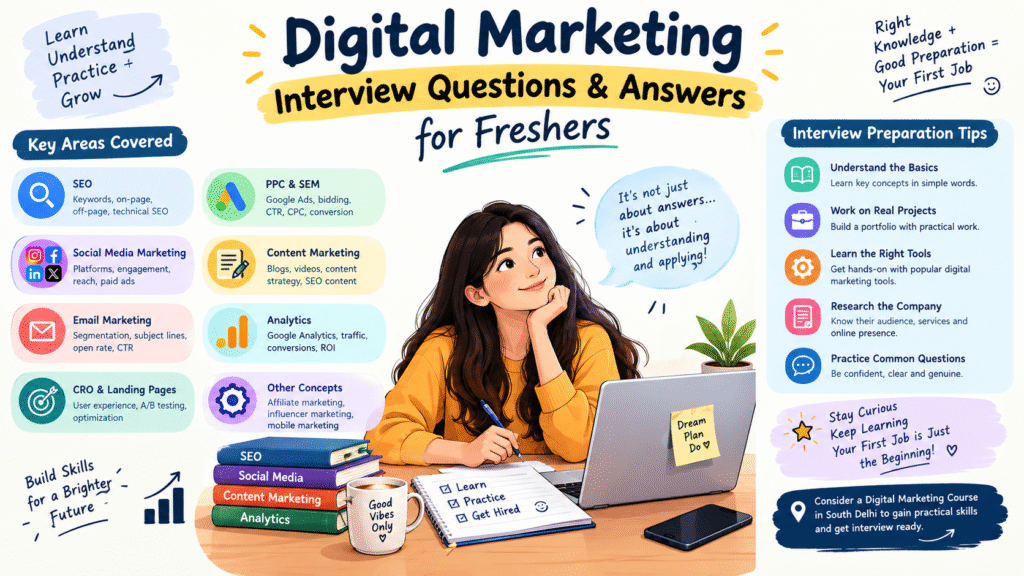
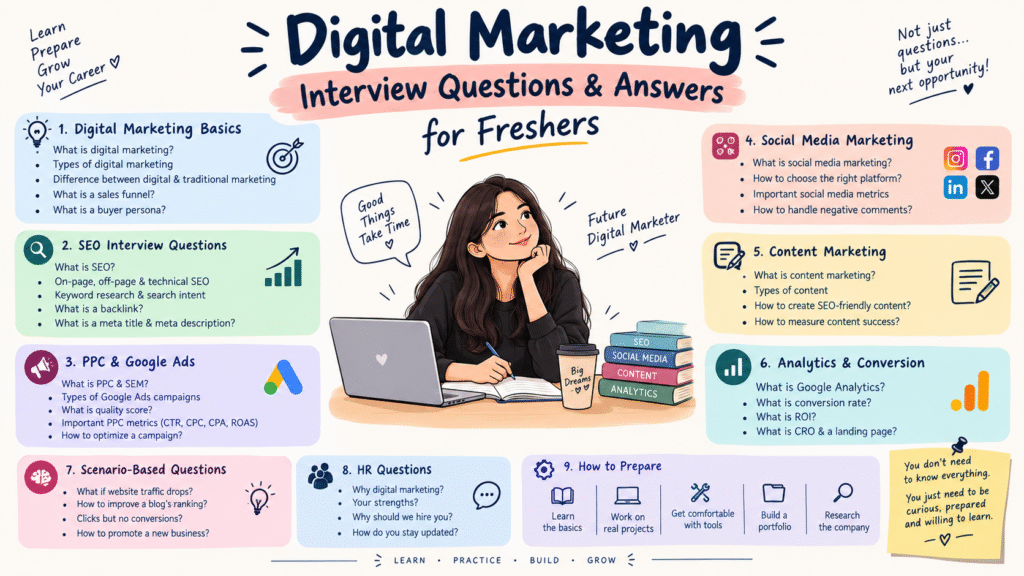
Topics include SEO, PPC, Google Ads, social media, and analytics.It also covers HR questions and real interview situations.
Prepare for the latest 2026 interview topics.
This guide helps build that understanding; practice explaining each idea in your words. Whether you are a student, intern, or career switcher, the goal is the same. Enter your interview ready to solve problems, not just recite definitions.
What Is Digital Marketing?
Digital marketing includes marketing activities on digital channels. It uses digital devices and platforms to promote products, services, and brands. It includes things like paid advertising campaigns, SEO, content marketing, social media marketing and many other things.
What Are the Different Types of Digital Marketing?
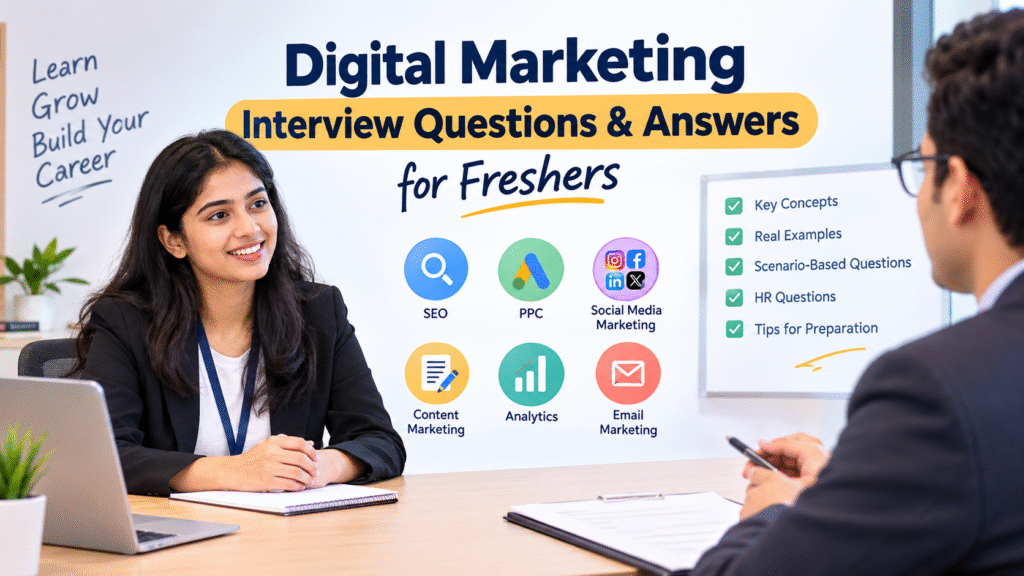
Digital marketing uses several channels. Key channels include SEO, PPC, social media, content, email, affiliate marketing, and analytics.. Many businesses use several channels together. Each channel supports a different stage of the sales funnel, such as awareness, consideration, or conversion.
What Is SEO?
SEO (Search Engine Optimization) helps improve your website’s organic search ranking. It includes keyword research, website optimization, technical fixes, and backlink building. These practices help search engines and users find your website relevant and trustworthy.
What Is the Difference Between SEO and SEM?
SESEO focuses on organic rankings through content and technical improvements. SEM uses paid marketing for faster visibility and depends on the advertising budget. Most digital marketing strategies include both without necessarily leaning toward one.
What Is the On-Page SEO?
On page SEO includes title tags, meta descriptions, headings, keyword use, internal links, image alt texts and the content itself. SEO will help make the page clear for search engines and, for people.
What Is the Off-Page SEO?
Off-page SEO focuses on activities outside your website. These activities improve website relevance and authority. They include relevant backlinks, brand mentions, and digital PR. Backlink quality matters more than quantity. A few relevant backlinks can outperform many irrelevant ones.
What Is the Technical SEO?
Technical SEO focuses on website improvements made in the backend. It includes crawlability, indexability, loading speed, mobile-friendliness, and structured data.
A website may have valuable content. However, search engines must crawl and index it before it can rank in search results.
What is a Keyword ?
A keyword is a word or a phrase, such as google analytics login, a person might enter into a search engine when they’re searching for something. They are helpful to marketers because they provide data about your content and your campaigns.
What Is Keyword Research?
Keyword research is the process of finding and assessing a keywords for relevance, search volume, competition, and user intent with regards to a specific business.
Don’t build your blog based on trying to rank for the most searched for keyword, but look for low competition keywords and high search volume keywords that your target market searches for.
What Is Search Intent?
Search intent is the purpose behind a search query which can be usually mapped into four categories: informational (“what is SEO”), navigational (“Google Analytics login”), commercial investigation (“best digital marketing course”), and transactional (“enroll in digital marketing course”). Matching content and search intent can rapidly improve your rankings and conversions.
What Is a Meta Title?
A meta title is the title you see in search engine listings when your website shows up on the results page. Your meta title should be relevant to the content of the page, should include the target keyword naturally, and be within 60 characters.
What Is a Meta Description?
The meta description is the snippet of text you see under a search engine listing that provides a summary of that page’s content. Meta descriptions may not directly affect rankings but they do affect clickthrough, so well written meta descriptions offer compelling reasons to actually visit that web page.
What Is a Backlink?
A backlink, also known as inbound links or incoming links, are links from one website to another.
A trusted website backlinks to your page giving you credibility in the eyes of search engines, but the backlink needs to be pertinent as well.
What Is Internal Linking?
Internal links connect two pages on the same website. This assists search engines to find and index other pages and assists users to easily find related content on your website.
Social Media Marketing Interview Questions
What Is Social Media Marketing?
Social media marketing is the discipline of managing and growing an enterprise’s reputation and positioning in the Social Media space. It encompasses both paid social advertising and organic social media activities on various social media channels such as Facebook, LinkedIn and Instagram, depending on where your organisation’s audience is present and the overarching goals of your organisation.
How should we choose a social media channel to promote a specific organisation?
Identify who is your customer and see which channels they are actually in. For example, B2B company would probably focus on LinkedIn and a visual brand could go straight for Pinterest and Instagram. Review what you find and don’t be afraid to change your emphasis – try not to be everywhere at once.
What Are the Main Social Media Metrics?
Every platform has a variety of metrics that signal success – we can share the right ones for your goals.
For awareness, look at reach and impressions; for a community, followership growth and engagement rate; for conversions, check leads and sales. Tie each metric back to the task at hand.
PPC and Google Ads Interview Questions
What Is PPC?
Pay per click or PPC is an internet advertising model where publishers of the service are paid by advertisers based on how many people or users click on their service or website. It is a way of pricing a service and is often used to direct users to a website.
What Are Google Ads?
Google Ads is Adwords – all search, display, video and shopping campaigns can be run through Google Ads. Its best to be able to explain the following fundamentals to someone who’s never run an agency account, without having ever done so yourself – campaign, ad group, keyword, bid, quality score, landing page and conversion.
What Is CTR (Click-Through Rate)?
UTMA”Clicks-Through-Rate. The time when it will take everyone to see the ad and link after it will take for anyone to catch it. The formula for CTR is as follows: (Clicks Impressions) 100.
So in this example it’s 20 clicks from 1000 impressions – that’s a 2% CTR.
This shows you how appealing your ad or headline is.
What Is Conversion Rate?
The number of conversions divided by the number of total visitors to a website Time To Convert Conversion Rate = Total Conversions 100 Visitors So if you get 1,000 visitors on your landing page and 50 of them convert, you have a 5% conversion rate.
Outside of ad campaigns, Google Ads offer keywords data including keyword quality scores and pricing – useful for optimizing content and for making SEO related decisions as well. Sometimes, interviewers want to see if you can tell them how to hook up a tool to the thing being measured. This includes both things in this section.
Google Analytics (GA4)GA4: The Google web analytics platform which informs us where traffic is coming from, what the user does on site and what channel has led to conversions. Freshers should be able to open traffic sources, see a few basic conversion events from a training project rather than client site.
Google Search Console, which tells you what your site looks like on Google Search, your search traffic, indexing issues, and technical issues to look for on your site. This is also checked when your organic traffic drops unexpectedly.
Google Ads In addition to paid campaigns, Google Ads provides insights into keywords along with quality score and cost data – insights which help with your SEO and content decisions as well.
Website Tags Google Tag Manager – The cheat sheet is a tool that enables marketers to put tracking tags on websites such as conversion tags or Google 4 (GA4) occasions, without requiring to change your site code. It is a popular use for this tool to set up conversion tags for landing pages.
What Is CPC (Cost Per Click)?
Cost-per-click (CPC) The cost-per-click is the amount paid by the advertiser for a click on their ad. CPC is driven by the competition, but also the relevance and quality score of your keyword and is one of the last management levers for the budget.
What Is CPA (Cost Per Acquisition)?
Why It Matters Your Average CPA (Cost Per Acquisition) is the average cost per conversion (sale, sign-up, or lead) based on all the channels you’re using. It’s more accurate of a success indicator than clicks because it ties spend to tangible business results.
What Is ROAS (Return on Ad Spend)?
Return on ad spend (ROAS) – the revenue your ad campaigns generate for every dollar spent on your advertising; or, to put it another way, 4:1 – you made $4 for every $1 you spent on advertising. Return on ad spend is one of the most straightforward metrics to measure the success of your paid campaign.
What Are UTM Parameters?
UTM stands for ‘Urchin Tracking Module’ and are tags added to URLs to help you identify what content / channels are bringing in visitors. Think of these as tracking codes – they tell you if people clicked on an email vs. a social media post.
What Is a Landing Page?
Definition of Landing Page A landing page is a single web page without navigation, designed specifically around one goal – usually aligned to a single ad or campaign and focused on converting someone into a lead or offers.
What Are Core Web Vitals?
Core Web Vitals: loading, interactivity and visual stability Google’s page experience metrics The impact on rankings and conversions of not meeting Core Web Vitals Because Core Web Vitals are clearly visible to visitors, web pages with bad LCP, FID and CLS can affect conversions due to bad user experience.
Content Marketing and Analytics Questions
What Is Google Analytics?
Google Analytics gives us insight into the behaviour of the users on your website – where they have come from, what they do on the website and what campaigns create results.It’s not the data that is valuable, but what you do with it.
What Is Content Marketing?
Content marketing is the art of creating appealing and useful content to gain a target market. It is not created to fill a page with text but is created in answer to their questions or making their life easier.
How Do You Create SEO Friendly Content?
Understand your target audience and what they are searching for and the search intent behind the queries, research for relevant keywords and construct headings then create original content which really answers the question and naturally optimise for the title, headings, URL and internally link without over optimising for keywords – ensure the content is created for the reader.
Scenario Based Digital Marketing Interview Questions
Scenario based questions help to assess your decision-making skills under pressure. It is important to answer such questions step by step, defining a problem, investigating it and identifying a solution.
All suddenly Lost Organic Search traffic on my website, what can I do?
Start with is this a first-party or third-party issue. First, identify when the loss in traffic began and whether it was overall traffic loss or it was specific to certain pages. Second, check if there are indexing issues present in Search Console, if certain keywords have changed rank, if an algorithm has rolled out, or if a site or content has been changed. Third, sequence the traffic loss causes and track for CTR after fixing those issues.
Suppose You Were No Longer Driving Organic traffic To your website?
Learn if it was a first- or third-party problem. – Firstly, find out when and on which pages the loss of traffic occurred. Were all pages affected or only certain URL? – Secondly, explore for indexing issues on Search Console, Search ranking updates, Search algorithm changes, Design or content update to website. – Thirdly, determine the cause of the website performance and record the search CTR trend after fixing the errors.
What Will You Do When Your Blog Post Is Not Ranking Well When It Is Well-Written?
Start your research by figuring out the keyword and search intent your blog post is trying to rank for. Many times, a blog post will be optimized for the wrong keyword with the wrong intent, so this is where it’s great to compare your prompt blog post to the top 3 similar ones. Then, identify if you can find any updates, omitted information or internal linking and technical SEO issues.
What Would You Do If a Pay-Per-Click Campaign is Getting Clicks but No Conversions?
Are you aware of your conversion funnel, and where your prospect fell of and why? If you are working a targeted PPC ad campaign with the correct keywords and are still not converting, look at your landing page, landing page CTR, page speed, user experience, mobile responsiveness and the set-up of your conversion pixel.
What Would You Do If an Ad Campaign is Getting Impressions But a Poor CTR?
High impression, low-CTR campaigns show that the ad might be irrelevant to the searchers. Is the ad copy attractive enough? Is the ad copy aligned with the search intent? Try to create different headlines and calls-to-action and analyze how the position of the ad and ad extensions can impact the CTR.
What Would You Do If Your CPC Suddenly Shoots Up? What Could Be the Possible Reasons?
I would first check whether competition for the targeted keywords has increased. I would also review the Quality Score to see if it has decreased and check for any recent changes in bidding strategies or budget allocation. Additionally, I would evaluate keyword relevance and ad performance, as these factors can also affect CPC.
What Would You Do If Your Landing Page Does Not Generate Good Conversions? How Would You Fix It?
I would analyze the page speed, whether the design was mobile optimized, how relevant the ad was to the landing page and the amount of friction on the page. In general, the most visit-related issues that affect the friction of a page, including form fields, can affect the conversion rate more than the traffic.
What Would You Do If a Page Is Indexed, but Get Little or No Traffic?
It’s a different context than a page that previously ranked well but fell in the rankings. Here, I would examine the content relevancy and volume in relation to your other pages, its success in answering the searcher’s questions, and whether other pages on your site link to it.
How Would You Promote a New Business Online?
After identifying the business, its target audience, competitors, budget and objectives, I would start by selecting the most relevant channels for the company, set up key performance indicators, set up campaigns, and optimize the marketing mix based on the observations and not favoring one channel over the others without reasoning.
HR Interview Questions for Digital Marketing Freshers
Why Do You Want to Pursue a Career in Digital Marketing?
The best answer here will be one which can connect your genuine interests in creating, communicating and analyzing information to digital marketing in some way. Avoid generic answers; come up with something that will have actually inspired you.
Reasons To Hire You As A Fresher What Is The Reason To Hire You As A Fresher?
Remember that you are a freshers yourself so do not have high Expectations from freshers. State that may be a fool, but never lack information about the new software, this keeps the freshers updated of their own new knowledge, so you all know the value of feedback.
What are your strengths as Digital Marketing Fresher?
State 2 to 3 strengths such as research, data, analytical thinking, creativity and flexible among others. Support with few examples from internship, classroom project and certification.
Never simply enumerate a few common strength.
What are Your Weaknesses?
Consider a real weakness you have, that is pertinent to the job, and are actually trying to improve it, so the interviewer knows you are actually making an effort to succeed. For example, you may not have experienced running a campaign in Google Adwords but you are doing it on a test basis.
Where do you see yourself 5 years from now?
Describe what you would have learned in the short run (e.g., deep dive into content marketing) and then how you would have narrowed to your long term goal (e.g., digital analyst).
How Can You Stay on Top of the Trends in Digital Marketing?
Reference good sources like platform blogs, industry emailers & webinars – and then mention that you have learnt by trying a few tricks yourself.
What Did You Study During Your Internship or School Assignment?
Be precise about the work you did and what you learned from it (not necessarily anything huge like the millions of keywords in a campaign).
Digital Marketing Interview Preparation Tips for Freshers
Learn the Basics Before Learning the Answers When I cannot explain anything without quoting a definition, I am not yet prepared to speak about that topic. I focus on learning how to explaining SEO, PPC and many other concepts in my own words.
Practice Makes Your Answers More Convincing
Working on practical tasks instead of studying theory. I do keyword research, a mini‑SEO audit a sample Google Ads campaign and create a content calendar. It helps me make more impressive answers during my interview, as I can give examples from practice.
Learn Tools You Mention on Your Resume
If my resume says I have experience with Google Analytics, Search Console or SEO tools it means I need to prepare a deep answer about what I did with them. I avoid such words as managed or optimized without explaining what specific actions I took with these tools. I always try to be precise describing my past involvement to prevent exaggerations. Mentioning particular metrics or results achieved with the help of these tools can also be a good idea.
Create a Simple Portfolio
I gather different materials that demonstrate my skills. Even if these are samples or tasks from trainings, they still show what I can actually do. I put them all together in one portfolio to impress my future employer with more tangible evidence of my abilities.
Research the Company to Find Some Insight
Before the interview, I spend time learning about the company. My research covers its products or services, target audience, media channels, and competitors. I also look for possible improvements in the website, content strategy, and SEO. This way I show initiative and interest in the company and maybe even find some valuable issues to discuss during the interview.
Common Mistakes Freshers Must Avoid
Memorizing Every Answer Word by Word
Interviewers ask follow-up questions. If your answer is memorized of understood you will have trouble when the conversation moves just a little bit away, from what you prepared.
Claiming Skills You Don’t Actually Have
If you have only used Google Ads in a course say that. Overstating skills usually gets found out by a question that comes after.
Focusing on Rankings, Traffic or Followers
Businesses care about results. Leads, sales, retention. Not fake numbers. Talk about how your answers affect the business much as possible.
Ignoring the User Behind the Data
When you talk about SEO, Ads or Content always links your answer to what the real people need, not what benefits a figure.
Not Preparing Your Questions for the Interviewer
Be prepared to ask 2 or 3 well thought out questions. Questions about the team or the role shows genuine interest in the position, and not just an application to another job.
Digital Marketing Interview Prep for 2026: What Is New
How AI Tools Are Changing Jobs, in Digital Marketing
I have seen that AI tools are now often used to write versions of content create several ad copy choices and sum up analytics data more quickly. Freshers are not expected to be AI experts. They should understand what AI tools can and cannot do reliably.
What Interviewers Now Expect From Freshers on AI and Automation
Familiarity beats mastery here. Being able to explain how you have used one AI tool in a project. Even a small one. Is far more convincing than claiming broad expertise you can’t back up.
STAR Approach to Response Behavioral Inquiries
The STAR method. Situation, Task, Action, Result. Is a framework for responding to HR and behavioral questions in a structured way. It is particularly useful for questions such as, ‘describe a project you have been involved in’ which require a concise answer.
Preparing for your digital marketing interview is not about memorizing many definitions. Digital marketing interview is about understanding why a strategy works, how the key tools and metrics are linked and how you would use that thinking in a situation. Use this guide to build that understanding across SEO, PPC, social media, analytics and HR rounds and practice explaining each answer in your words. You do not have to know everything, as a fresher.What makes you unique is communication, realness and developing a solution by talking about it.
Ready to Start Your Digital Marketing Career?
Practical knowledge can make your preparation much stronger. NSIM National School of Internet Marketing offers marketing training that focuses on real-world learning. The programs include industry-focused modules, live projects, case studies and career support to help you build skills that matter.
From SEO and Google Ads to media marketing, data analytics and AI‑powered marketing NSIM covers all the areas of digital marketing. Depending on the course you choose you can also gain internship experience in marketing, earn recognized certifications for digital marketing and get placement assistance for digital marketing.
If you are serious about launching your marketing career NSIM can help you take the steps.Explore their programs. Find a course that matches your goals.
👉 Explore NSIMs Digital Marketing Courses | Book a Free Demo
FAQs
A course in digital marketing can certainly contribute towards knowledge and project experience but self-practice and practice interviews are also equally essential.
(30–60 seconds per answer) This allows enough time to walk us through your thinking, while keeping a single question from turning into a lengthy explanation.