The Evolution of Online Business Visibility
Create Google Business Profile Using Chatgpt Initially, online visibility mainly depended on traditional search engines like Google, where businesses focused on keywords, website rankings, backlinks, and SEO to appear in search results. Later, platforms such as Facebook, Instagram, YouTube, and LinkedIn created new opportunities for businesses to connect directly with their audiences, build brand awareness, and generate customers.
Today, online business visibility is entering a new phase with the growth of Artificial Intelligence (AI). People are no longer relying only on traditional search engines to discover businesses. They are increasingly using AI-powered platforms such as ChatGPT, Google AI Overviews, Gemini, and Perplexity to find information, compare services, and receive recommendations.
This shift has changed how businesses need to approach their online presence. Simply ranking on Google is no longer the only goal. Businesses must also build credibility, publish useful information, maintain accurate business details, and establish a strong digital reputation so that AI-powered platforms can understand, recognise, and potentially recommend them.
In simple terms, online business visibility has evolved from simply being present on the internet to being discoverable, trustworthy, and recommended across multiple digital platforms. This evolution represents a major change in digital marketing and highlights the growing importance of combining traditional SEO, social media marketing, online reputation management, and AI visibility strategies.
Understanding Google Business Profile (GBP)
Google Business Profile (GBP), formerly known as Google My Business (GMB), is a free business listing platform provided by Google that helps businesses establish their presence across Google Search and Google Maps. It allows businesses to display important information such as their business name, address, phone number, website, working hours, services, products, photos, and customer reviews.
The main purpose of Google Business Profile is to help customers discover local businesses when they search for a particular product, service, or business category. For example, when someone searches for “Digital Marketing Agency in South Delhi”, Google may display a list of relevant businesses along with their locations, ratings, contact details, and directions.
Unlike traditional website SEO, where businesses mainly focus on ranking their web pages, Google Business Profile focuses on improving local business discovery. It gives customers quick access to essential business information without requiring them to visit the company’s website.
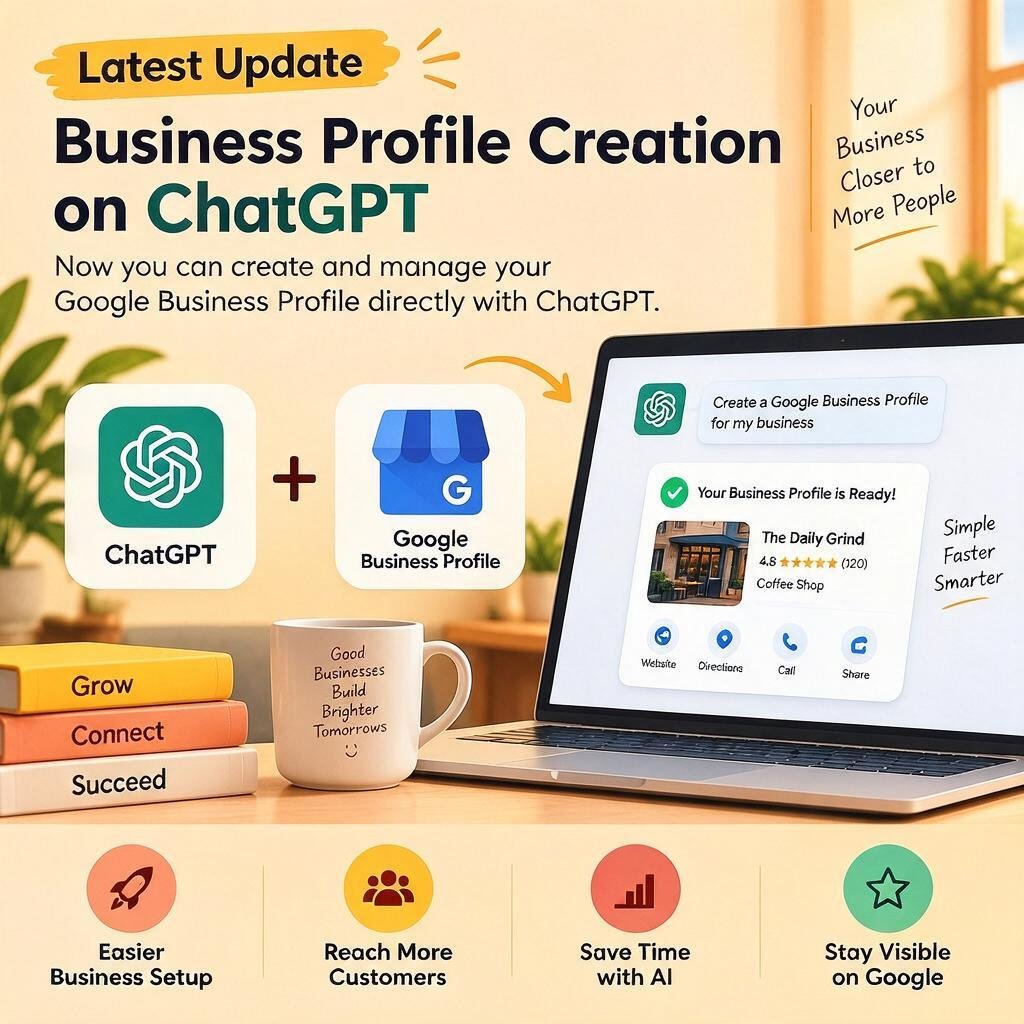
Latest ChatGPT Business Profile Updates (2026)
1. Business Profile Claiming: Businesses can claim existing business listings through ChatGPT Business Hub.
2. Business Verification: Businesses can verify ownership through phone, email, website domain, and identity verification.
3. Verified Business Badge: Eligible businesses receive a blue verification badge after successful verification.
4. Business Information Management: Owners can update business descriptions, websites, logos, services, products, and other details.
5. Business Performance Insights: Businesses can monitor aggregated mentions, website clicks, profile views (where available), and discovery topics.
6. Business Agents: AI-powered agents can answer customer questions and provide product and service information.
7. Product Feed Integration: Businesses can connect Shopify or upload compatible CSV product feeds.
8. ChatGPT Ads Integration: Eligible businesses can promote their Business Agents through sponsored placements.
9. Improved Product Discovery: ChatGPT can use structured product information to help customers explore products.
10. AI-Powered Customer Interaction: Businesses can use AI agents to support product discovery and customer enquiries.
11. Business Profile Updates: Business information changes can be submitted for review before publication.
12. Limited Regional Availability: Some features, particularly local business claiming and Business Agents, remain restricted to eligible businesses in supported markets.
What is ChatGPT Business Hub?
ChatGPT Business Hub is a business management platform designed to help businesses manage their presence and visibility within ChatGPT.
It allows eligible business owners to claim their existing business listings, verify ownership, update business information, and access performance insights.
The main purpose is to help businesses maintain accurate information so customers can discover and learn about them through ChatGPT.
How to Create or Claim a Business Profile on ChatGPT
OpenAI has introduced Business Hub, where eligible businesses can claim their existing listings, verify ownership, and manage their business information.
Here is the step-by-step process.
Step 1: Open ChatGPT Business Hub
Visit the official page:
OpenAI – Claim Your Business on ChatGPT
Sign in using your ChatGPT account.
Step 2: Search for Your Business
- Open Business Hub from the ChatGPT sidebar.
- Search for your business name.
- Select the correct business listing.
- Confirm the ChatGPT account you want to use to manage it.
Step 3: Verify Business Ownership
Choose one of the verification methods offered for your business.
| Verification method | What you need |
| Business Phone | SMS or automated call |
| Business Email | Access to official business email |
| Website Domain | Access to domain DNS settings |
| Shopify Store | Access to the business Shopify account |
For website verification, ChatGPT provides a TXT record that must be added to your domain’s DNS settings.
Step 4: Complete Identity Verification
After claiming the business, complete identity verification through Persona.
You may need:
- Government-issued identification.
- Business registration information.
- Proof that you are authorised to represent the business.
OpenAI reviews your submission and sends the verification decision by email.
Important
Claim approval and Persona identity verification are separate steps. The blue verified badge appears after Persona verification is approved.
Step 5: Update Your Business Profile
Once the required approvals are completed, open your business profile and update:
- Business name and description.
- Website URL.
- Business category.
- Logo and cover image.
- Products and services.
- Delivery and return policies.
- Other relevant business information.
OpenAI reviews submitted changes before publishing them.
Step 6: Connect Your Product Feed (Optional)
If your business sells products online, you can connect a Shopify product feed or upload a compatible CSV file.
This helps provide ChatGPT with structured information about your products, pricing, and availability.
Step 7: Monitor Business Insights
After verification, visit the Insights section to monitor:
- Business mentions.
- Website clicks.
- Discovery topics.
- Aggregated business engagement.
Understanding ChatGPT Business Agents
1. What Are ChatGPT Business Agents?
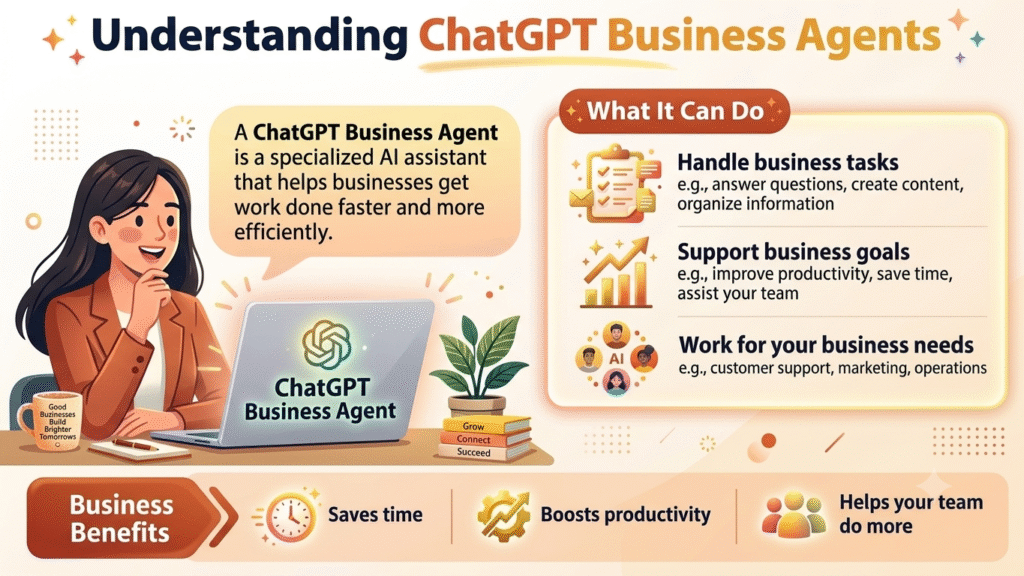
ChatGPT Business Agents are AI-powered virtual assistants that businesses can create to communicate with potential customers through ChatGPT.
These agents are designed to answer customer questions, explain products and services, provide relevant business information, and help customers understand what a business offers.
Unlike a traditional chatbot that usually follows fixed questions and answers, a Business Agent can understand natural-language questions and provide responses based on the business information and instructions supplied by the owner.
In simple words: A ChatGPT Business Agent works like a virtual sales representative for a business. It helps customers explore products, understand services, and get answers without immediately contacting a human representative.
2. How Do Business Agents Work?
Business Agents use the information provided by a business to answer customer questions.
For example, imagine a customer wants to purchase a laptop from an online electronics store.
Instead of searching through multiple product pages, the customer can start a conversation with the store’s Business Agent.
The customer might ask:
- Which laptop is best for students?
- What is the difference between these two models?
- What is the product price?
- What is your return policy?
- Does this product come with a warranty?
The Business Agent can use the business’s available product information and policies to answer these questions.
3. Key Features of ChatGPT Business Agents
Customer Support: Answers frequently asked questions about products, services, and business policies.
Product Discovery: Helps customers explore available products and understand their features.
Personalised Conversations: Understands customer questions and responds according to their requirements.
Business Information: Uses information provided by the business to explain its offerings.
Website Redirection: Can direct customers to the business website to complete purchases or take further action.
Agent Customisation: Businesses can review the information and instructions used by their agents before publishing.
4. How to Create a ChatGPT Business Agent
The basic process is:
01 Claim your business
Access your eligible business profile through Business Hub.
02 Complete verification
Get business claim approval and Persona identity verification.
03 Create your agent
Open your business profile and create an agent if eligible.
04 Add business information
Provide product details, services, policies and instructions.
05 Test your agent
Ask common customer questions and check response accuracy.
06 Publish your agent
Review the final version and select Publish.
A business must have an approved claim and Persona verification before creating and publishing an eligible agent.
How ChatGPT Helps Customers Discover Businesses
A. Understanding Customer Queries
ChatGPT understands what customers are looking for instead of depending only on short keywords.
For example, a customer can ask:
“I need an affordable website development agency near South Delhi for my small business.”
ChatGPT understands the customer’s requirements, location, and service preferences to help find relevant options.
B. Searching Across the Internet
When ChatGPT Search is used, it can retrieve information from publicly accessible websites and other online sources.
These may include:
- Official business websites.
- Online business directories.
- Review platforms.
- Industry-related websites.
- Local business guides.
- Published articles and recommendations.
ChatGPT can provide links and citations so customers can explore the original information.
OpenAI Help Center+1
C. Showing Relevant Business Recommendations
Based on the customer’s query and available information, ChatGPT can present relevant businesses.
For example, it may help customers compare agencies based on their services, location, pricing information, and reputation where reliable information is available.
D. Helping Customers Compare Businesses
Customers can ask ChatGPT to compare different businesses before making a decision.
For example:
“Compare three digital marketing agencies based on their SEO services, experience, pricing, and customer reviews.”
This makes the discovery process easier because customers can explore multiple options within one conversation.
E. Providing Business Information
ChatGPT can help customers understand important business details, such as:
- Business name and location.
- Products and services.
- Website and contact information.
- Available pricing information.
- Customer reviews from accessible sources.
- Working hours, where available.
The information depends on what ChatGPT can access and verify.
F. Directing Customers to Business Websites
Once customers find a suitable business, ChatGPT can provide website links and other relevant sources.
Customers can visit the website to explore services, check product details, make enquiries, or complete purchases.
How Can Businesses Improve Their Visibility on ChatGPT?
Businesses can improve their chances of being discovered by maintaining a strong and consistent online presence.
The following practices are useful:
- Maintain an informative and accessible business website.
- Publish helpful and relevant content.
- Keep business details accurate across online platforms.
- Collect genuine customer reviews.
- Build authority through relevant websites and publications.
- Use structured information to explain products and services.
- Allow OpenAI’s OAI-SearchBot to crawl the website.
Common Challenges and Limitations of ChatGPT Business Profile
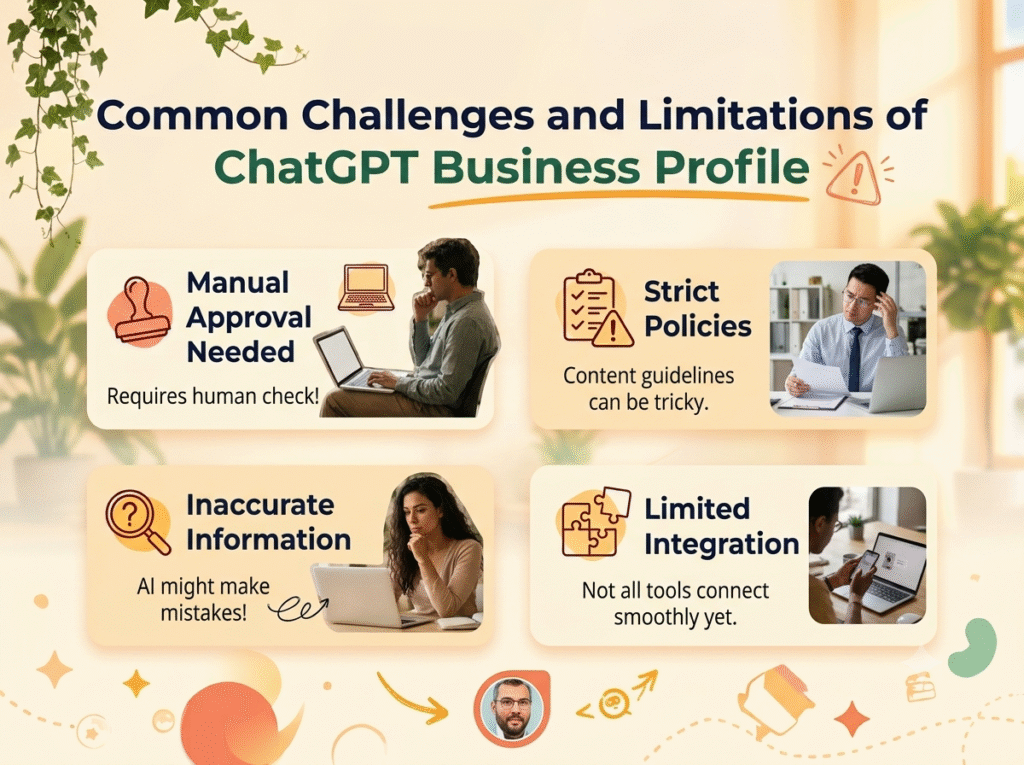
1. Regional Availability
One of the biggest challenges is limited regional availability.
Not every business can currently access all Business Hub features. Availability depends on business location, industry, and verification requirements.
For example, local stores and restaurants currently have restrictions on claiming listings through the self-service process outside the United States.
2. Business Verification Issues
Businesses must prove that they own or are authorised to manage a business profile.
Verification may require access to a registered business email, phone number, website domain, Shopify account, or identity documents.
If business information does not match official records, verification can become difficult or delayed.
3. No Guarantee of Business Visibility
Claiming a business profile does not guarantee that ChatGPT will recommend or display the business in every relevant search.
ChatGPT independently generates recommendations based on available information and user queries.
Even after verification, a business may not appear in every relevant conversation.
4. Limited Control Over Business Information
Business owners can submit updates to their profiles, but they do not have complete control over how ChatGPT represents their business.
OpenAI may use information from other online sources, supplement submitted information, or decline to display certain details.
This means businesses must maintain consistent information across their website and other online platforms.
5. Delayed Profile Updates
Changes submitted through Business Hub may require review before publication.
For example, if a business updates its website, description, logo, or service information, the changes may not appear immediately in its profile or ChatGPT responses.
This can create difficulties when businesses need to communicate urgent updates.
6. Limited Performance Tracking
Business Hub provides aggregated insights such as business mentions, website clicks, and discovery topics.
However, it does not provide complete information about individual customer conversations.
Businesses cannot directly identify every customer query that led to a recommendation or understand the exact reason behind each interaction.
Some performance metrics may also remain blank when reporting thresholds are not reached.
7. AI-Generated Information Accuracy
AI-generated responses may sometimes contain incorrect, incomplete, or outdated business information.
For example, ChatGPT might display outdated service details or misunderstand a business’s offerings.
This can create confusion for customers and affect their purchasing decisions.
8. Limited Business Agent Availability
Business Agents have separate eligibility requirements.
Currently, they are available to eligible e-commerce and online-service businesses in the United States.
This means many local businesses and businesses in other countries cannot yet use all Business Agent features.
9. Product Feed Management Challenges
Businesses selling products can connect supported product feeds to share product information, pricing, and availability.
However, maintaining these feeds requires regular updates and accurate product data.
Incorrect product URLs, missing information, mismatched website domains, or technical feed errors can create problems.
10. Dependence on Online Reputation
ChatGPT can use information from different online sources when answering questions about businesses.
If a business has inconsistent information, limited online content, or a weak digital reputation, it may be harder for customers and AI systems to understand its services and credibility.
Maintaining a trustworthy online presence therefore remains important.
Future of AI-Powered Business Discovery
1. Conversational Business Search
In the future, customers will increasingly use natural language to find businesses. Instead of typing simple keywords, they will explain exactly what they need. AI platforms can understand these requirements and help identify relevant businesses based on available information.
2. Personalised Recommendations
AI will make business discovery more personalised by understanding customer preferences, budgets, locations, and requirements. This can help customers find services and products that better match their needs rather than browsing through hundreds of unrelated results.
3. Growth of AI Business Agents
AI Business Agents will play an important role in future customer interactions. Businesses will be able to use AI-powered assistants to answer questions, explain services, share product information, and guide potential customers. These agents may become an important part of digital customer support and sales.
4. Evolution of Search Engines
Traditional search engines mainly display websites and advertisements. AI-powered search is moving towards providing direct answers, summaries, and relevant business suggestions. As a result, businesses will need to focus on creating clear, useful, and trustworthy online information.
5. Integration of Business Profiles
Business profiles will become increasingly important for AI-powered discovery. Accurate business names, descriptions, contact information, services, and product details can help digital platforms understand what a business offers. OpenAI’s Business Hub is an example of this developing approach to business information management.
6. Voice-Based Business Discovery
Voice assistants will provide another way for customers to discover businesses. People may simply ask their devices to find nearby restaurants, repair services, shopping stores, or other businesses. AI will make these searches more natural and convenient.
7. AI-Powered Shopping Experience
AI will also change how customers discover and compare products. Instead of manually visiting multiple websites, customers can ask AI platforms to compare product features, prices, and available options. This may make online shopping more informative and easier.
8. Changing Role of Digital Marketing
Digital marketing will gradually expand beyond traditional SEO and social media marketing. Businesses will also need to focus on AI visibility, Generative Engine Optimisation (GEO), online reputation, structured content, and accurate business information to improve their discoverability across AI platforms.
9. Challenges and Opportunities
AI-powered discovery will create new opportunities, but competition for visibility will also increase. Businesses may face challenges related to inaccurate information, changing AI systems, limited performance data, and uncertain recommendations. Maintaining a trustworthy and consistent online presence will become increasingly important.
Conclusion: The Evolution of Online Business Visibility and the Future of AI-Powered Business Discovery
The evolution of online business visibility has completely changed how businesses connect with customers. From traditional search engines and Google Business Profile to AI-powered platforms like ChatGPT, Gemini, and Perplexity, the process of discovering businesses is becoming more advanced, conversational, and personalised.
With the introduction of ChatGPT Business Hub and Business Agents, businesses are getting new opportunities to manage their online presence, provide accurate information, interact with customers, and improve their visibility across AI-powered platforms. Customers can now use AI to discover businesses, compare services, understand products, and make more informed decisions.
However, AI-powered business discovery also comes with challenges, including regional restrictions, verification difficulties, information accuracy, limited performance tracking, and no guarantee of business recommendations. Therefore, businesses should not depend entirely on AI platforms or ignore traditional digital marketing practices.
Ultimately, the future of online business visibility is not just about ranking on Google or appearing in search results. It is about making a business easy to find, understand, trust, and recommend across both traditional search engines and AI-powered platforms.
Frequently Asked Questions
No. ChatGPT does not directly create or publish a Google Business Profile. However, its new Businesses in ChatGPT feature allows eligible businesses to claim and manage their presence within ChatGPT through Business Hub.
Businesses in ChatGPT is a new OpenAI feature that allows companies to claim their business listings, update information, manage product details and view business engagement insights.
You can visit ChatGPT’s Business Hub, search for your business and follow the claiming and verification process. Once approved, you can manage the available business information.
Claiming your business profile and managing its information through Business Hub does not require you to purchase advertising. Advertising and Business Agent features are separate offerings.
No. Claiming a business on ChatGPT does not directly improve its Google rankings. Google rankings and ChatGPT’s business discovery are separate systems.
ChatGPT uses a verification process through Persona. Businesses may need to provide official business information and complete the identity verification steps requested during registration.
Yes. Once your business claim is approved, you can update supported information such as your business details and other available profile information through Business Hub.
ChatGPT can mention businesses when users search for relevant products, services or local recommendations. However, claiming a profile does not guarantee that your business will appear more frequently or receive recommendations.
A Business Agent is an AI-powered assistant that allows eligible businesses to interact with potential customers, answer questions and provide information about their products or services. Availability depends on business eligibility.
Yes. Business Hub provides aggregated insights, including business mentions, website clicks and discovery topics. These insights help businesses understand how people discover them through ChatGPT.