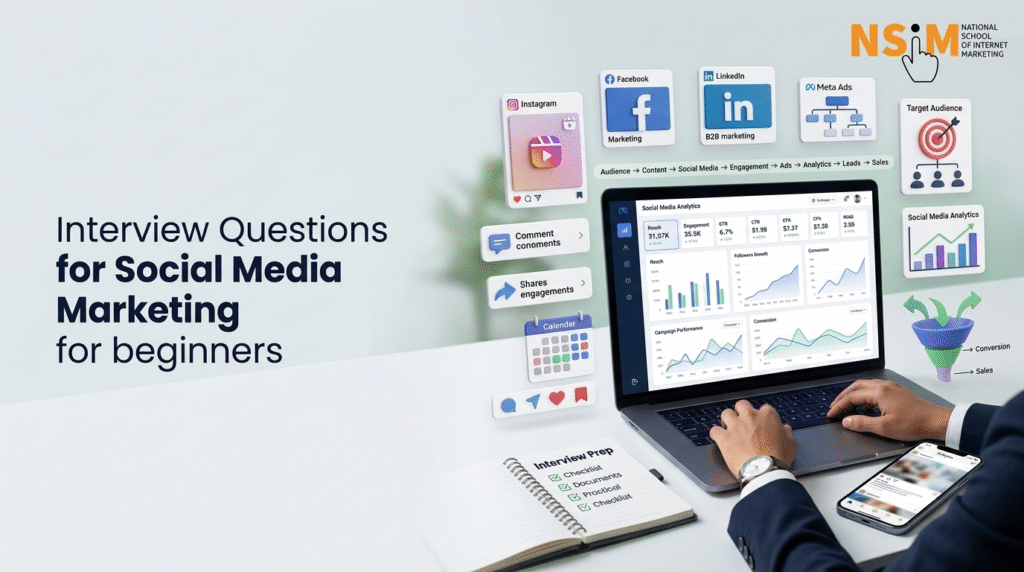
Social media marketing plays an indispensable role in digital marketing due to the growing business presence of Instagram, facebook, linkedin, youtube and other related sites for building brand awareness, engaging and communicating with potential customers and lead generating and sales. Accordingly, business is looking for talented individuals who can comprehend both social media and business marketing aspects.
For a social media marketing interview the interviewer can ask many things regarding content making, Social Media Strategy, social media analytics, paid advertising, targeting specific audience, engagement and campaign optimization and so on. For the freshers they can ask common and basic questions, on the other hand they can ask practically/scenarios based questions to the executives and manager level.
This guide gives a comprehensive list of the social media marketing interview questions and answers covering new employees (freshers), interns, executives, managers and experienced individuals, also includes interview questions in reference to Meta Ads, Instagram, Facebook, Linkedin, analysis and content marketing, as well as various tools and interview questions regarding the job scenario.
Social Media Marketing Interview Questions: Quick Overview
What to Expect in a Social Media Marketing Interview
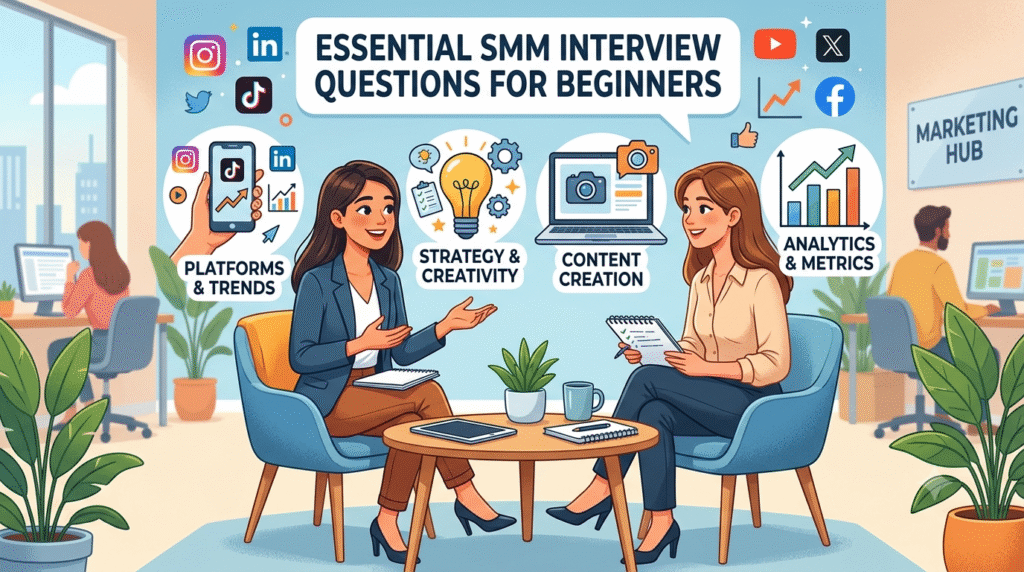
Social media interviews could consist of following types of questions: theoretical, technical, analytical, and behavioral. Interviewers might test your understanding of social media terminology, expect you to plan a campaign strategy, evaluate performance of existing social media campaigns, deal with negative feedback on social media profiles or create a fictional social media marketing solution.
It’s more likely that interviews test decision-making skills, efficiency at implementing campaigns, effectiveness of ROI, knowledge of audience and reading of reports, and ability to overcome issues when trying to implement a veteran job role.
Skills Interviewers Look for in Social Media Professionals
Employers seek general communication, creative capacity, analytical thinking,Content planning, Target audience analysis, Platform knowledge, trends, basic advertising strategies.
A good candidate needs to know it’s not just about putting pretty pictures on social media. Social media should tie to a business goal of either awareness, engagement, traffic, lead or sales.
How to Use This Interview Guide
As a beginner, start with general questions. Then use a section related to your role: Fresher/Executive/Manager questions. At last, practice for analytics, Meta ads, scenario based, behavioral questions.
Don’t just memorize interview answers for definitions – explain them in your own words with a practical example when you can.
How to prepare for a Social Media Marketing interview
Research out the Company and its social media presence.
Before the interview, do research on the company’s website and social media. Take note of their style of communication, what they say about themselves, how often they update, the type of engagement they have with their audience, along with the kinds of competitors they can associate with. You should also put forth at least 1 or 2 ideas that you have for them. It is a great way to show that you did your homework rather than just coming in with stock answers.
Understand the Target Audience
Social media marketers must understand the intended audience for the business. Research your target users and identify the age group of your desired users, interests your potential customers may have, their geographic location, potential problems your target customers might face, their purchase behavior, and also the types of social media they use.
Perhaps a B2B business relies too heavily on LinkedIn and a clothing brand will be solely focused on Instagram and short-form video.
Review Important Social Media Metrics
It’s crucial to have a basic understanding of some advertising terms before diving into any sort of campaign; you should definitely know the following terms and their purpose. Impressions, engagement, CTR, CPC, CPM, CPA, conversion rate, ROAS, ROI
Rather than simply reciting definitions, analyze what you would actually do under an improve / decline in the various metrics.
Prepare Real Examples of Your Work
Have you had an internship, course project, personal page, freelance project, or campaign where you may have completed work you would be able to talk about?
Summarize the objective, strategy, action, metrics and result. If not having working experience please craft using an example with a clear assumption of a hypothetical campaign.
Tackle case-based marketing scenarios
These questions evaluate the marketer’s mind. Prepare to handle situations that will test such skills. Like decreased engagement, High impressions, Low conversion, negative comments, bad CTR, Limited budget.
For a good answer you should describe what you would look at; what you would do; and how you would evaluate the outcome.
Basic Social Media Marketing Interview Questions and Answers
What Is Social Media Marketing?
Social media marketing means advertising your business by making use of the use of social networking websites for various purposes, like communicating with the audience and many more etcetera. Creating a platform to bring people from different sources to business or promote the business online is being called social media marketing and many such activities which would encourage sales or gain New Business Leads in particular.
This includes both organic actions like posting and community management, as well as paid efforts through services like Meta Ads.
Why does your business need a social media presence?
Social media allows companies a direct conversation to have with their intended customer. It can enhance brand awareness, establish connections, drive web traffic, develop leads, and boost sales.
Also gives good useful audience and campaign information to business to analyze the future marketing campaign effectively.
What Is the Difference Between Organic and Paid Social Media?
Organic social media simply involves the practice of free posts, Reels, comments, participation in the community, and content sharing on social networks, on a consistent basis.
Paid social refers to money spent to display targeted ads to a target market, whether organic marketing or paid advertising strategies used in content to build relationships over time while reaching audiences at greater scale.
What Is a Social Media Marketing Strategy?
A social media strategy is a plan designed to meet business goals using social media
It usually consists of objectives, audience, platform, content ideas, content plan, ad plan, KPIs, and how to track everything, as well as any set budget.
What Is a Social Media Campaign?
A social media campaign is the marketing plan with one specific goal that’s related to a specific message to the specific audience within the designated period of time.
For example, a company could also run a marketing campaign when launching a new product, using the company and influencing materials and paid advertising.
What Is Social Media Engagement?
Social media engagement describes when users are performing an action on the platform related to content. Social media engagements consist of: comment, share, save, click, reply etc.
Engagement allows marketers to identify if the audience is interacting with its content.
What is Reach in Social Media?
It is the absolute number of people or accounts that saw your post or advertisement. For instance in our case, we have 10,000 views on a given post which implies our reach is 10,000. It is also a good metric to determine brand awareness and the level of your audience’s exposure to your brand.
What Are Impressions?
The first metric is the measure of content distribution frequency. Any single user can create numerous impressions. 5,000 people have been reached, but each one could see the post more than once, which would have a larger number of impressions.
What Is a Call to Action (CTA)?
A CTA (Call-to-Action) is an appeal to action, directed to the recipient of the message. The most common examples of CTAs are: Shop Now, Learn More, Download Now, Sign Up, Contact Us.
There is no bad or good CTA. However, the most effective CTAs are those which indicate what one is supposed to do clearly and are relevant to the set goal.
What Is Community Management?
Community management refers to communicating with your online audience as a brand.
All these tasks such as replying comments, messages, questions, complaints as well as having a good interaction between other users and the account so that you retain and acquire followers.
What Is Social Listening?
Social listening is the ability to find and follow conversations about your brand, product or competitors, industry or topic of interest on social media or on the web. It helps marketers gain insight into their customers to track trends, see what’s popular or new, and what content or campaigns work or do not work.
Understanding Influencer Marketing
Influencer marketing is the partnership with people that hold a developed audience and presence within a given industry.
It’s not only about followers count – the perfect influencer has to be relevant to an audience, convincing, engaging (the right kind of interaction), compatible with the campaign, and match the campaign goal.
Ensure your social content drives result
It is also essential to highlight that the audience that needs to receive the information has to be considered. The contents need to match with the brand’s values, and the messages transmitted can entertain, educate, motivate, and provide the necessary information to take a specific action. The post’s format, attraction factor, creativity, captions, call-to-action, time of publication and target audience are some of the factors that will determine the contents’ success.
Entry Level Social Media Marketing Interview Prep Questions
What draws you to the field of social media marketing?
A compelling response would link your interests in creativity, communication, digital platforms and data.
You can say to them that social media has both creative aspects and calculable marketing results, which has the appeal for you to work.
Why Should We Hire You as a Social Media Fresher?
Talk about eagerness to learn, the knowledge of basics of digital marketing, creativity, communication skills and tracking capabilities.
Also speak of completed projects or practical work done to back up the claims and show that one has implemented the acquired skills.
What Skills are necessary for a Social Media Marketer?
Key skills are such skills as Content creation ability, communication, creativity, market research, analytics, platform expertise, awareness of trends, copywriting, knowledge of advertising principles, and team work.
The marketer should also be flexible due to the continuous changes in Social Media platforms and people’s likes.
How Would You Increase Instagram Engagement?
The initial plan is to review content and determine top performing format types and topics. From there, I will enhance the hooks, video quality, captions, CTAs and posting consistency.
I would also test Reels, carousels, Stories, interactive elements, community involvement and look at the overall engagement.
What Social Media Tools Have You Used?
Include more tools you have actually utilized such as, Meta Business Suite, Meta Ads Manager, Canva, Google Analytics, Google Search Console, scheduling devices, excel sheet, etc. Don’t lie about knowing how to use something when you have never ever really seen or utilized it. Say “I know what it does” and I ‘d be delighted to discover how to use it.
What Would You Do If a Post Gets Very Low Engagement?
I would evaluate: topic, hook, format, creative, caption, CTA, audience, timing, and past results.
Rather than removing the post straight away, I would work out a probable cause for the under-performance, and test fixes in future work.
Social Media Intern Interview Questions and Answers
What Would You Do as a Social Media Intern?
I am more inclined to agree with content research, caption writing, content scheduling, community management, competitor analysis, basic reporting and campaign implementation.
Focus on quickly learning the brand’s voice and procedures and efficiently doing what was asked.
How Would You Analyze Social Media Performance?
I will track key metrics against prior periods and campaign goals.
I would look at which piece of content received significant engagement, reach, clicks, or conversions and use these insights as recommendations to make future content better.
How Would You Write a Social Media Caption?
I’d begin with a good opening or hook, have one key message, and end with an appropriate call to action.
The style would vary depending on the brand and platform. I would make it clear and user focused.
How Would You Find Relevant Hashtags?
I’d select hashtags by their relevance, their topic, audience and context of the content rather than just picking the most popular.
I would be monitoring the kind of content themes and hashtags associated with increased discoverability and engagement
What Do You Want to Learn During This Internship?
The hands-on learning would be all around skills for content planning, campaign creation and execution, analytics, paid advertising and reporting and community management. The learning would ultimately focus on how social media can drive real business results.
Top questions for social media executives
What strategies would you use to boost brand awareness?
I would focus on brand awareness by continuously interacting with the brand, having great content quality, channel relevance, excellent creative formats, community participation, co-marketing activities and paid promotion if required.
I would measure it by having more reach, impressions, video views and audience growth.
How Would You Improve Instagram Engagement?
I would comment on the most popular content formats-patterns and try to repeat the applicable one for the current news. I would use Reels, carousels, stories, poll, question, or other interactive formats.
I also worked on improving the hooks, captions, CTAs, posting consistencies, and engagement in general.
How do you determine which social media channels are most suitable for your target audience?
I think about the target customer, industry, type of content, competition, objective of campaign, resources available, platform behavior.
It is important not to have all business accounts on social networks. We should only have accounts on networks where the business could truly reach their desired clients.
Could you describe your workflow for content planning and posting?
My first step is to build a list of content based on the company’s objectives, campaign goals, content pillars, and key dates. After it has been approved, I proceed to designing the graphics and captions and scheduling the content on publishing platforms with some room for reactive posts.
How will you manage more than one Social Media account?
Centralized content calendar with distinct roles on each platform.
Brand messages stay consistent; content style is adjusted to the platform rather than repeating the identical post across all channels.
How Do You Analyze Competitors on Social Media?
I evaluate the competition based on the types of content, frequency of posts, engagement activities and audience interaction, campaigns and messages, offers, and visual appeal. My aim is to develop unique and non-derivative content or occupy a niche that would give the brand an advantage.
How Do You Report Social Media Performance?
I prepare my reports according to your business goals & KPI’s and not just a list of figures for you to decipher. You can expect to see sections such as: Reach, Engagement, Traffic, Leads, Conversions, Ad Performance, Best Performing Content, Worst Performing Content, Key Insights & Recommended Actions.
How Would You Improve an Underperforming Campaign?
Firstly, I would try to understand where the problem occurs in the sales funnel. To do this, I will analyze the following factors: the Audience, creatives, offer, messaging, placement, landing page, budget, and tracking.
I would test different hypotheses trying to change a minimum of one element and check whether it will improve the results.
Social Media Manager Interview Questions and Answers
How Do You Define a Social Media Target Audience?
Looking at data based on demography, geography, behaviour and interest as well as customer research.
Considering existing customers, website visits, remarketing list, and any other relevant signals used as audience sources would also be part of it in paid advertising.
How Would You Allocate a Social Media Marketing Budget?
Business goals, estimated volume of participants, past experiences, cost of new acquisition and campaign priority. Based on those, it’d be easy to spend money.
I would probably cut a portion of that for testing and allocate it to the campaigns and audiences that are performing better.
How Would You Handle a Social Media Crisis?
Initially I would need to see and understand the facts and the magnitude of the problem and communicate with necessary internal colleagues and then will give an appropriate response.
My communication would be quick, accurate, professional, and transparent. I would also monitor conversations and document the incident to prevent this from happening again.
How Do You Build and Manage a Social Media Team?
I would define concrete ownership for strategy, content, design, community, advertising and analytics.
I would set defined and clear KPIs, encourage constant communication and updates, hold reviews and provide detailed feedback while also making sure that the team always remembers and shares the brand’s purpose.
How Do You Set Social Media KPIs?
The KPIs you use must tie directly into the objective of the campaign, you might consider reach and impressions for an awareness based campaign but would probably want engagement rate on an engagement focused campaign and leads,CPL, conversion rate and lead quality for a lead gen campaign.
How Do You Present Social Media Reports to Management?
I can focus on the implications of the business rather than the numbers on a slide show
I would talk about what happened, why it happened, what worked, what didn’t work, and what we will do in the future.
How Would You Improve a Brand’s Overall Social Media Presence?
I would perform an audit of the brand, content, platforms, audience, competition, engagement, performance.
Subsequently I would build a prioritized list of improvements addressing quality, consistency and community management; platforms; paid strategies; measurement.

Social Media Strategy Interview Questions
How Do You Create a Social Media Marketing Strategy?
Usually, the strategy is developed based on the following: business objectives, audience research, Competitive Analysis, platform choice, content, budget, KPIs, implementation, and optimization. The strategy also needs to describe in detail the specific actions that company representatives will take and the impact each will have on the specified business goal.
How Do You Define Social Media Marketing Goals?
The objectives should be precise and measurable to achieve a specific result, such as raising awareness of the brand, generating leads, traffic, engagement, and sales. I will then determine the best indicators to measure performance (KPIs) best fitted for this task at various levels to attain the objective.
How Do You Identify the Right Target Audience?
I analyze all customer data available, market intelligence, website information, social media data, competitive intelligence, survey results, and current behavior of my customers.
Based on demographic, needs, interests, behavior and buying behavior I create the right audience.
How Do You Choose the Right Social Media Platform?
I align the platform’s demographic to the target demographics as well as the goals/ brand aspirations. For example, LinkedIn may appeal to a B2B decision maker but would Instagram be the best option for a visual consumer brand? Decisions should not be made on assumptions.
How Do You Perform a Social Media Competitor Analysis?
Analyze competitor content, frequency, reach/engagement, target reactions to content, media format, voice and messaging, the offers provided, potential brand advocates/influencers and all campaign information (old and new).
Now looking for white space and opportunities. Not only will this information help me learn market intelligence; it will also help me establish a unique brand position.
How Do You Create a Content Strategy?
I define the content pillars in accordance with the above-mentioned factors. They may include educational, entertaining, promotional, inspirational, testimonial, or behind-the-scenes content. Then, I determine the type of formats, platforms, frequency, calls for action, and metrics.
How Do You Plan a Social Media Campaign?
We need the goal, the target audience, the key message, the value proposition, the idea, the media, the schedule, the budget, the Call to Action and the KPIs. We need to measure, analyze the results of our campaign implementation based on the above indicators.
How Do You Set Social Media KPIs?
To choose KPIs for a campaign I take the campaign funnel into account. A campaign for awareness could possibly optimize reach and impressions while an engagement campaign could optimize interaction or a conversion campaign could possibly optimize leads, CPA, conversion rate, revenue or ROAS.
How Do You Measure Campaign Performance?
Comparison of the actual results and the initial KPIs and targets.
This section looks at the success against quantified data alongside qualitative feedback so not only working out if the campaign was successful but why it was either a success or failed.
How Would You Improve a Failing Social Media Strategy?
I would perform an audit and instead of just throwing darts at the wall I would do a close analysis of audience, positioning, content, creative, platform choice, frequency, engagement, advertising (ads), tracking and conversion funnel.
Then concentrate on the main problems and run A/B tests.
Social Media Analytics and Metrics Interview Questions
What Is Engagement Rate?
The engagement rate is a metric calculated by dividing the number of users who interact with the piece of content by a specific measure of delivery during a particular period.
Based on the delivery method and medium used, it can be expressed in terms of impressions, reach, followers and other figures.
How Do You Calculate Engagement Rate?
One common approach is:
Engagement Rate = Total Engagements ÷ Reach × 100
For example, if a post receives 500 engagements and reaches 10,000 users:
500 ÷ 10,000 × 100 = 5%
The exact formula can vary depending on the platform and reporting method.
What Is CTR in Social Media Marketing?
CTR or Click-Through Rate is the ratio that shows what percentage of impressions have been clicked.
CTR= Number of Clicks / Number of Impressions × 100%
For instance, if there are 200 clicks per 10,000 impressions, the rate will equal 2%.
What Is CPM?
CPM means Cost Per Mille, or cost per 1,000 impressions.
CPM = Ad Spend ÷ Impressions × 1,000
It is commonly used to understand the cost of reaching audiences through advertising.
What Is CPC?
CPC means Cost Per Click. It indicates how much an advertiser pays, on average, for each click.
CPC = Total Ad Spend ÷ Total Clicks
Lower CPC can be useful, but a low CPC is not automatically good if those clicks do not produce valuable actions.
What Is CPA?
CPA means Cost Per Acquisition or Cost Per Action.
CPA = Total Ad Spend ÷ Number of Conversions
It helps advertisers understand how much they spend to generate a desired conversion.
What Is Conversion Rate?
The conversion rate equals how many percent of users who visited the page or were shown the campaign performed the action expected from them on the page/campaign.
In other words, if your landing page had 100 visitors and 5 of them filled out the form on your page, then your conversion rate for this landing page is 5%.
What Is ROAS?
ROAS means Return on Ad Spend.
ROAS = Revenue Generated From Ads ÷ Advertising Cost
If you are spending 20,000 on advertising, and this results in attributed revenue of 80,000, then ROAS is 4.
Which Metrics Are Most Important for Brand Awareness?
Some of the key awareness metrics would be the reach, impressions, frequency, and video views or sometimes include indications of brand search or Website Traffic.
The right metrics will vary depending on the objective and measurement system for a given campaign.
Which Metrics Are Most Important for Lead Generation?
For Lead Generation, I will look for leads, Cost per lead, CTR, conversion rate, lander’s performance, lead quality, maybe CPA.
Lots of cheap leads are not beneficial if the leads’ quality is bad.
How Do You Analyze Social Media Campaign Performance?
I measure and analyze actuals against the objective of the campaign and against KPIs. Next, I examine the funnel -from impressions through clicks to landing page actions, then to conversions.
I also compare audience, creative, placement and time period to determine the strong points and weak points.
What Would You Do If CTR Is High but Conversions Are Low?
So the first thing I’d check is if the promise made by the ad is consistent with the offer that’s on the landing page. Following that I’d dive into the speed of the landing page, its messaging, the offer, form length, audience quality, tracking and finally the conversion experience.
A good CTR indicates your ad can drive people to click on it, it doesn’t indicate that your post-click experience is conducive to converting those visitors.
What Would You Do If Reach Is High but Engagement Is Low?
I’d assess whether content was suitable for my audience. I’d test better headlines, a better format, more useful information, better CTAs and better content subjects.
A high number of reaches and a low level of engagement is the signal that the presence made does not inspire any specific interested audience actions.
Meta Ads Interview Questions and Answers
What Are Meta Ads?
A Meta Ad is a paid advert that is fed to you by the Meta ad system (this includes both Facebook, Instagram etc…) Businesses will use a Meta Ad for a number of reasons, including: To build awareness, to boost traffic, engagement, leads generated, app installs or purchases made directly through the online advert.
What Is Meta Ads Manager?
Meta Ads Manager is used to build, execute, observe and examine advertising efforts.
The marketer can make use of it for selecting objectives, specifying audiences, determining budgets, creating ads, controlling placement, analyzing results.
What Is the Meta Ads Campaign Structure?
The basic structure has three levels: Campaign → Ad Set → Ad. Campaign level sets general objective, ad set handles audience settings, budget, delivery related options and Ad holds creative messaging.
What Is the Difference Between Campaign, Ad Set, and Ad?
It is at the Campaign where the overall advertising objective has been set.
The Ad Set has these items depending on campaign set up: audience, budget, schedule, placement.
The Ad: has the creative, the copy, the headline, the CTA, and the destination (that are within this specific Ad).
What Are Meta Ads Objectives?
Meta objectives are chosen based on your business objective.
Objectives are used in line with the current Meta ads setup for:
– Reach
– Traffic
– Engagement
– Lead Generation
– App Promotion
– Sales
What Is the Meta Pixel?
This tracking tool from Meta is used to track visitors activity on the business website and optimize ads.
This enables the tracking of website actions against Meta advertising campaigns if used properly.
What Is a Custom Audience?
A Custom Audience is an audience made up of existing first party or user interaction platform data based on the audience source.
This could be for example website visitors, a list of clients, user behavior on an application or maybe audience figures for a piece of content.
What Is a Lookalike Audience?
Lookalike Audiences help you find new customers like your past customers. This is useful if you want to target new customers but also utilize your existing signals like customers/audience or engagement.
What Is Retargeting?
Targeting is a method, due to which ads are shown to users, who interacted with a company in some way previously. For instance, one user saw an advertisement or visited a website but did not make a purchase.
How Do You Reduce CPA in Meta Ads?
So I will analyze the audience quality, creative performance, offer, placements, landing page experience, conversion tracking and campaign structure.
I would try new creatives and audiences, limit the wastage in spends, and scale up to the combination showing the better conversion quality.
How Do You Improve CTR in Meta Ads?
My plan would be to try: more powerful hooks, more clarity of message, different creative formats, more attractive offers and stronger calls-to-action. I’d also be reviewing the audiences/placements to figure out where they might be more likely to click.
What Would You Do If Meta Ads Get Clicks but No Conversions?
I’d check conversion tracking first. Second, I’d check: landing page, offer, page speed, audience quality, message parity, and conversion process.
The goal would be to identify if the issue is with the tracking, the quality of traffic, or the experience on post-click.

Instagram Marketing Interview Questions
How Would You Grow an Instagram Account?
First I would define the target and content strategy and create valuable and continuous content based on suitable formats like reels, carousels, stories and other.
I would then evaluate the performance and re-create the content formula that did perform well.
How Would You Increase Instagram Engagement?
I would develop the content for my audience, use attractive hooks, encourage people to comment or save the post, develop interactive stories, respond to the comments, and experiment with different types of content.
I would track the audience by content type to discover the actual interests of our target audience.
What Type of Content Performs Well on Instagram?
There isn’t one format which always excels. Video in the forms of instructional, entertainment, inspirational, product launch and demonstration, behind the scenes (BTS) or customer testimonial videos can work and of course video of any genre will work in the right context to target the market.
The key to success here is experimentation and tracking.
How Do Instagram Reels Help a Business?
Businesses will be able to access new markets by offering these short-format videos. As well as driving brand awareness, increasing engagement, demonstrating products, entertaining customers and creating an online community. The success of these videos will rely on content, audience and the overall execution.
How Do You Create an Instagram Content Calendar?
I would define content pillars with their corresponding format types. Then I would schedule publishing dates strategically targeting campaigns, launches, seasonality and behavior of my audience.
I will allow for responsive content/timely trends to fill in remaining publishing dates.
How Do You Measure Instagram Performance?
I’d look at metrics appropriate to the goal including reach, impressions, engagement, followers, video views, profile behavior, clicks, conversion (where possible).
I’d look for trends or by content (rather than at a single metric)
How Do Hashtags Help Instagram Marketing?
Related tags may organize and possibly enhance discoverability. Hashtags are not growth tactics though. Content relevance, quality and the user’s reaction plus platform reach are key.
How Would You Promote a New Product on Instagram?
My Launch strategy will comprise of: teasers, educational content, Reels, Stories, demo of product, social proof, strategically placed paid advertising.
A concise CTA. A method for tracking reach, traffic, leads, sales whatever may be the ultimate goal.
Facebook Marketing Interview Questions
How Would You Create a Facebook Marketing Strategy?
To determine the target audience and purposes, and then create corresponding content and advertisements.
I would use some organic and paid content as needed and measure their effectiveness based on engagement, traffic, leads, conversions, etc.
How Do Facebook Pages Help Businesses?
Facebook Pages are the perfect opportunity for businesses to share content, engage with customers, share information and gather feedback and support the brand awareness. The business might be linked to paid advertising campaigns and customer relationship campaigns as well.
What Type of Content Works on Facebook?
What’s valuable to people can be: Educational posts, Videos, customer stories, information about products, offers, questions, posts engaging the community (among other things that suit the audience).
It should be explored and found out through testing, via performance data, too.
How Would You Increase Facebook Page Engagement?
I would look at current engagement and topics and formats that seem to resonate most with our audience.
Then I would upgrade content quality, use better hooks and CTAs, initiate conversations, engage with replies and publish more consistently.
How Do You Measure Facebook Marketing Performance?
It depends on the aim. The metrics could be of reach, impressions, engagement, clicks, CTR, videos, leads, conversions, CPA and revenue metrics, etc.
It should link these metrics with the business goal
LinkedIn Marketing Interview Questions
How Is LinkedIn Marketing Different From Instagram Marketing?
Obviously, LinkedIn is more focused on business communication and B2B, whereas Instagram is more related to visual B2C and lifestyle communication.
Therefore, the communication tactics (style of content, target audience, intention and message) should be different for each platform.
How Would You Promote a B2B Brand on LinkedIn?
I’d concentrate on areas like expert insight, industry knowledge, use case examples, educational material, customer successes, opinion pieces and useful professional insight.
With regard to paid campaigns I would concentrate on reaching the right professional user in terms of audience targeting and the quality of leads as opposed to clicks.
What Type of Content Performs Well on LinkedIn?
Value driven content – professional insight, educational posts, industry trends, case studies, employee stories, opinion of experts and helpful business info will succeed. Don’t be pushing products with each post.
How Would You Increase LinkedIn Engagement?
I would be consistent with my valuable content for my field, foster discussion, take care with my introductions, partner with people who are experts in their fields, and always on the lookout for comments and conversations that draw professional discussion.
I would be checking analytics for trending topics and discussions leading to good professional discussion.
Which LinkedIn Metrics Would You Track?
Based on what I am looking for, I may consider impressions, reach, engagement, clicks, CTR, number of followers gained, Lead acquisition, conversion rate, and lead quality. For B2B I would prefer business outcomes over vanity metrics.
Social Media Content Marketing Interview Questions
How Do You Create Engaging Social Media Content?
My process always begins with understanding the needs of audiences and the business’s overarching goal. Following that, I create an engaging hook, an important message, the perfect format, a clear, visible structure and an irrelevant CTA.
The text must also give the target audiences an incentive to stay, listen and perhaps even respond to the message.
How Do You Generate Content Ideas?
Based on customer questions, comments, reviews, competitor analysis, industry trends, keyword analysis, popular search themes, internally generated insights, as well as previous performance results. High performing subjects also lend themselves well to repurposing into alternative formats.
What Is a Content Pillar?
Content pillars are basically general categories to which your entire social media presence as a brand should be grouped.
Content pillar examples could include Workouts, nutrition tips, client reviews, motivational posts, and product info (for fitness, obviously).
How Do You Write an Effective Social Media Caption?
The writing should be strong at the beginning, with the body and CTA (Call to Action) very explicitly at the appropriate time. The voice should be appropriate to the platform and brand but inclusive of the audience.
How Do You Create a Social Media Content Calendar?
I always begin working from the goals, then the content pillars. Then I will choose the topics, formats, channels, dates, campaigns, CTAs, and required creativity.
Once the content is out there, I will use performance data to optimize the planning in the next go-round.
How Do You Adapt Content for Different Platforms?
I do not copy-paste the same info everywhere.
I will keep it the same core message, but I will modify the format, the caption length, the tone, the creative look/feel, the CTA and the presentation by audience of platform & platform content-behavior.
How Do You Use Trending Topics in Social Media Content?
First, I assess if the trend fits the brand and its audience. If it does, the next step is integrating it naturally into the content rather than force-feeding unrelated trend content.
The speed at which I need to integrate trends is also valuable, but of course relevant brandy value comes first.
Scenario-Based Social Media Interview Questions
What Would You Do If Instagram Engagement Dropped by 50%?
I would also double-check the time frame against past information to see when the trend started to drop. Then I would look at format, topic, reach, audience engagement, posting frequency, changes to the creative, and updates to the platform. I would experiment with alternate approaches to the content, and see how the figures rebound.
What Would You Do If a Campaign Gets High Impressions but No Conversions?
High impressions suggest awareness, not necessarily buying intent.
I would look at the audience quality, CTR, landing page efficiency, the offer, conversion data tracking, messaging coherence and the customer path. Finally I would address the funnel’s weakest stage.
How Would You Handle a Viral Negative Comment?
I would start with looking into the facts, see if the complaint is legitimate and then respond professionally without appearing at all defensive.
If serious, I would rope in the correct internal department and be as transparent as possible whilst watching the rest of the conversation.
What Would You Do If a Competitor Gets More Engagement Than Your Brand?
I’d attempt to determine where the resonance was coming from and attempt to differentiate, not simply copy, it by letting their content inspire. I’d examine the subjects they deal with, the formats they create, their hook creation style, their frequency, audience engagement and their underlying message. At that point I’d just be attempting to find the opportunities to develop original content for my own audiences.
How Would You Promote a New Product With a ₹50,000 Budget?
The budget would be split based on campaign objective & the required testing rather than being spent straight off.
Audiences and creative’s would be tested, results observed & budget re-distributed gradually to best performing audience/creative combinations that would generate the strongest business outcome.
What Would You Do If CTR Is High but Conversion Rate Is Low?
I would find out why there was a disconnect between the advertisement and the experience which led to the conversion.
The specific actions of investigation would involve the advertisement’s relevance, loading time of the landing page, its offer, form/checkout structure, user intention, tracking,and messaging- essentially looking into why a click resulted in a failure to convert.
What Would You Do If Your Social Media Posts Get High Reach but Low Engagement?
I would check if the content is finding the correct audience and if the content offers any value or interest to them.
I would check stronger hooks, other formats, interesting topics, relevant issues, good CTAs, interaction content and their engagement quality.
What Would You Do If a Social Media Post Was Published With Incorrect Information?
The issue will be promptly reported to the responsible team and the magnitude of the mistake would be determined.
It would then be revised/edited or otherwise corrected, with appropriate communication and a review of the approval process to avoid future occurrence.
Behavioural Social Media Marketing Interview Questions
Tell Me About a Successful Social Media Campaign You Worked On
Provide your response in this format. What was the objective of the campaign, what was your role, what methodology did you apply, and what was the quantitative outcome? For the Freshers with no real work experience, use a course project or a mock scenario campaign.
Tell Me About a Social Media Campaign That Failed
Do not blame others. Tell what happened, what you learned from what happened and what you would do differently in the future. The interviewer probably wants to know that you will accept responsibility and learn from your mistakes.
How Do You Handle Tight Deadlines?
I sequence and prioritize work based on urgency and business impact. I also break down large bodies of effort into sub-tasks and escalate as early as I can if a sub-task is a dependency to a deadline achieving activity.
I am also quality focussed and avoid churning through a task thus creating rework.
How Do You Handle Criticism From a Manager or Client?
I try to go back to understand the ‘why’ behind the feedback rather than perceive it personally.
I take on the feedback if it results in better work and/or better helps us reach the goal. I explain if my professional opinion differs, with data and reasonable explanation
Tell Me About a Time You Solved a Marketing Problem
Always use an example to illustrate the situation, the problem, the action you took, and the result.
Emphasis should be placed on your contribution and what you learned through the experience.
How Do You Work With Designers and Content Writers?
I try to provide and seek clear communication. Briefs are clear where they show objective, audience, message, format, dimensions, references,CTA and deadline.
It is encouraging that I will get the feedback. I confirm everyone clearly understands the goal of the campaign.
How Do You Prioritize Multiple Social Media Tasks?
My priorities are set based on: deadline, business impact, importance to the campaign, dependencies, and urgency.
An example of this would be a product launch, because of a tight deadline, trumping a scheduled ‘normal’ post a month later.
How Do You Handle Creative Differences With Your Team?
In my approach to the campaign objectives rather than the “nice to haves” and also consider the target audience.
In cases where creative views may differ, I would weigh the proposals against the briefs, brand guidelines, past performance and any data I have at hand, and opt for the argument that is best supported.
Social Media Marketing Tools Interview Questions
Which Social Media Management Tools Have You Used?
Depending on the degree of experience, one might include Meta Business Suite, Meta Ads Manager, Canva, Google Analytics, spreadsheets, scheduling software, or social media analytics software among the tools one is adept at using. One should simply describe honestly what one is capable of.
How Do You Use the Meta Business Suite?
You can utilize it to organize content, messages, comments, publications, and performance data within compatible Meta business assets.
You may benefit from it as a streamlining and simplification aid for routine social media management and monitoring tasks.
How Do You Use Canva for Social Media Marketing?
Through the use of Canva you are able to design your social media posts, presentations, advertisements, carousels, thumbnails and more marketing content.
Although using Canva the marketer must always consider the brand guide-where fonts, language, image style, sizes and consistency play a major role in marketing materials.
How Do You Use Google Analytics for Social Media Traffic?
Google Analytics provides details to recognize the traffic reaching to a website from social channels, and examine the behavioral patterns of the visitors who access the websites after visiting from social sources. It further allows marketing and branding efforts to correlate social channels with engagement and conversion.
How Do You Use Social Media Analytics Tools?
The use of analytics will monitor my content performance, the audience behaviour toward it, engagement, traffic sources and any conversions where applicable.
The most crucial part is to translate this raw data into usable information instead of just numbers.
Common Social Media Marketing Interview Mistakes to Avoid
Giving Only Theoretical Answers
Make it a living thing. Beyond the definition, provide a concrete example or demonstrate how you would apply it in a campaign.
Not Knowing Basic Social Media Metrics
A social media specialist needs to know these metrics such as reach, impressions, engagement rate, CTR, CPC, CPM, CPA, conversion rate, ROI and ROAS.
Confusing Reach, Impressions and Engagement
These three metrics measure distinctly different characteristics, and understanding their differences is imperative because this is one of the basic concepts interviewers often quiz.
Ignoring Business Goals
Don’t imply that a campaign was successful just because it got many likes. Make it clear that the performance of the campaign drove another goal such as awareness, traffic, leads, sales, or customer retention.
Not Researching the Company
When you get ready to walk into an interview, if you haven’t read the companies website, and gone over their social media then your answers are likely to sound like everyone else’s.
Giving Generic Answers
Explain how you would solve a problem rather than merely say, “I would increase engagement” wherever applicable.
Not Using Real Examples
Real-life instances will strengthen your answers. If you are a Fresher then you have to mention the academic projects, interns, own projects or state explicitly as Hypothetical Examples
How to Answer Social Media Interview Questions Using the STAR Method
What Is the STAR Method?
STAR stands for Situational, Task, Action, and Result. This technique will be extremely helpful when you are asked behavioural interview questions and the interviewer asks you to tell them about your experiences.
Situation
Here you want a quick summary. What was going on and what was the problem/opportunity that arose?
Task
Explain your responsibility. What were you expected to accomplish?
Action
Explain the specific steps you took. Focus on your contribution rather than describing what the entire team did.
Result
Explain the outcome using measurable results whenever it’s possible, such as increased engagement, leads, traffic, conversions, or reduced costs etc.
Example of a STAR-Based Social Media Interview Answer
Situation: An Instagram page had declining engagement.
Task: I was responsible for improving content performance.
Action: I analyzed previous posts, identified stronger-performing topics, and tested Reels and carousel formats.
Result: Engagement improved compared to the previous content period.
Social Media Marketing Interview Cheat Sheet
Important Social Media Definitions
Remember:
- Reach: Unique users who saw content.
- Impressions: Total times content was displayed.
- Engagement: User interactions with content.
- CTA: Call to action.
- Organic: Unpaid social activity.
- Paid: Advertising activity.
- Retargeting: Advertising to previously engaged users.
- Social listening: Monitoring online conversations.
- Important Social Media Metrics
- Know these metrics:
- Reach, impressions, engagement rate, CTR, CPC, CPM, CPA, conversion rate, ROAS, ROI, follower growth, video views, and conversions.
- Always connect the metric to the campaign objective.
- Important Formulas
- CTR = Clicks ÷ Impressions × 100
- CPC = Ad Spend ÷ Clicks
- CPM = Ad Spend ÷ Impressions × 1,000
- CPA = Ad Spend ÷ Conversions
- Conversion Rate = Conversions ÷ Relevant Visits or Clicks × 100
- ROAS = Revenue From Ads ÷ Ad Spend
- Important Meta Ads Terms
Important Social Media Metrics
Know these metrics:
Reach, impressions, engagement rate, CTR, CPC, CPM, CPA, conversion rate, ROAS, ROI, follower growth, video views, and conversions.
Always connect the metric to the campaign objective.
Important Formulas
CTR = Clicks ÷ Impressions × 100
CPC = Ad Spend ÷ Clicks
CPM = Ad Spend ÷ Impressions × 1,000
CPA = Ad Spend ÷ Conversions
Conversion Rate = Conversions ÷ Relevant Visits or Clicks × 100
ROAS = Revenue From Ads ÷ Ad Spend
Important Meta Ads Terms
Understand:
Campaign → Ad Set → Ad
Also learn Meta Pixel, Custom Audience, Lookalike Audience, retargeting, campaign objectives, creative testing, audience targeting, placements, CTR, CPC, CPM, CPA, and ROAS.
Important Interview Tips
Ensure all the replies given by you should be to the point and systematic. No need to rote learn the large answers by heart.
For practical questions, explain:
Problem → Analysis → Action → Measurement → Improvement
For behavioural questions, use:
Situation → Task → Action → Result
Conclusion
When preparing for a social media marketing interview you don’t have to just memorize terms. You have to prove you realize how social media contributes to the business objectives and are able to describe social media marketing strategy, social media content, Social Media Analytics and measures, social media advertising, audience analysis as well as campaign optimization.
For freshers- Focus on the basics and examples/ case studies. For executive/ manager post- Be ready for more in-depth questions which will be more about KPI, budget, ROI, Team management, situation based etc.
While dedicated training such as that offered by NSIM, which bundles hands-on exercises, live projects, case studies, and interview preparation into an overall digital marketing curriculum, can certainly strengthen practical skills and interview readiness for aspiring digital marketers.
Right, before the interview, take a refresher on your key metrics and Meta Ads terminology, platform based campaign tactics as well as potential behavioural questions. It’s important though that you know the rationale behind every marketing step you make.
You cannot be a good social media marketer only by knowing how to post. Good marketing knows your audience, goal, tactic, data and business result for a campaign.