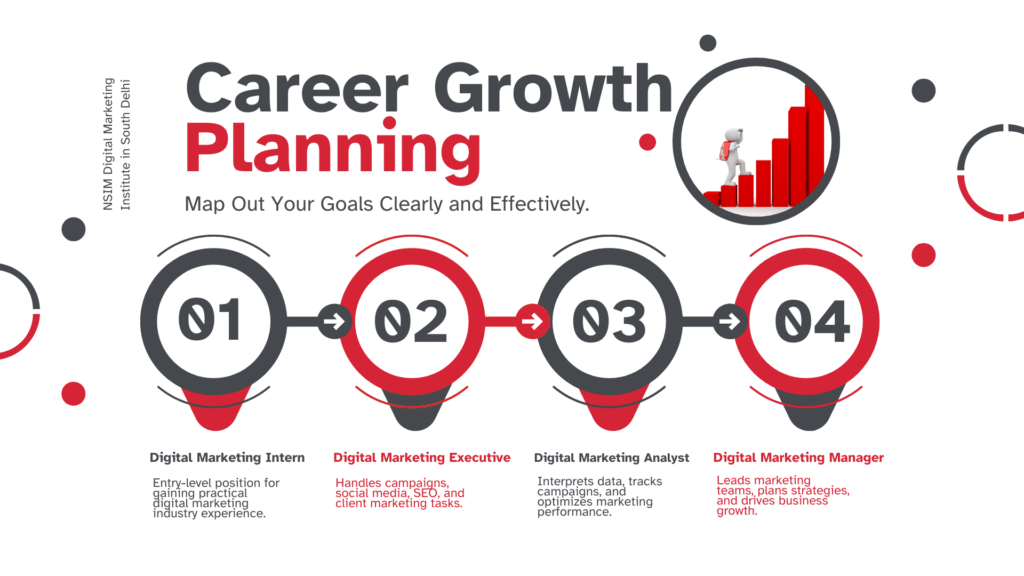
This SEO interview guide will help freshers, SEO executive, SEO Specialist, analyst, and veterans who will be interviewed for SEO positions. This will either be your first and/or more advanced job interview on SEO. It will also help you in framing yourself so you are knowledgeable of the questions, knowledge and ability that are generally explored during SEO interviews.
What Does This SEO Interview Guide Covers?
The SEO job interview questions include the most important ones in on-page, technical, off-page, local SEO, analytical, SEO tools, and real-world situation aspects of SEO. Also more advanced and trending topics of AI search, AEO, GEO, semantic SEO, and topical authority, in order for the interviewee to stand a good chance for the modern SEO jobs.
How to Use This Guide for Interview Preparation?
Instead of trying to memorize answers letter by letter, try to grasp the ideas of each question and also its applicable to real websites. Reading the example and analyzing the rationale of each answer then being able to explain an SEO topic using your own words. Hence both the theoretical question and the scenario question would be well answered by you.
Most Asked SEO Interview Questions
How Does Google Search Work?
Usually a google search involves 3 parts: Crawling, Indexing and serving results. When Google discovers new pages, either through links in existing websites and sitemaps, it takes those contents in the repository, analyzing and storing it in an index.
When someone searches with words such as SEO course in Delhi then Google gives some results according to their relevance and utility by the indexed pages in the data store. Often people mistakenly think that google indexes the page according to the presence of the keywords in the pages indexed.
What Is Search Intent?
Search intent is the reason why somebody does a search, it could be described as what sort of information, task or results that the user wishes to find. The most common kinds include; Informational, Navigational, Commercial and Transactional.
An example of an information intent might be the search “what is technical SEO” whereas an example of a transactional intent would be “buy SEO course.”
Over-optimization based around keywords not matching up with content.
What Is Keyword Research?
Search is used to discover information, products, services. Keyword research is the process to discover and analyse search queries used by users on search engines. It will help the SEO to have an idea of demand, competition and user intention before creating the content.
For example: a digital marketing institute researches about “digital marketing course in Delhi” and their similar search terms.
One common mistake in keyword research is only by using search volume.
What Is Organic Traffic?
Organic traffic consists of users who visit a website from non-paid search engine listings. This is a crucial SEO factor because it represents how well a site can attract traffic without the site paying directly for each visitor. For example, a user looking up “SEO interview questions” and landing on the site from Google’s un-paid listings accounts for organic traffic. A major error on the part of new website owners is mixing up paid and organic traffic.
What Is an SEO Audit?
An SEO audit is the review of a website for potential problems with search visibility, organic traffic and user experience. It usually involves looking at things such as; Technical SEO, on-page and backlink quality, content quality, indexing and performance. It might flag up broken links, duplicated content or blocked from being indexed. Common issues may focus only on technical problems rather than content and search intent.
What Are SEO Ranking Factors?
A SEO ranking factor is a signal that Google’s search algorithm takes into account while calculating the rank for a specific webpage against a specific search query. The main components regarding search engine ranking factors are content(relevance and quality), search intent, backlinks and authority, technical feasibility, page experience and mobile friendliness. At a given search query, you’ll find a page performing very well when it matches all these points. One of the major mistakes is the myth about a fixed ranking factor list or a secret formula for search ranking.
What Is E-E-A-T?
E-E-A-T stands for Expertise, Experience, Authoritativeness and Trustworthiness, and is used throughout the Google Search Quality Evaluator Guidelines to establish if a piece of content is of good quality. An example would be a blog post regarding SEO by a leading SEO expert that has all correct information, authors can be identified, it relies on a credible source etc. E-E-A-T is not a search ranking factor.
SEO Interview Questions for Freshers
What Are Long-Tail Keywords?
Long-tail keywords are more extensive and specific search queries usually targeting broader search intent. These may have lower search volume however can drive in more targeted traffic. ‘SEO interview questions for freshers with answers’ is specific compared to ‘SEO interview questions.’ The interviewer would expect you to have known long-tail keywords and can be useful in an intent targeting content.
What Is Keyword Stuffing?
Keyword stuffing means filling up your page artificially and unnecessarily with keywords to get to the top of the rankings. In effect it becomes an incomprehensible text and could get you penalised by google’s spam policy. For instance saying the ‘SEO interview questions’ again and again at the end of every sentence would be keyword stuffing. An interviewer wants you to write helpful and engaging content with naturally integrated keywords.
What Is a Title Tag?
A title tag is an HTML attribute which tells search engines and visitors what a web page is about. For example, with an article aimed to answer possible SEO interview questions it may appear as “SEO interview questions and answers” or something like this at the top result. An interviewer does not assume you will stuff Keywords everywhere, but instead you are conscious enough to be clear and relevant on the terms.
What Is a Meta Description?
An HTML attribute where a short summary of a webpage appears sometimes beneath the title displayed in search results-can help a potential visitor understand what a webpage is about before actually visiting. For instance: “Learn about SEO interview questions and answers for both freshers and experienced”. From an interviewer’s perspective, you know that the description is another click-affecting element of the search snippet, but is not directly part of your ranking factor.
What Are Backlinks?
Backlinks are simply other domains pointing to yours. They help the search engine find your pages, plus for the most trusted related domain giving you some authority for your domain. For example an authoritative digital marketing web portal hyperspace and your own SEO writeup can be a great backlink. Your interviewer would expect you to understand that numbers do not matter much when it comes to irrelevant quality.
What Is an XML Sitemap?
A XML sitemap is a file which lists down to the site’s key URLs so the search engines can know them and reach them. It is most necessary when the site is bigger, or has many updated sites, for instance, you have newly added your blog articles, then you must notify it to Google using updated sitemap for the same to find them. An interviewer assumes that you only know that sitemap is for discovery; no more than for discovering.
What Is Google Search Console?
A free tool from Google that website owners can use to track and improve their website’s performance in Google Search. The tool offers insights into traffic, search visibility, clicks, and much more like impressions, clicks, CTR, query and indexing on Google search console. For example, the SEO can find that some pages are losing clicks.
They can also determine what keywords they are receiving many impressions for.
An interviewer would expect you to know what to do with this data.
On-Page SEO Interview Questions
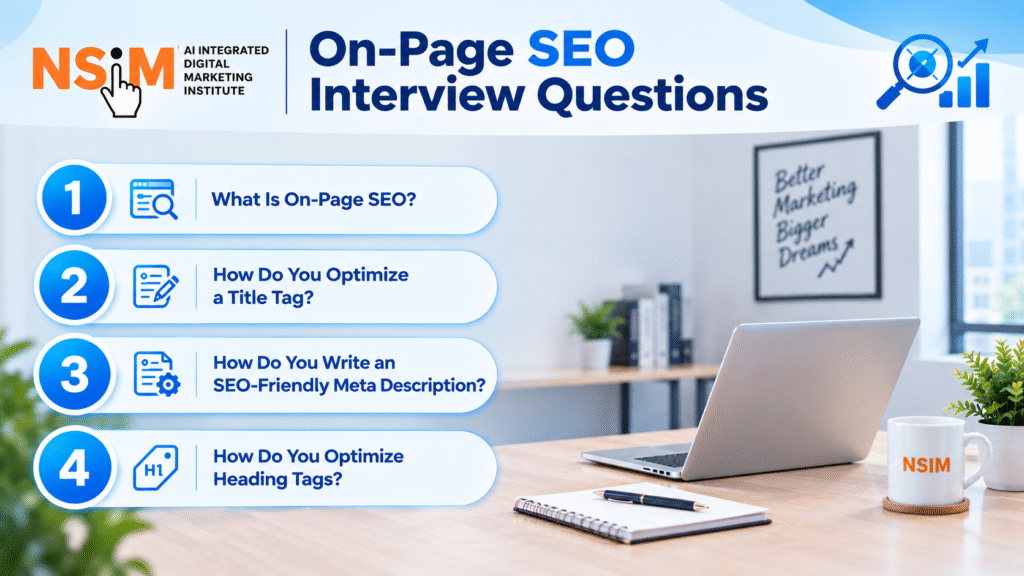
What Is On-Page SEO?
Optimize your webpage elements – your content, search intent, page title and headings, URLs, internal links, and images – to make your Webpage easily understandable to search engines, and engaging for your users.
✅A service page can match its H1, content, and internal links with the search target.
✅Common mistake: Stuffing keywords into every available spot of your content without relevance, quality, or ease of reading in the process.
How Do You Optimize a Title Tag?
When I optimize the title tag and I ensure it’s relevant to the target search intent, uses clear descriptive language about the page content, and is concise. I add in the main keyword without overstuffing and use appealing language to attract the searcher.
✅Example: “SEO Interview Questions for Freshers 50+ Answers”
✅Common Mistakes- Spamming keywords and weak or irrelevant page titles.
How Do You Write an SEO-Friendly Meta Description?
So now I am writing a meta description for the above content of the page: a clear description which reflects contents, matches the user’s search intentions and makes people click in search results. I put the natural keyword when it is appropriate and explain the value of the page.I make no false promises.
✅Example: Here are over 100 SEO interview questions on everything technical SEO, on-page SEO, off-page SEO, scenario based questions.
✅The most common mistakes are keyword stuffing and writing a bland and uninformative description.
How Do You Optimize Heading Tags?
Using heading tags properly: I do this to structure the page for users to scan and to optimize it for search engines, using an H1 tag to discuss the overall page topic, and H2s and H3s to introduce sub topics of content in a logical order. It’s also important to integrate your keywords naturally
✅Example: Show H1 as “SEO interview Questions” in capital, follow H2 with “Technical SEO” and “On-Page SEO”.
✅Wrong use of Headings: Use headings just to give style to text and not to structure the content.
How Do You Optimize URLs for SEO?
URLs are clean, short, and easy to read. It provides benefits to users and search engines by showing what the page is about. Also I do not have to make complicated URL patterns including other info.
✅Example: To increase URL readability for users, use keywords in it (URL-like: /seo-interview-questions/) instead of numbers (page?id=12345).
✅Typical mistake: stuffing too many keywords/words unnecessarily and changing established URLs without redirecting.
What Is Keyword Cannibalization?
In keyword cannibalization multiple pages on your site attempt to rank against one another on search result pages because they all attempt to cover the same search intent. I locate the redundant keywords, examine the search intents and determine if I should merge, redirect, or separate content.
✅Example:Three pages targeting the keyword phrase with an extremely close intent, for example, “SEO course in Delhi.”
✅Standard Mistake: Assuming any recurring keyword results in cannibalization.
What Is Internal Linking?
Internal linking is when you link from one page of a website to another page of the same domain. Internal linking allows people to navigate the rest of your site while it also helps search engines understand how your site is laid out and how your pages relate to each other.
✅An SEO guide could link to a full ‘Technical SEO’ section with the right anchor text.
✅Added too many or inappropriate internal links without thinking about context and user experience.
How to Optimize Content for Intent of Search?
I figure out why someone is looking for something and what kind of results that search gets on Google, and then I format content to best answer that intent with information that’s clear, valuable and relevant.
✅For ‘SEO interview questions for freshers’, I shall share ready-to-go interview questions, illustrative use cases, and preparation tactics.
✅Common mistake: churning out keyword filled copy without understanding search intent.
What Is Image SEO and Alt Text?
Optimizing images (called image SEO) so that it will be quickly downloaded, accessible, will help search engines to determine its content. There should be correct file types, proper compressing, good file names, and meaningful Alt text.
✅Example: An SEO audit dashboard-image can be called an SEO audit dashboard showing technical issues.
✅Common Mistake: Stuffing keywords (e.g., “SEO report traffic analysis keywords) instead of accurately describing.
What Is a Canonical Tag?
A canonical tag is an HTML tag which informs search engines of what URL should be considered authoritative when duplicate or very similar content exists across several URLs. The benefit is to push various ranking signals toward the chosen canonical and ease confusion for the search engines.
✅So, Here,if ‘seo-guide’ and ‘seo-guide?source=blog’ returns the same content then the canonical URL should be/seo-guide.
✅Common Mistake: This is a knee-jerk reaction to fix all problems of incorrect indexing and is often wrongly targeted at unimportant pages.
Technical SEO Interview Questions
What Is Technical SEO?
Technical SEO refers to any optimization to a website for easier crawlability, understanding, indexing by search engines. Its importance lies in that, although you have amazing content, it will struggle to rank, if it’s being blocked, for example by the robots.txt file from a critical page, it can’t be crawled. During a technical SEO audit would assess crawability, indexability, redirects, canonical tags, sitemaps, site speed, Core Web Vitals, mobile usability and structure data.
What Is Crawling and How Does It Work?
Crawling-search engine bots like Googlebot finding and connecting to a specific webpage with the objective to understand the content of that specific webpage. This is an SEO job because the engines have to crawl the page first in order to be considered for indexing. Like it can happen that the Googlebot found the new blog via internal links or sitemap, and as an SEO person I should check robots.txt, internal links and sitemap URIs, server response, redirects and crawl errors.
What Is Indexing?
The process Google takes to crawl and catalog data about webpages to potentially appear in search. It is important because a webpage likely can’t rank without an index. For instance, a fresh blog entry may be crawled by Google, but because the index is technically or quality-unsuitable it might not appear for users to index. As an SEOer would check index status,no index tags,canonical tags,robots.txt, sitemaps signals, content quality,etc..
What Is a Crawl Budget?
Crawl budget represents how many URLs on the website Googlebot wants and is able to crawl in a specific time frame. This seems to be relevant especially for large websites as having tons of meaningless URLs can simply waste the crawl activity, e.g. Huge filter based URLs on an e-commerce site will eat up the crawl resource. To answer an interview question I would state: I would improve the crawl efficiency by identifying unnecessary URLs and by ensuring that relevant pages are easy to find.
How Does Robots.txt Work?
A robots.txt file guides search engine crawlers through website crawling on their path to index web pages for Google. It manages and controls crawler access but does not guarantee the web page will not appear on Google at all.
✅Example: An SEO might not want the search engine to crawl under /admin/ but certainly wants the important blog pages to be seen.
✅Common Mistake: Preventing a page from ranking in google through robots.txt rather than by using the correct indexing controls.
What Is an XML Sitemap?
The XML Sitemap: It’s just a file you create on your web space, it contains a list of most relevant URL addresses of your web space, that allows search engines to find all your URL addresses more efficiently, and will be a great help for big web sites, also for new or frequently updated sites.
✅For instance, once a new blog is live, it can notify Google of the new page.
✅A Mistake that Many people make-The mistaken belief that a Sitemap ensures that all of the URLs included on a map are indexed or ranked by Google.
What Is Canonicalization?
Canonicalization refers to signals that tell search engines which version of a URL they should regard as the “master” version if many versions exist that are either identical or very similar. It serves to collect signals together in order for the search engine to assess which one to index.
✅For example, if /seo-guide and /seo-guide?ref=blog display the exact same content then only specify that your canonical URL should be the former one
✅Common mistake: Setting all page canonicals to home-page, setting canonical tags for wrong URLs.
What Are 301 and 302 Redirects?
To make that more clear the 301 then makes use of “move users and search engines from one url to another permanently”, and the 302, “almost certainly indicate” a temporary move, although both 301 and 302 will help you as it would allow smooth UX and relevance signals.
✅If I were changing ‘/old-seo-guide to ‘/seo-guide’ permanently, this is how I would do 301 redirects:
✅The 2 most common mistakes are a Using a 302 for a permanent URL change and b Creating a useless redirect chain
What Are Core Web Vitals?
Core Web Vitals are Google’s native measurements for user experience regarding the loading performance, reactivity and visual stability of your site. They are: LCP, INP and CLS.
✅Example: A page where you wait to see meaningful main-content then LCP might be hurt by this slow delivery.
✅Mistake: Trying to optimize scores in general rather than optimizing the content itself for the user.
What Is Mobile-First Indexing?
Mobile-first indexing- Search engines will rely on the mobile version of pages to index and rank them. Significance – A very thin or missing content on a mobile page could harm search engine indexing.
✅Example: The desktop homepage has the crucial content it lacks in the mobile homepage and Google will be unable to crawl the important desktop content.
✅Mistake: Regarding mobile first as distinct from a mobile ranking system and simply not have feature-parity and content-parity with the desktop homepage.
Off-Page SEO Interview Questions
What Is Off-Page SEO?
Off-page SEO are efforts that occur outside of your own website and can work to boost its authority, credibility and relevance in the eyes of search engines. It can involve acquiring relevant back-links, receiving brand mentions, engaging in Digital PR and generally building relationships throughout the web. A great, relevant site in your niche back-linking to your SEO guide naturally will help to make your SEO guide become authority and gain presence. During an interview, articulate that good off-pageSEO is actually earned through credibility and relevance.
What Makes a Backlink High Quality?
Good backlink will come from a relevant, reliable, authority website. I would assess the referring website topicality, relevance, trustfulness and also context of your link, how it’s been placed within the website (above/ below fold) and its usefulness.
✔️Example: Having a high authority website in relation to SEO links your technical SEO guide naturally from your topic and target user groups.
✔️Priority is to build reliable and relevant links and no focus to get more backlinks.
What Is the Difference Between Dofollow and Nofollow Links?
Dofollow and Nofollow are basically about how search engines can treat links: a regular link will pass ranking signals whereas a no follow link has an attribute that tells search engines it should not treat it like any other linking ranking signal.
For example, a proper editorial backlink coming from an SEO relevant site may well be a do follow link whereas a paid link should use a suitable qualifying attribute, among others:
What Is Anchor Text?
Anchor text is the specific words in a hyperlink which tell search engines, and in turn users, what the linked page is about. Anchor text should also be descriptive of the content, relevant and not forced into its surrounding natural text.
For example, “Technical SEO best practices” will allow both the search engine and the visitor to know what they will find by clicking on the link to a technical SEO article.
The ideal SEO strategy has diverse anchor text rather than using an exact anchor text on more than one occasion.
What Are Toxic Backlinks?
Toxic backlink are low quality & harmful links may be signs of manipulative building schemes or bad origins. I will assess this by the quality of the link itself, context, relation,origin rather than automatically assume a low quality is harmful.
E.g. Many thousands Irrelevant links from spammy pages created just to play with ranks.
A better plan is to do your homework on bad links that could be detrimental and act on it if needed; remove them if not needed.
How Do You Build High-Quality Backlinks?
I create high-quality backlinks through the creation of valuable, link-worthy content then outreach to relevant websites, publishers and community of people in this sector, aiming to earn links naturally through digital PR, expert contributions,resource pages, original research or guides.
Example: An informative study in SEO with unique data would then attract links back to that content from marketing bloggers or industry resources
Relevance, trustworthiness and truly editorial merit is more important than generating volume of links
Local SEO Interview Questions
What Is Local SEO?
Local SEO helps a company to optimize its online presence and gain higher ranking for local searches. This helps businesses draw people that are searching for products/services nearby to their business. For instance, a digital marketing institute in Delhi can optimize its website and presence, for “digital marketing institute Delhi”. Local SEO uses elements of relevance, proximity, prominence and the business information.
What Is Google Business Profile?
Google Business Profile is a tool that allows free posting on Google Business. Through this listing you have control over the businesses being displayed in Google searches, and Google Maps, it may display business name, telephone number, address, opening times, website, picture or customers’ reviews. E.g., an expert in SEO can use it by providing information (correct and according to categories) with a better return for local searches.
What Is NAP Consistency?
NAP-Name, Address, Phone number. NAP consistency is having your business information accurate and uniform across your website, Google Business Profile, directory listings etc. If you have multiple phone numbers in a few different listings, the customer gets confused about the correct phone number. Consistent information ensures that the customer as well as the search engines know where your business is located.
What Are Local Citations?
Local citations consist of business listings with name, address, phone number, website and any other related business details online in various directories, local platforms and websites. Local citations help the search engines verify the business details and establish local presence. For instance, a restaurant accurately listed in the local directories proves its relevancy in the locality, hence helping build better business web presence. Citations importance is valued in quality, relevancy and accuracy.
How Do You Improve Local SEO Rankings?
I would approach local SEO by Google Business Profile optimization, NAP consistency, relevant local citations, legitimate customer reviews and relevant localized content creation. I would optimize the core website pages to be intent friendly. For example, if I have a business that is getting queries with Delhi related keywords then I would prefer building relevance for it rather than adding the word “Delhi” excessively for it.
SEO Tools Interview Questions
Google Search Console Interview Questions
✔️What is the tool: The Google Search Console(GSC) is a free tool from google that SEOS can use to keep track of their performance of organic search, indexing and presence.
✔️What is the tool used by SEOS: SEOs will use the tool to look at queries, clicks, impressions, CTR, ranking pages, indexing state, and technical issues.
✔️Interview Example: If traffic falls, I would examine the queries and pages to look for this and also to investigate the number of clicks, impressions, CTR and examine the indexing.
GA4 Interview Questions
✔️What is the tool? GA4 is a Google tool used to monitor a website/user engagement and its performance.
✔️What is the usage for SEOs? SEOs use GA4 to evaluate Organic Traffic, Landing Page performances, User behavior, Engagement, Conversion and Acquisition.
✔️Interview example: If Organic traffic has increased but conversions have decreased, what will be your approach to investigate it? I would compare landing page performances, user engagement, traffic sources and conversions rate to pinpoint the drop-off.
Google Keyword Planner Interview Questions
✔️What is the tool?Google Keyword Planner is a free google tool to show you search volume data and suggest keywords.
✔️What SEO’s use it for? SEO’s use it for keyword research, content ideas, see search volume, competition.
✔️Interview example: “How would you begin keyword research for a new niche?” answer “Start seed keywords and organize by volume, intent, and competition.”
Ahrefs Interview Questions
✔️What is the tool?Ahrefs is a backlink research and SEO analysis tool for understanding Domain Authority, rankings and competitor data.
✔️What do SEOs use it for?Link building, analyzing competitor gap analysis and trackingKeyword Rankings over time.
✔️Interview example: “A competitor suddenly begins ranking higher – how would you research this?” Answer: Compare the competitor’s link profile against their own and analyze the content gaps using the site explorer and content gap analysis in Ahrefs.
Semrush Interview Questions
✔️What is it?Semrush- an all-in-one SEO toolbox providing keyword analysis, audits, and competitor tracking functionality.
✔️Why do SEOs use it? Technical audits, monitor keywords rankings and how competitors behave over organic and paid searches.
✔️Interview question example:Q- “What is the first thing you analyze in a site audit?” A- “crawlability, indexability, and any major errors within a tool before delving into minor concerns.”
SEO Analytics and Reporting Interview Questions
Which SEO Metrics Do You Track?
I monitor organic traffic, impressions, clicks, CTR, keyword positions and conversions in a grouped view because each metric leads to a business impact on leads and revenue.
✔️Example: rising impressions with flat clicks signals a CTR issue, not a ranking issue.
✔️Interviewer wants: metrics linked to business outcomes.
✔️Common mistake: listing metrics without explaining their relationship.
How Do You Measure SEO Success?
Success means traffic, rankings, and clicks moving in the right direction, but the real measure is conversions and business impact, not visibility or rankings alone as standalone numbers.
✔️Example: a #1 ranking with zero conversions isn’t true success.
✔️Interviewer wants: business-outcome thinking over vanity metrics.
✔️Common mistake: defining success only by traffic or position.
How Do You Identify an Organic Traffic Drop?
I‘ll look at Search Console to see if there were indexing problems, manual actions; I’ll compare ranking and impression numbers to before and after the fall and see if there have been any new algorithmic updates or site changes.
✔️Example: a sudden drop with stable rankings often means a technical issue like no index.
✔️Interviewer wants: structured, data-first diagnosis.
✔️Common mistake: assuming it’s a ranking problem without checking data.
How Do You Analyze Google Search Console Data?
I will then check the Performance report to see a list of my keywords, pages, click data, impressions, CTR and have another look at the Coverage report, to ensure there are no indexing errors and hindering my good performance, being discovered
✔️Example: high impressions with low CTR usually means weak titles or meta descriptions.
✔️Interviewer wants: turning raw GSC data into action.
✔️Mistake frequently done: looking at only clicks, and forgetting of impressions and CTR trends.
How Do You Report SEO Performance to a Client?
I present traffic, impressions, clicks, CTR, and rankings alongside conversions, framing everything around actual business impact rather than just raw numbers on a slide.
✔️Example: showing ranking improvements led to more leads, not just traffic growth.
✔️Interviewer wants: clear communication linking SEO to results.
✔️Common mistake: presenting data without context or next steps.
Scenario-Based SEO Interview Questions
Website Traffic Suddenly Dropped 40%. What Would You Do?
✔️Situation: Sudden steep drop in organic traffic over days-client nervous about revenue.
✔️I would check: GSC for manual penalties/indexing issues and for algorithm update timing surrounding the drop date.
✔️I would diagnose: By looking at affected pages and queries in GSC to understand whether the drop is site-wide or localized, and by correlating to any recent site changes.
✔️I would act: By both fixing any technical issues promptly and then, for algorithm-related drops, auditing the content quality and E-E-A-T signals.
✔️I would expect: For technical issues the traffic should revert within days; for algorithm shifts a slow return within weeks.
A Page Is Indexed but Not Ranking. What Would You Check?
✔️Scenario: Page appears in index, doesn’t rank for targeted keyword
✔️What I’d check: Content depth, search intent, internal linking, competing pages on the same site.
✔️How I’d diagnose: Examine top-ranking competitors compared to the page for content quality/structure and backlinking profile.
✔️What I’d do: Improve content for search intent, include internal linking, establish authority within the topical cluster.
✔️Desired outcome: Progressive ranking gains as authority and relevancy signal strengthen.
Your Competitor Suddenly Outranks Your Website. What Would You Analyze?
✔️Situation: Competitor has jumped ahead of my page in ranking a previously stable keyword.
✔️What I would investigate: competitor content changes, backlink growth, page experience signals, Recent site changes, if any
✔️How I would diagnose: Use ahrefs/SEMRUSH to compare backlink profiles, content gap, freshness of content
✔️What action I would take: Refresh the content, make more in-depth or use fresh data in, build more internal links to the page, outreach for more backlinks to the page.
✔️What I expect to happen: Rank back up position by strengthening authority signals, content authority.
Website Traffic Dropped After a Migration. How Would You Fix It?
✔️Situation: organic traffic drop suddenly after migrating domain / platform / url structure
✔️What I would check: Redirect mapping, indexing status of new pages, coverage error post-migration
✔️How would I diagnose: crawl the site and see if there were any broken redirects, missing page, incorrect canonical tags.
✔️What action would I take: Fix broken 301 redirects, resubmit sitemap, ask to re-index important pages
✔️Expected result: Within a few weeks, traffic should be restored when the redirecting, indexing issues will get settled.
A Page Has High Impressions but Low CTR. What Would You Do?
✔️Situation: You rank for a keyword and get impressions, but there is a low CTR to your pages.
✔️What I’d check: Title tag, meta description, and SERP appearance against top performers for the given keyword.
✔️How I’d diagnose it: I’d analyze your SERP snippet against those that rank for missing appeal or unclear value in the description.
✔️What action I’d take: I’d rewrite your meta title and meta description to appeal and match intent much closer and continue to test new titles and metas.
✔️What I’d expect to see: Increased CTR within weeks and this could have a positive effect on your rankings.
Google Is Not Indexing Important Pages. What Would You Check?
✔️Situation: critical pages aren’t in the G index, even though live & important.
✔️What I’d investigate: robots.txt blocking; “noindex” tag present; conflicting canonical tags; crawl budget being an issue.
✔️How I’d diagnose it: utilize the URL Inspection tool in the Search Console to discover the reason G is not crawling or indexing the pages; crawl for blocks.
✔️What I’d fix: “noindex” & block tags; canonical problems; improve internal linking to the blocked pages; possibly resubmit sitemap.
✔️How long I’d expect it to take: the pages should re-appear within days and weeks if the technical blocking is removed.
Multiple Pages Are Targeting the Same Keyword. How Would You Fix It?
✔️Situation: One keyword is targeting several pages,diluting ranking signals and search engines are unsure about ranking the page.
✔️What I would review: Keyword Search Intent overlap, on-page similarities and current positioning of the pages.
✔️How I would diagnose it: Comparing all ranking pages against the intent, content and position data in the search console.
✔️What action I would take: consolidate low ranking pages into high performing one and apply 301s and canonical tags for them.
✔️Expected out of action: a cleaner rank signal and better ranking position for one consolidated page.
Advanced SEO Interview Questions
What Is Semantic SEO?
Semantic SEO optimizes based on the meaning, context, related keywords, and search intent on a topic instead of exact-match keywords. It gives an interpretation to search engines of the actual content in a page.
➡️Example- An SEO guide will cover topics like crawling, indexing, keywords, backlinks, technical SEO, and search intent, without excessively repeating the word SEO.
More thorough content and higher customer satisfaction due to meeting users’ search demands
What Is Entity SEO?
Entity SEO means giving search engines an understanding around real-world objects, such as people, businesses, places, products and organisations, and their relationship. The intention is not just to optimize on keywords, but to build clearer context around the topic of interest.
➡️For example;a digital marketing institute can build up its entity signals via business consistency details, mentions, structured data & high authoritativeness links to establish a clearer contextual link between itself and its subject and identity.
What Is Topical Authority?
Topical authority-comprehensive mastery over an entire topic (all the main subtopics)- is earned in SEO through linked, and diverse, content covering multiple intents relevant to the primary subject; search engines will know much more about your topic relevance if the web is saturated with extensive coverage.
➡️Example: A digital marketing website about SEO, keyword research, technical SEO, link building, local SEO and analytics will have strong topical relevance for SEO.
What Is Programmatic SEO?
This is a process that uses templates, structured data and automation to automatically create a huge number of highly targeted web pages. Programmatic SEO suits sites that have a large number of search opportunities in relation to location, products, services and comparisons. Automatically created pages need to deliver actual value and not simply correct information that can provide a different angle. Generating thousands of pages that lack value can harm the site’s performance.
➡️Example: Web travel site that generates useful hotel pages in various cities without any manual work.
What Is Zero-Click Search?
In this case the webmaster does not need to give the website a click. So the searcher get what he wants through the search result page. For example it’s featured snippets, knowledge panels, local results or direct answers and so on.
In zero-click search website click is lower, however appearing in these features, increases website vision, prestige and brand awareness at most.
So now, modern SEO should focus on search visibility and brand exposure with not just the organic traffic and click.
AI & Modern SEO Interview Questions
What Is AI Search Optimization?
With AI search optimization we focus on optimizing website information forAI-driven search systems to better comprehend, retrieve and possibly cite. Focuses on directly answering questions, accuracy, relevance, structure and reliable sources opposed to using repetitive keywords.
➡️Example: A well-structured and definitive guide that answers questions in the way you expect can be understood by AI search engines.
What Are Google AI Overviews?
Google AI Overviews are AI-generated summaries that could be featured in Google Search for specific queries and will pull together a bunch of information to give people an initial answer instead of organic search results.
➡️Example: Instead of providing endless blue links, searching something like ‘how does technical SEO work?’ could provide an AI explanation with linked relevant resources, helping users get the basic info before even clicking on a link.
What Is Answer Engine Optimization (AEO)?
Answer Engine Optimization is the process of designing content in such a way that search engines and answer engines can accurately interpret and use it in order to answer questions. Key concepts include straightforward answer focus, structure, factuality, and matching search intent.
➡️For example, a page optimized for a question “what is a canonical tag” using a succinct definition with explanation and implementation in plain and understandable language can be more useful than a page talking about SEO more generally.
What Is Generative Engine Optimization (GEO)?
Optimizing for visibility in AI responses (e.g. Within generative search experiences). Making content authoritative, valuable, structured and easily understood by generative systems so that they may ingest it and include it in answers.
➡️E.g. Publishing original seo studies with detailed data methodology, research and an original perspective allows a generative system to learn from high-quality information.
How Is AI Changing SEO?
AI has impacted SEO by: the ways consumers find information, the ways search engines understand content and how marketing and analysts create as well as examine information.SEO has now centered on satisfying searchers, authenticating expertise, accuracy and establishing real authority, not only identifying keywords.
➡️Example: Instead of building minor differences of keywords to separate pages, the SEO specialists can create a single article resource addressing that searcher’s underlying intent.
How Can Brands Improve Visibility in AI Search?
Businesses can also enhance their visibility in AI search through the publication of correct, non-duplicate and beneficial content and consistent brand entities across established networks. High topicality, concrete brand entities, contributions from experts, semantic structure and reliable links can contribute to the AI finding about the brand and what the brand does.
➡️Example: A digital marketing company, in creating an archive of expert, error-free guides on various SEO topics, case studies, and accurate contact and firm details, enhances its online authority.
SEO Interview Questions for Experienced Professionals
How Would You Create an SEO Strategy From Scratch?
My first priority would be to gather as much information as possible about business goals, target audience, products/services and conversion goals. After gathering the above, I would perform a technical SEO audit, competitor analysis, keyword and search-intent research and an assessment of the content and links. I would develop a prioritized roadmap with both technical, content and link building priorities and begin implementation. KPIs such as qualified organic traffic, search rankings, organic conversions, and revenue would be defined with ongoing analysis and refinement.
How Do You Prioritize SEO Tasks?
In SEO work, I evaluate priorities based on business impact, SEO opportunity, implementation effort, and urgency. I first focus on issues that prevent crawling, indexing, ranking, or conversion. Then, I give priority to high demand and realistic ranking opportunities. Instead of “most bugs fixed”, my choices are influenced by dependencies, resource availability, and predicted ROI-developing both “low-hanging fruit” and sustainable growth paths.
How Do You Perform Competitor Analysis?
First, competitors that frequently battle the same valuable Search Intents and not only direct business competitors. Their keyword visibility, content architecture, search intent targeting, backlink profiles, internal architecture, technical capabilities, SERP capabilities and conversion oriented landing pages. I then pinpoint and explore areas where competitor’s coverage is more advanced and others that are likely missed. Lastly, turn these insights into priorities rather than a duplicate approach.
How Do You Handle a Google Algorithm Update?
I wouldn’t make changes solely on speculation immediately. First of all I would verify the update, and the search traffic, ranking, and conversion changes by analyzing Google Search Console, analytics. And I will divide the pages affected,queries, devices, search intents.
Examine content quality, relevancy, technical issues, competitor websites.
Make changes based on the data and take steps. Ultimately, I will observe improvement and recovery over time.
How Do You Measure and Communicate SEO ROI?
Rather than just “my ranking changed,” I tie SEO actions back to business results. I would measure qualified organic traffic, conversions, conversion value, leads, revenue, assisted conversions alongside visibility measures. I would set baselines, determine a meaningful time frame and segment into branded/non-branded as appropriate. In reporting, I would define how SEO metrics translated into business impact and articulate what delivered the results, what’s unknown and what the next dollar would be spent on.
SEO Interview Preparation Tips
Understand SEO Fundamentals
Possess an in-depth knowledge and understanding of Crawling, Indexing, Keywords, Search Intent, On-page SEO, Technical SEO, Off-page SEO, Analytics and Core Web Vitals. Be able to explain these principles clearly and concisely with real-world examples.
Practice Practical Scenarios
Practice situations involving traffic drops, indexing issues, ranking losses, migrations, low CTR, algorithm updates, and competitors. Explain your diagnosis, actions, and expected outcomes clearly.
Learn Essential SEO Tools
Get to know Google Search Console, GA4, Google Analytics, Google Keyword Planner, Ahrefs, Semrush, Screaming Frog and PageSpeed Insights well understand what each tool measures.
Prepare Real Examples
Build examples from past projects, internships, personal practice sites, or case studies. Clearly define the problem, your approach to finding a solution, how you solved it, what tools you used, the outcome you produced, and any insights you gained.
Research the Company
Examine their website, business type, customers (their target audience), the competitive niche, content, how they perform in search results, and their business operations. Understanding these details allows you to address them directly within their own, real-world SEO framework.
Don’t Memorize Answers Word-for-Word
Understand the logic behind each answer, rather than just recite rote lines. Oftentimes, interviewers rephrase their questions. A fluid knowledge base helps enable a true, confident, and honest answer.
SEO Interview Quick Revision Cheat Sheet
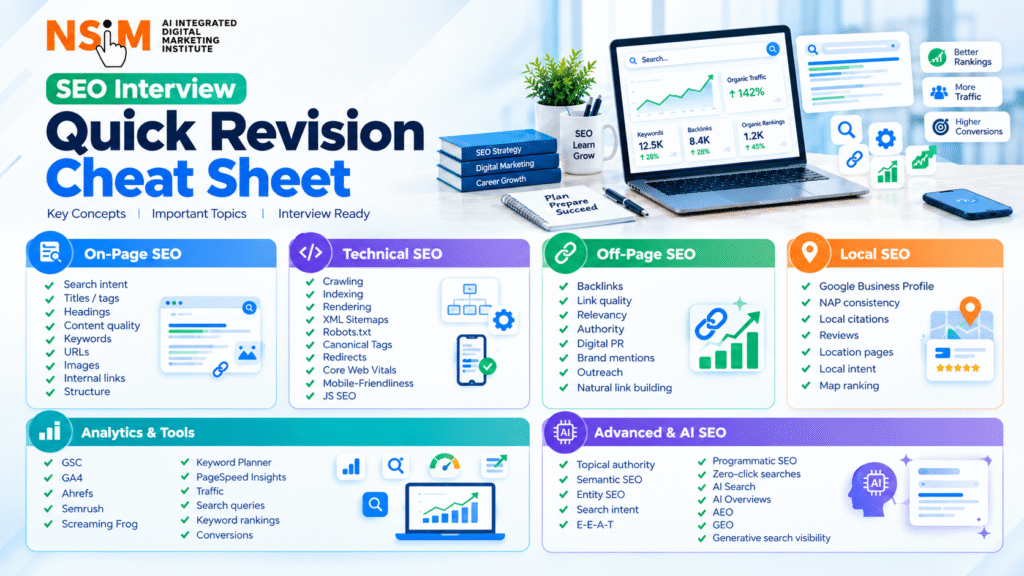
| SEO Area | Quick Revision |
| On-Page SEO | Search intent, titles/tags, headings, content quality, keywords, URLs, images, internal links, and structure. |
| Technical SEO | Crawling, Indexing, Rendering, XML Sitemaps, Robots.txt, Canonical Tags, Redirects, Core Web Vitals, Mobile-Friendliness, JS SEO. |
| Off-Page SEO | Backlinks, link quality, relevancy, authority, digital PR, brand mentions, outreach and natural link building |
| Local SEO | Google Business Profile, NAP consistency, local citations, reviews, location pages, local intent, and map ranking are critical for local SEO. |
| Analytics & Tools | GSC, GA4, Ahrefs, Semrush, Screaming Frog, Keyword Planner, PageSpeed Insights, traffic, search queries, keyword rankings, and conversions. |
| Advanced & AI SEO | These topics include topical authority, semantic SEO, entity SEO, search intent, E-E-A-T, programmatic SEO, zero-click searches, AI Search, AI Overviews, AEO, GEO and generative search visibility. |
Conclusion
Use this for a review, but always keep using real-world web sites and performing organic SEO testing. If you can justify your answer instead of reciting it then you will be a stronger interview candidate than even the most experienced people. NSIM offers courses and training on acquiring all the skills necessary for building business focused, online digital marketing experience which helps you to become work ready, get your next move.
In order to prepare for an SEO interview, it’s less about memorizing definitions and hundreds of questions, and more about showing the ability to break down and explain how a particular SEO strategy is used, why you would pick it over an alternative strategy, what tools you’d use and how you’d resolve website-related challenges. Focus on revamping the basics, preparing practice scenarios, and gathering real examples that reflect analytical reasoning and application to problems. While dedicated training such as that offered by NSIM-which bundles hands-on exercises, live projects, case studies and interview prep in one’s overall digital marketing studies-can certainly bolster practical, interview readiness in any aspiring digital marketer.